
Why ground-floor apartments in Nice are a soft target
Nice is built on a slope, and that geography creates an odd security problem nobody warns you about when buying. In Fabron, Saint-Antoine, Cimiez or the back streets behind Rue de France, a huge number of ground-floor units actually open onto a garden, a service alley, or a semi-public courtyard that sits below street level and out of sight from passers-by. That privacy is exactly what makes these flats appealing for a pied-à-terre and exactly what a burglar is looking for: nobody walking a dog on the Promenade is going to notice someone working on a window for ninety seconds in a sunken garden in Riquier.
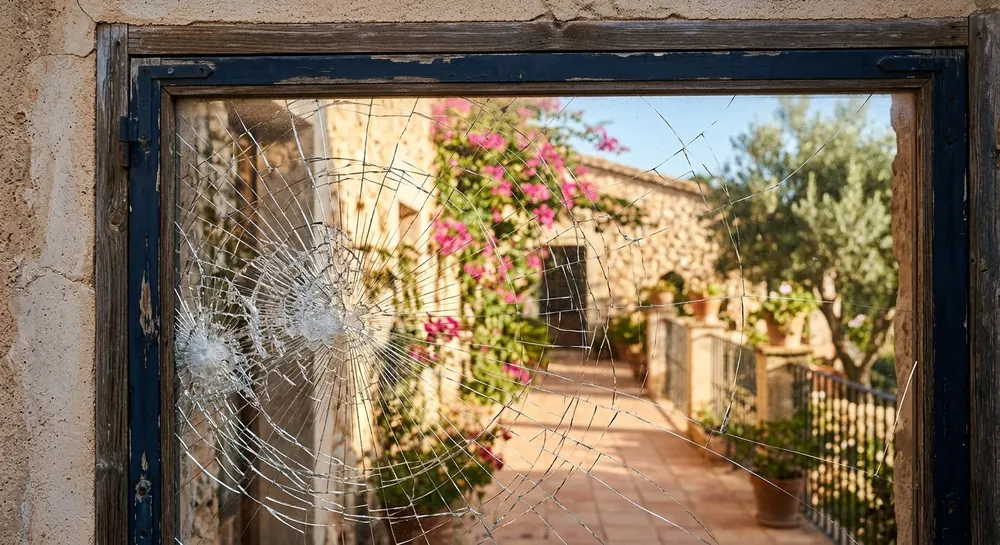
Police statistics for the Alpes-Maritimes consistently show that single-glazed or thin double-glazed windows on the ground floor are the entry point in roughly six out of ten residential burglaries in dense urban areas, and Nice's old building stock makes this worse. Many Belle Époque and Nissart buildings from before 1948 still have their original wood-framed windows with 4mm glass, sometimes behind a volet that gets left half-open for ventilation in July and August. A standard glass pane like that breaks in under five seconds with a centre-punch or even a rock, which is roughly the time it takes most alarm systems to even register the vibration, let alone alert anyone.
The ABF problem: why you cannot just add bars or swap the glazing
Here is where Nice gets genuinely complicated compared to, say, a pavillon in Mandelieu. A large chunk of ground-floor stock sits inside the secteur sauvegardé around Vieux Nice, the Colline du Château, parts of Cimiez, and the protected perimeter along the Promenade des Anglais and Carré d'Or. Any visible modification to a facade that is classified or simply located within 500 metres of a monument historique falls under the Architecte des Bâtiments de France. That includes installing exterior security bars (barreaudage), replacing window frames with reinforced ones, or fitting external roller shutters that were not there originally.
I have seen co-owners in a building on Rue Smolett wait four months for an ABF response on a simple request to add discreet horizontal bars to a ground-floor window, only to get a refusal because the proposed finish did not match the original ferronnerie style. Even when ABF does approve something, you are often looking at custom ironwork painted to match, which routinely costs 600 to 1,200 euros per opening once you add the administrative delay. For owners who need security now, not in six months, and who cannot touch the visible exterior of the building at all, this is precisely the dead end that pushes people toward a solution that changes nothing on the outside: reinforcing the glass itself from the inside.
How anti-burglary film actually reinforces the glass without touching the facade
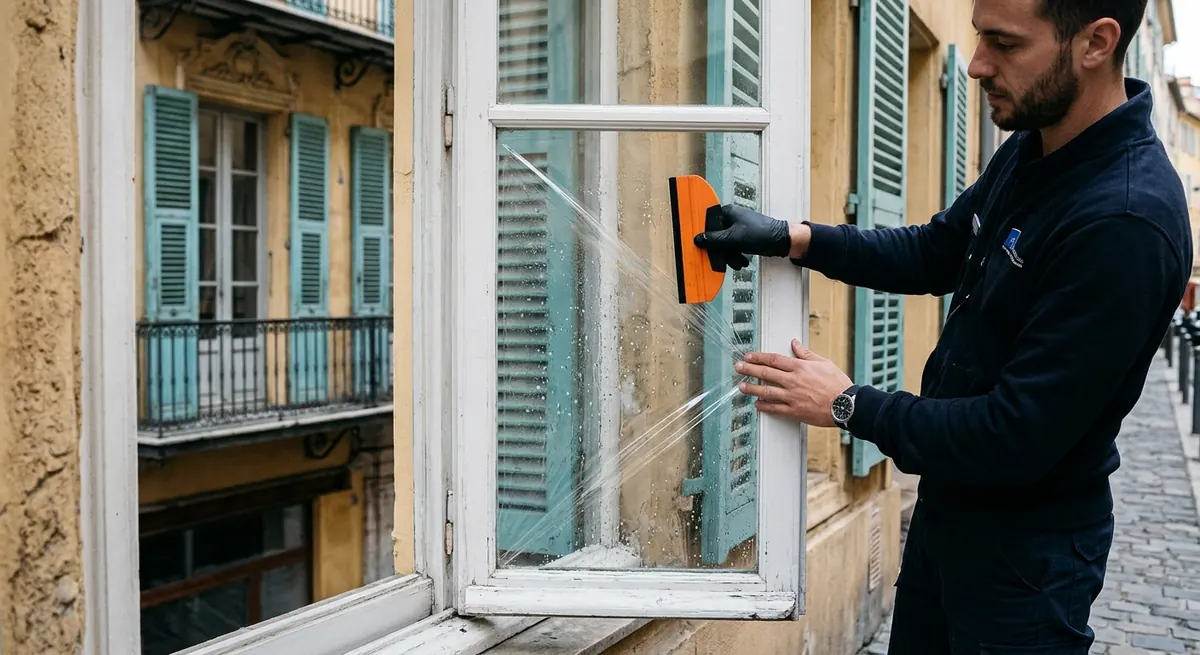
Security window film is a polyester laminate, typically 300 to 450 microns thick, applied directly onto the interior face of the existing glass with a specialised adhesive. From the street, through shutters, behind curtains, it is essentially invisible: no bars, no new frame profile, no change to the mullions or the paint colour that ABF would ever flag. The film does not stop a determined attacker from eventually getting through, but it radically changes the physics of a smash-and-grab. Instead of the pane shattering into pieces that fall away, the glass stays bonded to the film in one sheet, so the intruder has to punch through the same spot repeatedly while the film stretches and absorbs the impact, buying anywhere from one to five minutes depending on the grade.
The relevant benchmark is the EN 356 European standard, with P4A film resisting roughly three minutes of manual attack with a hammer and axe test, and P5A pushing that closer to five minutes. For a ground-floor flat in Nice, P4A is usually the sensible minimum, and I push clients toward P5A on garden-level units that back onto an unmonitored alley with no camera coverage at all. Good installers also treat the full pane edge to edge and anchor the film into the frame rebate with a mechanical attachment strip, because a film that only covers the visible glass and stops short of the frame can be peeled or pried loose far too easily — a corner-cutting shortcut I still see from some cut-rate installers chasing volume jobs.
Real costs, timing and what a job on the ground floor in Nice actually looks like
Pricing in the Nice market generally runs between 95 and 160 euros per square metre, fully supplied and installed, with the variation driven mostly by film grade and whether the installer adds the mechanical frame anchoring. A typical French window of around 1.4m² lands somewhere between 150 and 230 euros, and most installers set a minimum charge of 170 to 190 euros per opening below that size because setup and precision cutting take the same time regardless of pane dimensions. For a two-bedroom garden-level apartment with five or six exposed openings, expect a total invoice in the 1,100 to 2,400 euro range, which is still a fraction of the 600-plus euros per opening that ABF-approved ironwork alone would cost, without the waiting period.
On site, the actual work is quick and clean: a competent two-person team handles four to six windows in a single morning, cleaning the glass meticulously, applying a slip solution, laying the film, then squeegeeing out air and moisture before trimming to the frame. The film needs 24 to 48 hours to cure fully and reach its rated strength, and you will see a faint milky haze during that window that clears on its own — do not panic and do not wipe it. Reputable suppliers back the work with a 10-year warranty against yellowing, delamination or bubbling, and several local insurers, including a number of Matmut and MAIF agencies in the Alpes-Maritimes, will knock a few percentage points off a home contents premium once you provide the installer's certificate and the EN 356 classification.
What the film will not fix, and how to combine it sensibly
Film reinforces glass, full stop — it does nothing for a rotten wooden frame, a weak espagnolette lock, or a single-point latch that a thin blade can slip in two seconds. I have walked into more than one Nice apartment where the owner proudly showed off brand-new security film on glass sitting inside a frame so loose you could rock the whole sash by hand; in that situation the film is basically decorative. Before applying film, check that the closing mechanism and the frame itself are sound, and budget 80 to 150 euros per window for a locksmith to add a secondary cremone bolt or anti-lift stop if the existing hardware is original and tired.
The other honest limitation is that film buys time, it does not make a window impenetrable, so pair it with something that notices the attempt: a 60 to 120 euro vibration sensor on the glass, wired into an existing alarm panel, turns those extra few minutes of resistance into a real deterrent because most burglars abandon an attempt the moment a siren sounds nearby. For owners inside ABF perimeters who eventually want full peace of mind, film is also a perfectly sensible interim step while you pursue the (slower) route of compliant exterior ironwork — many of my clients run both projects in parallel, protecting the flat immediately with film and adding heritage-appropriate bars eight months later once approval finally comes through.
Frequently asked questions
No. Because the film is applied to the interior face of the existing glass and changes nothing visible from the exterior, it falls outside the scope of ABF review, even inside a secteur sauvegardé. You only need a déclaration préalable if you also change the frame, the shutters, or add external hardware.
A typical job with five to six openings takes half a day to a full day on site, done by a two-person team. The film itself needs 24 to 48 hours afterward to cure and reach its rated strength, during which a slight haze is normal and should not be wiped off.
Some insurers, including local Matmut and MAIF agencies, offer a modest discount once you submit the installer's invoice and the EN 356 classification certificate, though it is rarely more than a few percent. It is worth asking your broker directly since policies differ, and the real value is the reduced claim risk rather than the premium saving itself.