
Why Ordinary Tiles Fail on a Riviera Pool Deck
I've walked onto more than one newly finished terrace in Cap d'Antibes where the owner proudly shows off gorgeous polished porcelain around the pool, and my first thought is always the same: someone is going to break a hip on this by August. Polished and even lightly honed tiles look sharp in a showroom in Nice, but the moment they get a film of sunscreen, pool water, and that fine white salt residue that blows in off the Baie des Anges, they turn into a skating rink. Add wet bare feet, a toddler running for the water, or grandma stepping out of the pool in flip-flops, and you have the single most common injury claim I see on Riviera villa renovations - not the roof, not the pool equipment, the deck itself.
The Mediterranean climate punishes flooring in ways that inland renovators rarely plan for. Surface temperatures on a south-facing deck in Villefranche-sur-Mer or Théoule-sur-Mer can hit 55-60°C in July, which causes thermal expansion that ordinary interior-grade tiles and standard grout were never engineered to handle. Salt-laden air off the sea accelerates efflorescence and mineral staining on natural stone within two or three seasons if it isn't sealed correctly, and the mistral wind carries grit that acts like sandpaper on soft honed limestone. Add chlorinated or saltwater pool splash, and you've got a material stress test most Parisian-spec tiles simply were not designed for. The fix isn't complicated, but it does require choosing the right product category from day one rather than retrofitting an anti-slip coating later, which almost never lasts more than eighteen months in this climate.
Choosing the Right Material: Porcelain, Natural Stone, or Salernes-Style Terracotta
For most pool decks between Nice and Cannes, I now specify structured porcelain stoneware in the majority of projects - it's simply the best value-to-durability ratio available today. Good outdoor porcelain with a textured, anti-slip surface runs €45 to €90 per m² for the material alone, and €70 to €120 per m² for premium ranges from Italian producers like Mirage or Ragno that offer stone-look finishes with genuine R11/R12 grip and near-zero water absorption. It won't fade under UV like some composite decking, it resists salt completely, and a well-laid porcelain deck on a villa in Mougins I worked on eight years ago still looks factory-fresh today. The trade-off is that it can feel slightly less warm underfoot at dusk compared to natural stone, though on a west-facing terrace that barely matters once the sun has been on it all day.
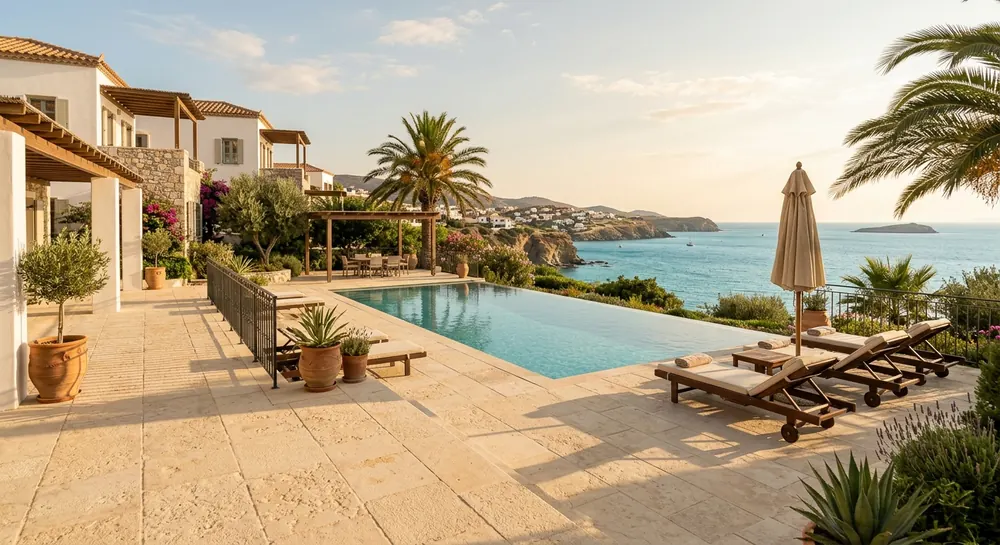
Natural stone remains the emotional favorite for a lot of Riviera clients, especially travertin and the honed limestone quarried around Rognes in the Var, and I understand why - nothing photographs better next to an infinity pool overlooking Monaco. Expect to pay €60 to €150 per m² for good quality stone, more for large-format slabs, and budget for periodic resealing every two to three years at roughly €8 to €15 per m² in labor and product. The other classic option, especially for older bastides and Provençal-style villas around Grasse or Vence, is Salernes terracotta - the traditional tomettes reinterpreted with a textured, slip-rated glaze. It's beautiful and historically appropriate, priced around €55 to €95 per m², but it does need a genuinely rough-cast finish rather than the smooth vintage look, or it becomes dangerous the second it's wet.
Understanding Slip Ratings So You Don't Get Sold the Wrong Tile
This is where most villa owners get talked into the wrong product, often by a showroom salesperson who's never actually stood barefoot on a wet deck at 7am. In Europe, the relevant standard for pool surrounds is DIN 51097, which rates tiles A, B, or C for barefoot areas - C is the highest grip, mandatory in my view for the coping stones right at the water's edge and the first 1.5 meters of deck around the pool. Further out on the sun terrace, where feet are usually dry, the R-rating system (R9 through R13, under DIN 51130) applies instead, and R11 is generally the sweet spot: enough texture to prevent slips even when wet from a stray splash or evening dew, without being so aggressive that it's uncomfortable to walk on or hard to keep clean of ground-in sand.
A trick I use on every site visit, whether it's a renovation in Antibes or a new build above Villefranche: bring a sample outside, wet it thoroughly with a hose, and actually stand on it in bare feet at an angle, simulating how someone steps out of a pool. Showroom lighting and dry-handling in a shop tell you almost nothing useful. I've rejected tiles that looked appropriately textured on paper but turned slick the moment a thin film of suncream-laced water sat on the surface, and conversely found some honed stones that grip surprisingly well once properly finished with a bush-hammered or shot-blasted texture. Always ask your supplier for the DIN certification sheet, not just a verbal assurance - reputable distributors around Nice and Sophia Antipolis will have this documentation on hand without hesitation.
Installation Details That Matter More Than the Tile Itself
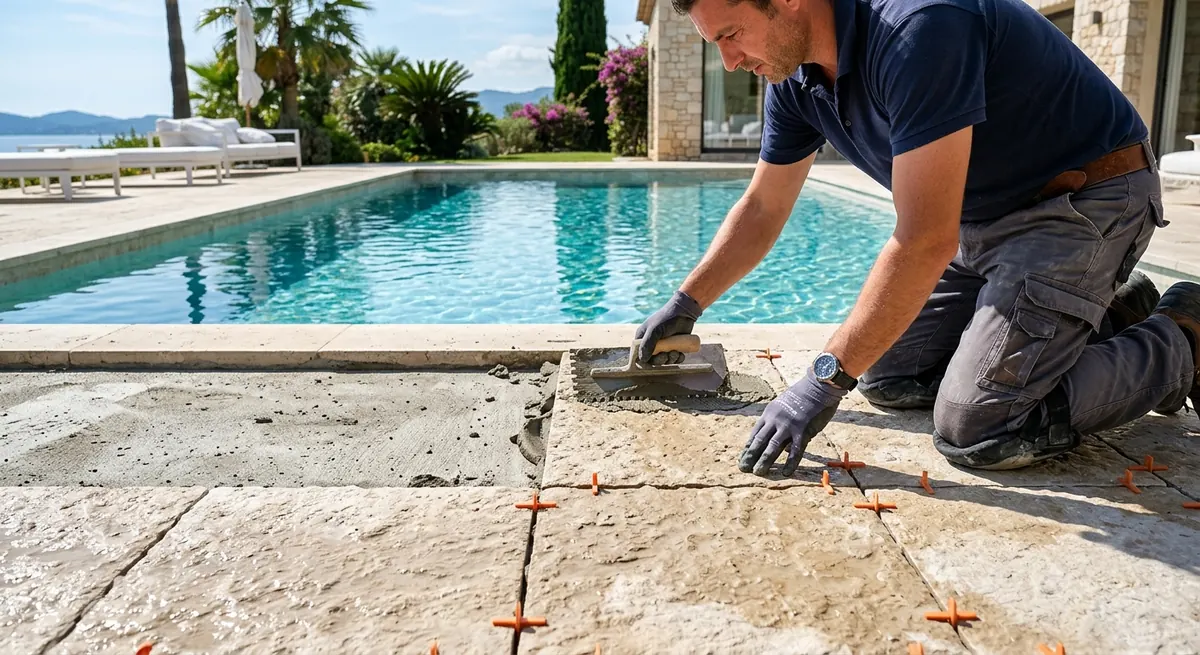
Even the best-rated anti-slip tile will fail prematurely if the substrate and drainage aren't handled correctly, and this is genuinely where I see the most costly mistakes on Riviera terraces. The deck needs a minimum 1.5% fall away from the house and pool coping so water doesn't pool and evaporate, leaving mineral deposits and increasing long-term slip risk as scale builds up on the surface. Expansion joints are non-negotiable given the thermal swings here - I specify a flexible joint every 3 to 4 meters and always around the pool coping itself, because I've seen too many decks in Cannes crack within two summers when a contractor tried to save a day's labor by skipping them. Budget €40 to €70 per m² for quality installation labor alone, more if the substrate needs releveling or if you're working around an existing pool shell that constrains access.
Salt water pools, now common in villas from Cap Ferrat to Roquebrune, add another layer of consideration: the salinity is roughly a tenth of seawater, but it's constant contact, and it will corrode poor-quality metal edge trims and degrade cheap grout within a few years. Use an epoxy-based grout rated for pool environments, not standard cement grout, even though it costs €15 to €25 per m² more - it simply doesn't discolor or erode the way ordinary grout does under chlorine and salt exposure. If your villa is in a protected zone (much of the coastline around Antibes and Saint-Jean-Cap-Ferrat has architectural restrictions), check with the mairie before altering exterior surfaces around a pool, since some communes require pre-approval even for like-for-like resurfacing near a shared boundary wall.
Long-Term Maintenance and Realistic Budgeting
A well-specified porcelain pool deck should need very little beyond a seasonal pressure wash and an annual deep clean with a dedicated salt-and-mineral remover, which costs about €15 to €25 for a product that covers 100m². Natural stone is a different story: plan on resealing every two to three years, and factor that into your ownership cost from the start rather than treating it as a surprise. On a typical 60m² terrace around a villa pool in Mougins or Théoule, total installed cost including materials, substrate prep, and labor generally lands between €7,500 and €16,000 depending on whether you choose mid-range porcelain or premium natural stone - and that figure is far cheaper over a fifteen-year horizon than the cost of a poorly chosen tile that needs full replacement after five or six seasons of salt and UV damage.
The single biggest maintenance mistake I still see is owners applying a glossy sealant to natural stone thinking it will make cleaning easier, when in fact it kills the slip resistance almost immediately and creates exactly the hazard the original tile selection was meant to avoid. Stick to matte, breathable, penetrating sealers specifically labeled for exterior pool surrounds, and re-test the surface grip with the bare-foot-and-hose method after every resealing. If you're renovating an older deck that's already showing crazing or lifted tiles, it's almost always more cost-effective to strip back to the substrate and start fresh with a properly rated product than to patch repeatedly - patched sections rarely match slip performance and tend to become the exact spot where someone eventually slips.
Frequently asked questions
For the immediate pool surround, look for DIN 51097 Class C, the highest barefoot rating. For the wider sun terrace where feet are usually dry, R11 under DIN 51130 offers the best balance of grip, comfort, and easy cleaning in a Mediterranean climate.
For a typical 60m² terrace, expect €7,500 to €16,000 total including materials, substrate preparation, drainage correction, and labor, depending on whether you choose mid-range structured porcelain or premium natural stone.
Yes, but it needs a genuinely textured finish such as bush-hammered or shot-blasted stone, epoxy-based pool grout rather than standard cement grout, and resealing with a matte penetrating sealer every two to three years to maintain both grip and salt resistance.