
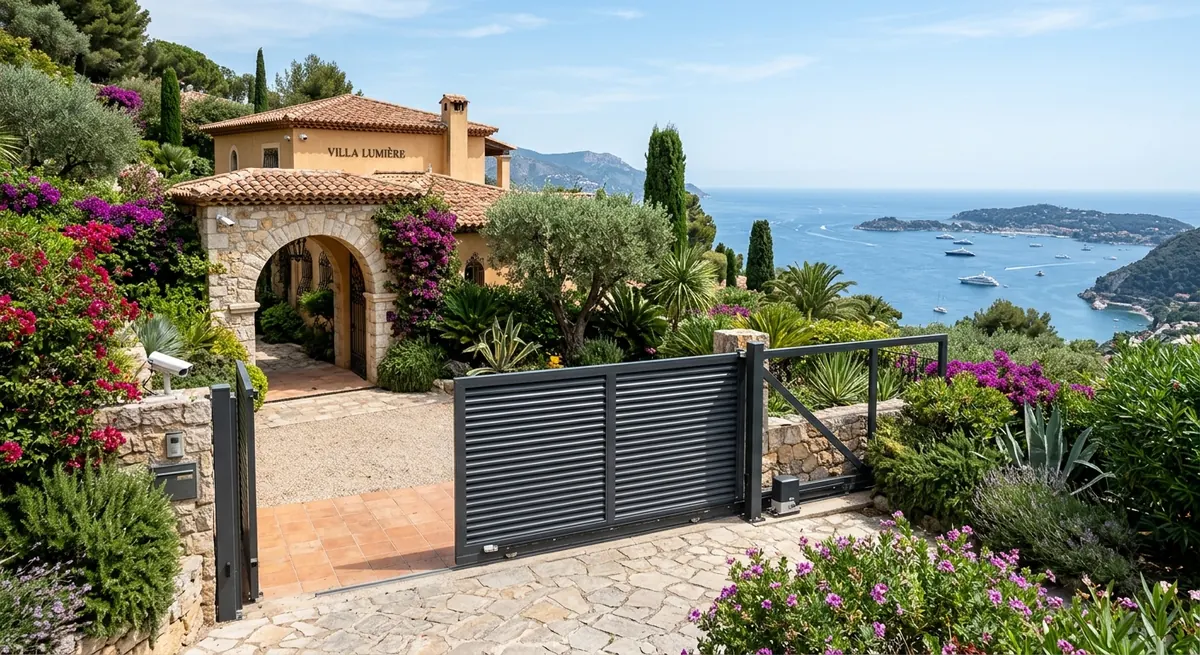
Why Ordinary Gates Fail Within Three Years on This Coast
I have pulled dozens of pitted, seized-up gate hinges off villas between Villefranche-sur-Mer and Golfe-Juan, and the pattern is always the same: a gate bought from a mainland catalogue, installed by a generalist who never worked within five kilometres of the sea, and dead within 24 to 36 months. Salt aerosol carried by onshore wind settles on every metal surface, works into weld seams, and starts galvanic corrosion wherever two dissimilar metals touch — a cheap steel bolt on an aluminium frame, for instance. Add the autumn episodes méditerranéens with driving rain and 90 km/h gusts off Cap Ferrat, and you get motors flooding, sensors shorting, and rails packed with sand blown up from the beach roads in Antibes.
The fix starts before you buy anything: insist on components rated for marine or at least C4/C5 atmospheric corrosivity class, which is the European standard contractors along this stretch should quote without being asked. A gate that looks identical in a showroom in Grasse can be built from mild steel with a thin paint layer, or from hot-dip galvanized steel with a powder coat over it — the price difference is maybe 15 percent, but the lifespan difference is a decade. I tell every client from Beaulieu to Mandelieu the same thing: on this coast you are not buying a gate, you are buying a fight against corrosion, and the fight is won or lost in the specification sheet, not during installation.
Choosing Material, Gate Type and Motor for Salt-Air Resistance
Aluminium is the default recommendation for most villas from Cagnes-sur-Mer to Théoule-sur-Mer, and for good reason: it does not rust, it is roughly 60 percent lighter than steel (which matters for motor sizing and wind load), and marine-grade powder coatings now hold their colour for 12 to 15 years even facing south over open water. Expect to pay 3800 to 7500 euros for a quality aluminium sliding gate 4 to 5 metres wide, fully automated, installed. Wrought iron still has its place on historic properties in Vieil Antibes or in the Cannes Californie district where the architecture demands it, but it needs sacrificial zinc primer, a proper top coat, and realistically a repaint every 4 to 6 years — budget 600 to 1200 euros for that maintenance cycle alone. Galvanized steel sits in between: tougher than aluminium against impact, cheaper than iron, but heavier, which pushes you toward a beefier motor.
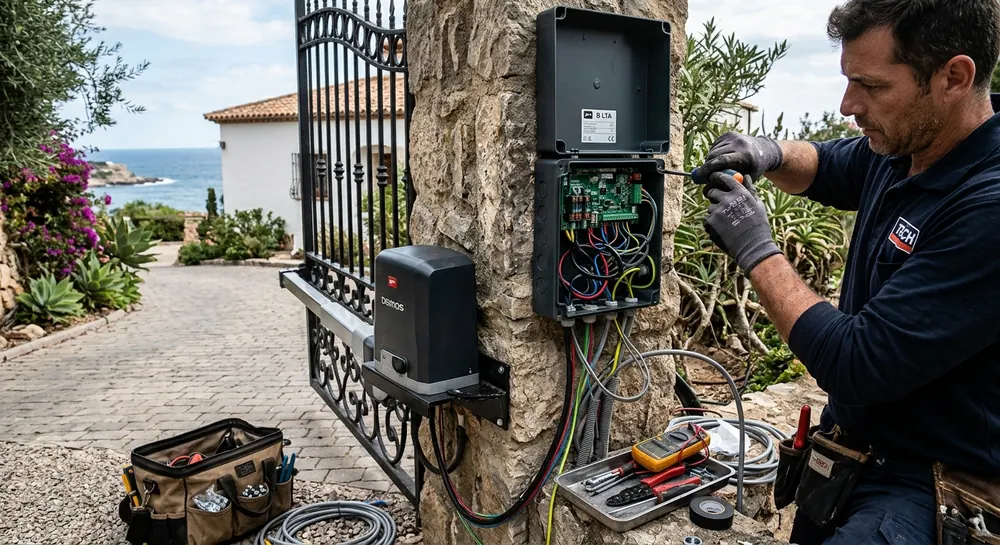
On motor choice, sliding gates handle coastal wind far better than swing gates because there is no leaf catching gusts off the Baie des Anges, and I specify sliding systems on almost every exposed property above Villefranche or along the Basse Corniche. For motors, brands like Came, FAAC and BFT dominate professional installations here, with a quality sliding kit running 1000 to 2200 euros before installation labour, and swing kits slightly less at 800 to 1600 euros. Always ask for IP44-rated or higher motor housings, stainless steel 316L fixings rather than standard zinc-plated bolts (316L resists salt pitting that ordinary stainless cannot), and a solar backup panel — with power cuts common during winter storms around Mougins and the back country, a solar trickle charger costing 150 to 300 euros extra means your gate still opens when the grid does not cooperate.
The Installation Process: Timeline, Permits and Realistic Costs
A full installation on an existing driveway — new posts, rails or hinges, motor, safety photocells and a keypad or remote — typically takes a two-person crew two to four days, longer if we are cutting into stone pillars common on older Cap d'Antibes properties or running buried power cable 20-plus metres from the house. Total project costs on the Riviera run from about 4500 euros for a modest aluminium swing gate on a flat, easy-access plot, up to 9000 to 14000 euros for a wide sliding gate with reinforced masonry pillars, video intercom integration and a cantilever track system needed where ground conditions near Mougins or Valbonne are uneven. Do not underestimate groundwork: cutting a channel through existing paving or decorative gravel in a Cannes garden can add 800 to 1500 euros on its own, and it is the line item most owners forget to budget.
On paperwork, any gate over 2 metres high, or visible from a public road in a protected zone — which covers large parts of Vieux Nice, central Antibes and most of Monaco's border communes — requires a déclaration préalable de travaux filed at the mairie before you start, with a typical one to two month response window. Skip this and you risk a stop-work order or a forced modification after the fact, which I have seen happen to a client in Cap-d'Ail who installed first and asked questions later. Insurance is the other piece owners overlook: several insurers covering high-value villas between Cannes and Menton now offer 5 to 10 percent discounts on home policies if the automatic gate is paired with a monitored camera, since unmonitored driveways remain one of the most common entry points for opportunistic burglary during the low season when owners are away.
Maintenance: The Only Way to Get Ten Years Out of a Coastal Gate
Twice-yearly servicing is non-negotiable here, not optional, and I mean a real inspection rather than a quick spray of WD-40. Spring service should clean out winter storm debris and sand from the rail or hinge assemblies, re-grease all moving parts with a marine-grade lithium grease, and check motor housing seals that salt-laden rain tends to degrade faster than anywhere inland. Autumn service, before the worst of the mistral and the équinoxe storms, should check battery backup condition, tighten any bolts that have worked loose from thermal expansion on hot aluminium, and confirm photocell alignment since a gate that reverses randomly is almost always a sign of a dirty or slightly misaligned safety sensor rather than a motor fault. A maintenance contract from a local automatisme specialist costs 180 to 320 euros a year depending on gate size and complexity, and it is genuinely the cheapest insurance you can buy against a 1500-euro motor replacement.
Between professional visits, owners can do a lot themselves: hose down the gate monthly with fresh water to rinse off salt deposits, especially after a strong Levant wind event that carries sea spray well inland toward Mougins and Grasse, and wipe hinges with a light oil rather than letting grime accumulate. Watch for early corrosion signs — a chalky white bloom on aluminium, orange streaking at weld points on steel, or stiffness in the slide — because catching these within weeks rather than months is the difference between a 40-euro touch-up and a 600-euro hinge replacement. I also recommend testing the manual release mechanism every few months; during a power cut you need to know it actually disengages smoothly, and on more than one villa near Villefranche I have found the manual override rusted solid from lack of use, which defeats the entire point of having one.
Frequently asked questions
Budget 4500 to 7500 euros for a standard aluminium swing or sliding gate on an easy driveway, and 9000 to 14000 euros for wider sliding gates, reinforced masonry pillars or sites with difficult access or uneven ground, which is common in hillside properties around Mougins and Vence.
Marine-grade aluminium with a powder coating rated for C4/C5 atmospheric corrosivity is the most reliable choice for most coastal villas, since it never rusts and needs far less upkeep than wrought iron or standard steel, which both require regular repainting to resist salt spray.
Yes, if the gate exceeds 2 metres in height or sits in a protected zone, which covers much of Vieux Nice, central Antibes and areas bordering Monaco, you must file a déclaration préalable de travaux at the mairie and wait for approval, usually one to two months, before starting work.