
Why Belle Époque Balconies in Nice Are Ticking Time Bombs
Walk along Rue de France, through the Carré d'Or, or up towards Cimiez and you'll see hundreds of cantilevered concrete balconies dating from 1890 to 1930, built during Nice's great hotel and apartment boom. The engineers of that era were working with reinforced concrete as a relatively new material, and they poured slabs with concrete cover over the rebar often no thicker than 15 to 20mm, well below the 30 to 40mm we'd specify today. That thin skin of concrete was never going to hold up forever against a Mediterranean climate loaded with salt aerosol, especially on buildings within a kilometre of the Promenade des Anglais or down near Le Port.
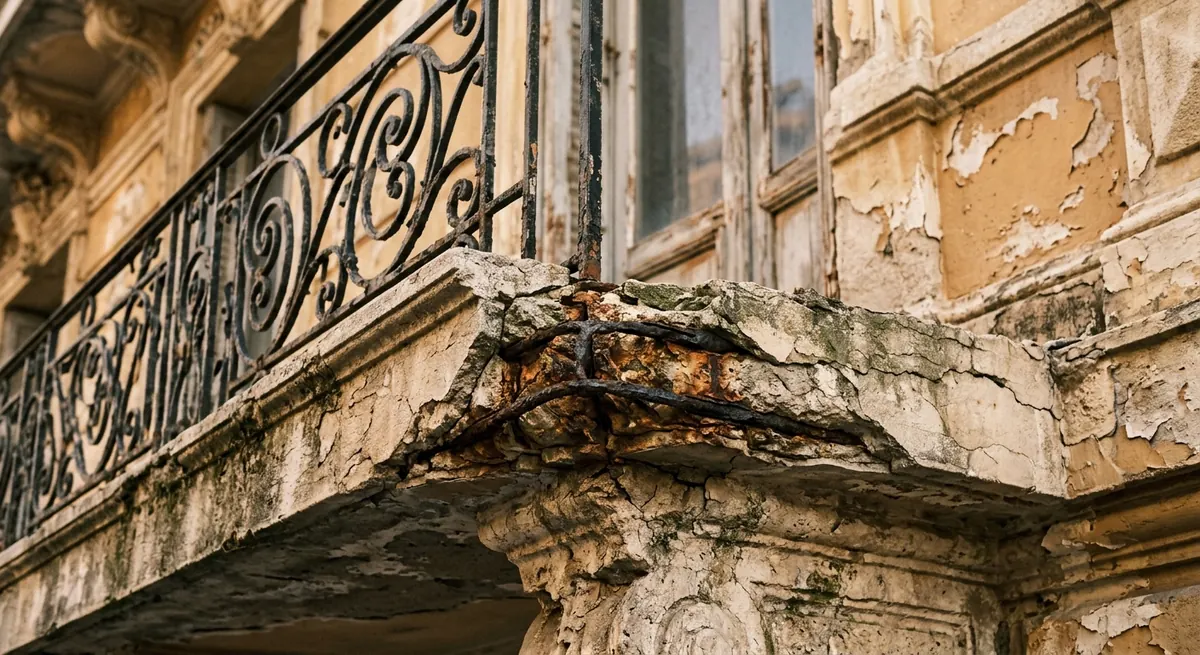
The failure mechanism is almost always the same, and I've diagnosed it on dozens of balconies from Mont Boron to the Musiciens district. Carbon dioxide and chloride ions penetrate the thin cover, drop the concrete's natural alkalinity, and strip away the passive oxide layer protecting the steel. Once rebar starts rusting, it expands up to seven times its original volume, and that expansive pressure cracks and eventually blows off the concrete cover from the inside. By the time you see a brown rust stain bleeding through paint or a hairline crack running parallel to the balcony edge, corrosion has usually been active for five to ten years already, quietly working its way through the structure.
Reading the Warning Signs and Getting a Proper Diagnostic
Before calling anyone, do a basic visual and acoustic check yourself, because it tells you how urgent the situation is. Look for rust streaks running down the underside of the slab, map-cracking on the top surface, and any bulging or drummy-sounding patches when you tap the soffit with the handle of a screwdriver or a small hammer — a dull, hollow knock means the concrete has already detached from the rebar even if it hasn't fallen yet. On older buildings in Nice I regularly find balconies where the guardrail anchors themselves are corroding, which is arguably more dangerous than the slab cracking, since a failed railing anchor can let someone fall rather than just drop debris onto the pavement below.
If you see any of these signs, don't wait for a quote from a general contractor — bring in a bureau d'études structure or a béton armé specialist for a proper diagnostic, which typically runs €800 to €1,800 depending on the number of balconies and whether they need to drill core samples for carbonation testing with phenolphthalein. This step matters legally as much as technically: in a copropriété, if a fragment falls onto a public street like Avenue Jean Médecin or onto a neighbour's terrace, the syndic and ultimately all co-owners can be held liable under the 1965 copropriété law, and the mairie can issue an arrêté de péril ordinary or even péril imminent forcing immediate scaffolding and work under municipal supervision. I've seen syndics in the Liberation and Riquier neighbourhoods get blindsided by a €150 fine turning into a forced €40,000 facade campaign because nobody acted on a diagnostic report sitting in a drawer for two years.
The Actual Repair: What a Proper Job Involves and Costs
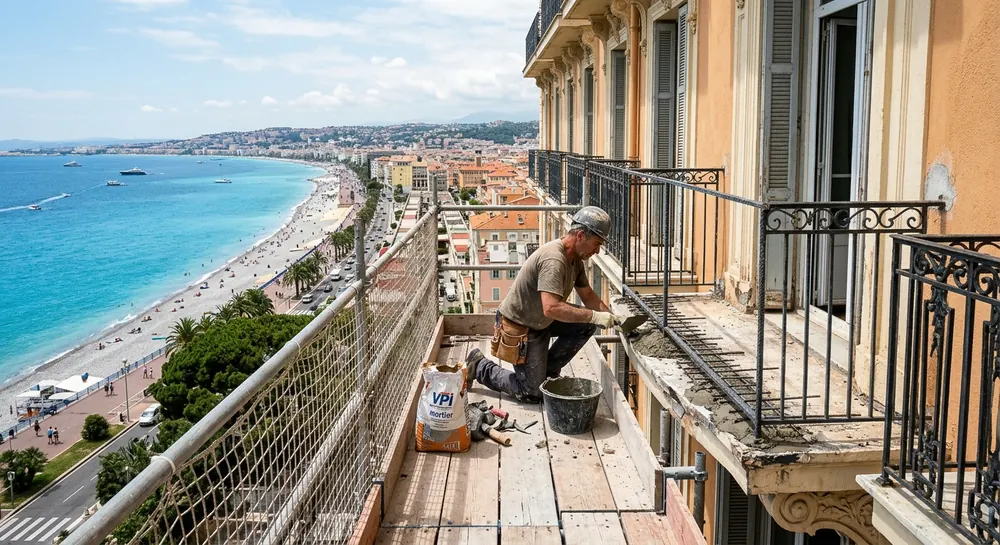
A correctly executed spalling repair is not just slapping mortar over the hole, and this is where I see the most botched work in Nice, usually from handymen who patch the visible crack and leave corroding steel underneath, guaranteeing the problem returns within eighteen months. The real sequence is: mechanically purge all loose and carbonated concrete back to sound material, usually with a needle gun or small jackhammer, expose at least 20mm of clean rebar all around, grit-blast or wire-brush the steel to bare metal removing every trace of rust, then apply a zinc-rich or epoxy anti-corrosion primer directly on the steel. Only after that cures do you rebuild the section with a thixotropic repair mortar such as Sika MonoTop or a Weber equivalent, applied in layers for anything thicker than 3cm, followed by a reprofiling coat and a breathable waterproof finish that matches the original render.
For a single balcony with moderate spalling — say two corroded corners and 0.5m² of repair area — expect €1,500 to €2,800 all-in from a qualified maçon specialised in béton armé, assuming reasonable access. Where rebar has lost more than 30% of its cross-section, which I measure with calipers after cleaning, you'll need to splice in new reinforcing bars welded or lapped to the existing steel, pushing the cost per balcony to €3,500 to €5,500. A full building campaign on a six-storey Belle Époque facade with fifteen affected balconies in the Carré d'Or has run clients anywhere from €45,000 to €90,000 depending on scaffolding needs and how many balconies require structural reinforcement versus cosmetic repair — and yes, always get at least two quotes, because I've seen a 40% price spread between artisans for identical specifications.
Scaffolding, Permits, and Coordinating with the Syndic
Because most of these balconies sit three to six storeys up and overhang either a public street or a shared courtyard, access is rarely simple. Scaffolding in central Nice runs roughly €12 to €18 per m² per month depending on street width and whether you need a permit to occupy public space, which you almost always do if the scaffold projects over Rue de France, Avenue des Baumettes, or similar narrow streets — that's a déclaration préalable or an arrêté de voirie through the mairie, and processing can take two to four weeks, so factor that into your timeline. On buildings where only one or two balconies need work, some contractors use a suspended platform or a mobile tower instead, which can cut access costs by half, but check this is actually feasible given the facade's ornamentation and any protected heritage status, since several buildings along the Promenade des Anglais fall under secteur sauvegardé rules requiring Architecte des Bâtiments de France sign-off on anything touching the facade.
Getting a syndic to move fast is its own challenge, and I say this having sat through more than one tense assemblée générale where co-owners argued over an extraordinary call for funds. My practical advice: push for the diagnostic report to be read at the next AG with a clear cost estimate and the explicit mention of péril risk — French co-owners respond far faster to liability exposure than to aesthetic arguments. If the building has a fonds travaux (mandatory reserve fund under the Loi ALUR), check its balance first, because partial funding from reserves can avoid an unpopular special assessment. For urgent cases where a fragment has already detached, you can legally authorise emergency conservatory work under Article 18 of the 1965 law without waiting for a full vote, which is often the fastest route to get a danger zone cordoned off and a temporary net or scaffold installed within days rather than months.
Prevention and Long-Term Maintenance That Actually Works
Once a balcony has been properly repaired, the smart move is to stop the next corrosion cycle before it starts rather than waiting another twenty years for the same conversation. I recommend applying a breathable, hydrophobic silane-siloxane impregnation to the whole balcony slab and guardrail zone, which costs around €25 to €40 per m² and significantly slows chloride and carbon dioxide penetration without trapping moisture inside the concrete — critical in a climate where salt-laden sea breeze hits facades from Antibes to Beaulieu-sur-Mer almost daily. Repainting alone with a standard acrylic facade paint does little against this specific threat; you want a product rated for anti-carbonation performance, and a decent applicator in the Nice area will know the difference between a cosmetic coating and a protective one.
Beyond coatings, set a simple inspection rhythm: a visual check every two years by the syndic or a maintenance company, and a full diagnostic every eight to ten years for buildings over seventy years old, which is most of what we're dealing with here. This costs a fraction of emergency repairs — typically €300 to €600 per routine inspection round for a mid-sized building — and catches rebar corrosion at the hairline-crack stage rather than the chunk-falling-off stage. I've managed buildings in the Fabron and Gambetta areas where this discipline, paired with a well-funded fonds travaux, kept facade maintenance costs roughly 60% lower over a fifteen-year span compared to sister buildings nearby that only acted after receiving a mairie notice. Spalling is predictable and slow until suddenly it isn't, and the owners who treat it as routine maintenance rather than crisis management consistently spend less and sleep better.
Frequently asked questions
For a single balcony with moderate corrosion damage, budget €1,500 to €2,800 for a proper repair including rebar cleaning and re-passivation. If significant steel section loss requires splicing in new reinforcement, costs rise to €3,500 to €5,500 per balcony. A full building facade campaign with scaffolding typically ranges from €45,000 to €90,000 depending on scale.
Under the 1965 copropriété law, balconies are generally considered part of the common structure (gros oeuvre) even when used privately, so repair costs are usually borne collectively by all co-owners through the syndic, unless the règlement de copropriété specifies otherwise. Urgent safety work can be authorised without a full vote under Article 18 as conservatory measures.
Warning signs include rust stains bleeding through paint on the underside, cracks running parallel to the balcony edge, a hollow or drummy sound when tapping the soffit with a hammer, and any visible bulging. If you notice these, get a structural diagnostic from a bureau d'études within weeks, not months, and consider restricting access in the meantime.