Why Nice balconies from the 1950s and 60s are falling apart
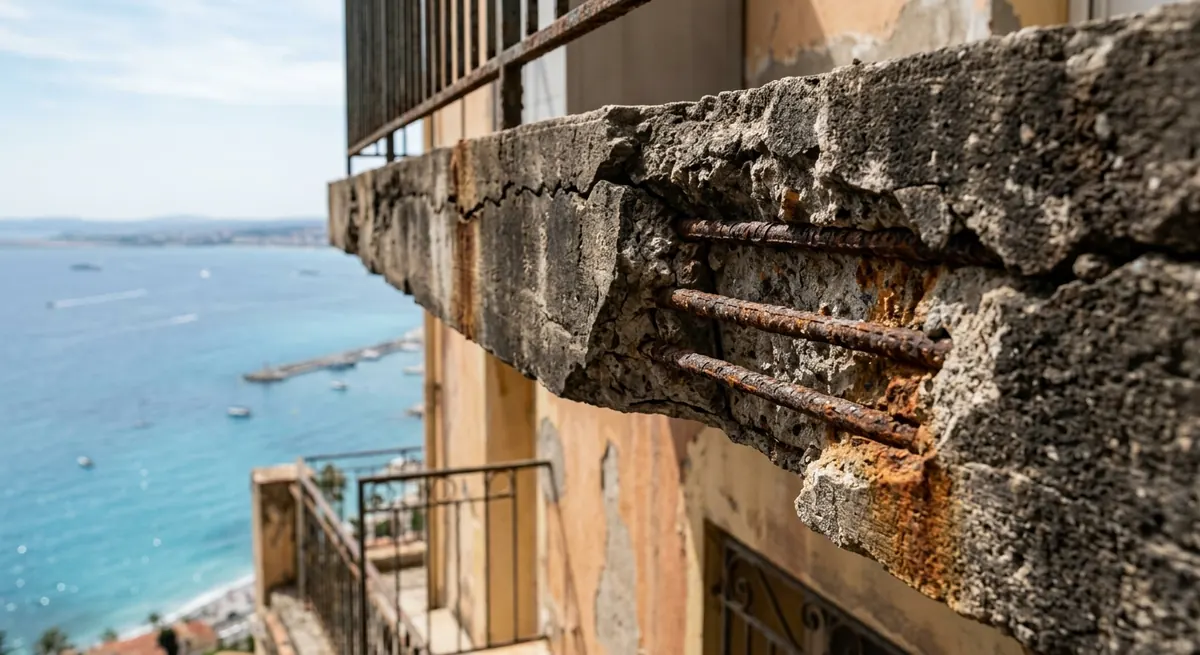
Walk along Rue de France, the lower end of Cimiez, or the residential blocks behind Riquier station and you will spot the same pathology on balcony after balcony: a rust-orange stain bleeding through a hairline crack, a chunk of concrete missing at the edge slab, sometimes a bent bit of rebar poking through like a compound fracture. This is not cosmetic ageing, it is corrosion of the steel reinforcement inside the concrete, and the Riviera coastline accelerates it dramatically compared to inland French towns. Salt-laden air blowing off the Baie des Anges penetrates the concrete cover over years, and once chloride ions reach the rebar they break down its natural passive protective layer. The steel starts rusting, and rust occupies roughly seven times the volume of the original steel — that expansion physically cracks and pops the concrete from the inside, which is the technical definition of spalling.
Buildings from before 1970 are particularly exposed because reinforcement cover was often skimped to 15-20mm rather than the 30-40mm we specify today, and the concrete mix itself was frequently more porous, with less attention paid to water-cement ratio. Balcony slabs are worse hit than facades because they are horizontal, catch rain and sea spray directly, and often have poor drainage falls, so water sits and slowly carbonates the concrete from the top down. I have opened up balconies in Le Port and Californie where the rebar was reduced to a lace of flaking rust with barely 60% of its original cross-section left — structurally, that balcony was one hard frost or one loaded flower pot away from partial collapse.
Diagnosing the real extent of the damage before you touch anything
The first mistake owners make is patching the visible crack with a bag of mortar from the local Bricomarché and calling it fixed. That treats the symptom, not the disease, because the corrosion almost always extends well beyond the area where concrete has already fallen off. A proper diagnosis starts with a sounding survey (sondage au marteau): a mason taps the entire underside and edge of the slab with a hammer, and any hollow, dull ring rather than a sharp, solid one indicates delamination that has not yet spalled but will within a season or two. On a typical 1.2m x 3m balcony I usually find that the area needing treatment is two to three times larger than what is visually cracked.
Beyond sounding, a serious diagnostic includes a carbonation test using a phenolphthalein spray on a freshly broken concrete sample — if it stays colourless rather than turning pink, the concrete has carbonated right down to the rebar and lost its alkaline protection, meaning any exposed steel anywhere in that zone is at risk regardless of appearance. For buildings with recurring, widespread damage across multiple floors, it is worth commissioning a bureau d'études structure (budget 900-2,200€ for a full diagnostic report on a facade of 15-20 balconies) rather than relying on a contractor's free quote, because an independent report gives the syndic and the AG vote real technical backing, and it protects you if a dispute arises later about whether the copropriété acted with due diligence. I always tell clients in Cannes and Antibes the same thing I tell them in Nice: a rusted balcony rail or a missing 10cm of edge concrete is a safety issue, not a maintenance nicety, and if there is any risk to pedestrians below, the syndic has a legal duty (obligation de sécurité) to act quickly, including temporary fencing off if needed.
Repair techniques and what they actually cost in 2026
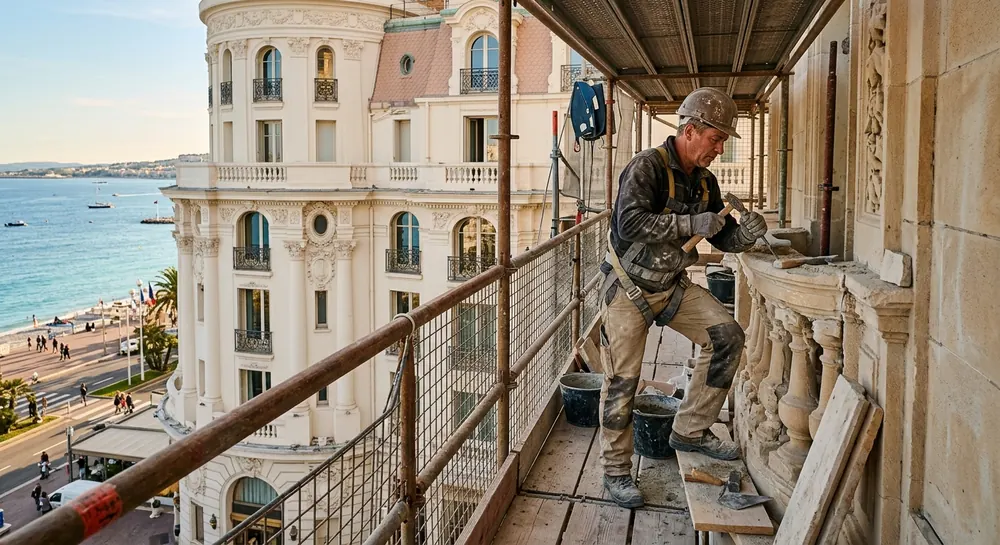
For a balcony with localized spalling and light-to-moderate rebar corrosion, the standard repair sequence is: remove all unsound concrete back to sound material (using a small pneumatic chisel, never a hammer alone, to avoid new microcracking), sandblast or wire-brush the exposed rebar to bright metal, apply a corrosion-inhibiting passivation primer, then rebuild the profile with a fibre-reinforced structural repair mortar (thixotropic, applied in layers up to 3-4cm each). Finish with a waterproof, UV-resistant coating and re-establish a proper drainage slope so water sheds outward rather than pooling. For a typical 3-4m² balcony in this condition, expect 1,800€ to 3,500€ per balcony including scaffolding access, done by a competent masonry artisan with décennale insurance — get at least three devis, because I have seen quotes for identical scope range from 2,100€ to 5,800€ in the same Nice building.
When corrosion has eaten more than 30-40% of the rebar cross-section, or when the slab shows structural deflection, you are into partial or full reconstruction territory: cutting back further, splicing in new rebar bars (goujons chimiques anchored with resin), and recasting the slab edge or even the full balcony in some cases. That work runs 6,000€ to 12,000€ per balcony depending on size and access, and on a building where 15-20 balconies need this treatment simultaneously, plus facade scaffolding shared across the whole elevation (150-280€ per m² of facade for scaffold rental and setup over a multi-month job), total project costs commonly land between 180,000€ and 400,000€ for a mid-size Nice building of 25-30 units. Guardrails also need checking against current safety height requirements (minimum 1m for balconies built before certain dates, 1.1m for newer standards) — replacing a rusted wrought-iron garde-corps typically adds 800€ to 1,600€ per balcony if it needs full renewal rather than just re-anchoring and repainting.
Getting the work approved through the copropriété
This is where good technical planning meets the slower reality of French co-ownership law. Balcony structural repair is almost always classified as travaux d'entretien or travaux conservatoires falling under the syndicat des copropriétaires' collective responsibility, since balconies are generally parties communes à jouissance privative — meaning the owner uses it exclusively but the structure belongs to the collective. Under the loi of 1965 as amended, urgent safety work can sometimes be authorized directly by the syndic without a prior AG vote if there is imminent danger (article 18), but planned restoration campaigns need a vote at the assemblée générale, typically under article 25 (majority of all copropriétaires) and falling back to article 25-1 or a second vote under article 24 if the first attempt falls short of quorum.
Practically, this means the process from first crack report to scaffolding going up rarely takes less than 8-10 months: the syndic commissions diagnostics and devis, presents them at the next AG (often only held once a year, sometimes with an extraordinary AG called specifically for urgent works), owners vote, and then the chosen artisan or entreprise needs their own lead time, often 2-4 months in high season when every mason in the Alpes-Maritimes is booked solid from May through September. If your building sits in a secteur sauvegardé or has a facade with any heritage character — this comes up more than people expect around Vieux Nice and parts of the Promenade — you may also need sign-off from the Architecte des Bâtiments de France, which adds real time and sometimes constrains coating colours and rail styles. Building up the fonds travaux (mandatory reserve fund since the loi ALUR, minimum 5% of the annual budget) ahead of time genuinely helps avoid an ugly appel de fonds exceptionnel where each owner is suddenly billed 4,000-15,000€ with 60 days notice — I have watched AG meetings turn hostile over exactly this kind of surprise bill.
Avoiding the classic mistakes and planning long-term maintenance
The single most expensive mistake I see is cosmetic patching without addressing the rebar, because within 18-30 months the rust resumes underneath the new mortar and you are paying for the same repair twice, this time at a higher price after the damage has spread further. A close second is choosing a contractor purely on price without checking their assurance décennale certificate is current and specifically covers structural masonry repair, not just general ravalement — ask to see it, and call the insurer to confirm if the sum involved is significant. Any repair beyond minor cosmetic patching should also come with a garantie décennale from the contractor covering structural failure for ten years, and for larger reconstruction projects, seriously consider dommage-ouvrage insurance even though it adds 2-4% to project cost, because it gives you a fast payout path if a defect appears rather than years of litigation.
Once the repair is done, maintenance is what actually protects your investment: have someone visually inspect every balcony every 2-3 years, checking specifically for new hairline cracks, rust bleed, or coating delamination at joints, and reapply the waterproof top coat every 8-10 years before it fails rather than after. If you are on a building facing directly onto the sea — anything on the front line from the Promenade des Anglais to Cap d'Antibes takes noticeably harder punishment than a building three streets back — budget for a slightly more frequent inspection cycle and consider a higher-spec marine-grade coating from the start, since the extra 15-20% upfront cost is cheap insurance against redoing the whole job a decade early.
Frequently asked questions
For a single balcony with moderate spalling and rebar corrosion, expect 1,800€ to 3,500€ including scaffolding access. Full reconstruction with new rebar and recast slab runs 6,000€ to 12,000€ per balcony, and building-wide campaigns across 15-20 balconies typically total 180,000€ to 400,000€ once shared scaffolding is included.
Since balconies are usually parties communes à jouissance privative, the structural slab and rebar are the collective's responsibility, funded through the syndicat des copropriétaires via a vote at the AG, often drawing on the mandatory fonds travaux. Purely private elements like potted plants or non-structural tiling generally remain the individual owner's cost.
Yes, it is a genuine safety risk, not just cosmetic damage. Once rusted rebar loses enough cross-section, the concrete edge can fail under normal loading, and falling debris also endangers people below. If you see exposed or heavily rusted rebar, notify your syndic immediately and request temporary fencing or bracing while a full diagnostic and repair are arranged.