
Why Nice's Old Basements Are Almost Designed to Get Damp
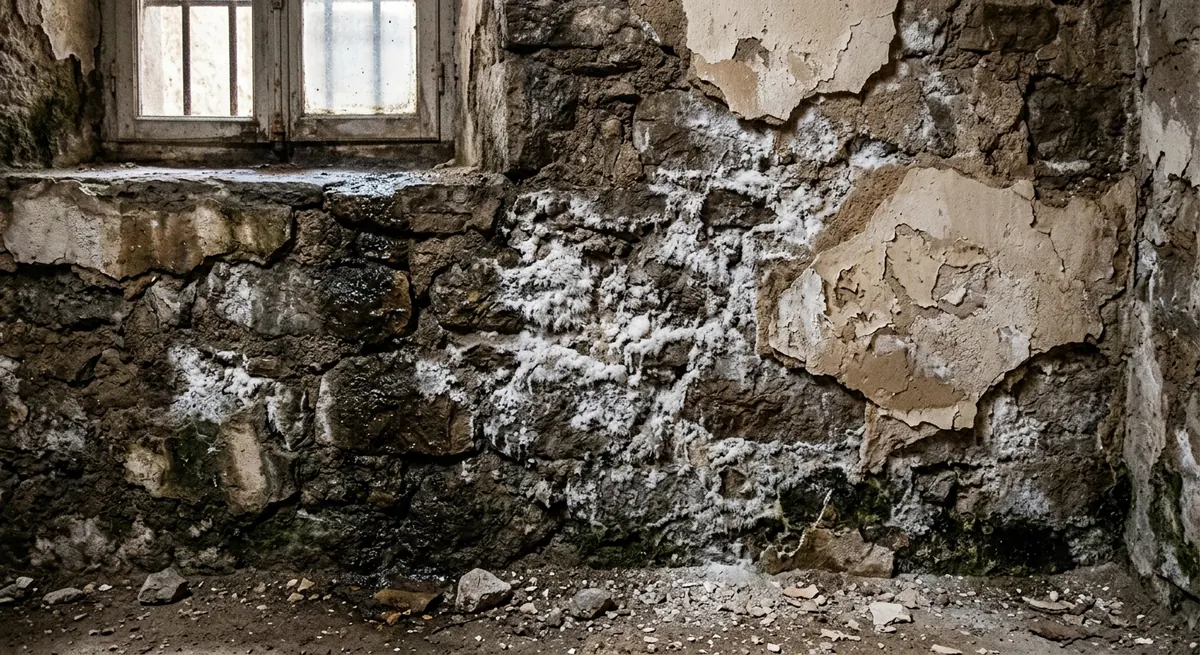
Walk into any cellar in Vieux Nice, Riquier or the lower streets of Cimiez and you will notice the same pattern: soft, crumbly plinths, a musty smell that never fully airs out, and a tide line of salt crystals creeping up the wall to roughly 80 centimetres or a metre. This is not bad luck. Buildings put up between the 1850s and the 1950s here were built directly on rubble stone or molasse (a soft local sandstone) foundations, often below the natural water table, with zero damp-proof course because the concept barely existed in French masonry practice before the 1970s. Add to that the fact that much of the old town sits on reclaimed land around the former bed of the Paillon river, culverted and buried under what is now Boulevard Jean-Jaurès and the Promenade du Paquis, and you get a permanent underground water presence that these buildings were never designed to resist.
The second factor is the mortar itself. Pre-1960s Niçois masons used lime-based mortars and renders, which are breathable and actually help manage moisture by letting it evaporate slowly. The real damage usually starts decades later, when a well-meaning owner or a previous renovation slaps a cement-based render or a plastic-based paint over that lime wall. Cement is far less permeable, so moisture that used to evaporate through the wall surface gets trapped, migrates upward, and pushes salts out at the first weak point it finds. I have opened up dozens of cellars from Cours Saleya to the port district where the diagnosis, ninety percent of the time, boils down to «someone sealed a breathable wall with the wrong material forty years ago» rather than a genuine structural failure.
Telling Rising Damp Apart From Condensation and Lateral Water Ingress
Before you spend a single euro on treatment, you need an accurate diagnosis, because the three main culprits behind a damp Niçois cellar require completely different fixes. Rising damp (humidité ascensionnelle) moves up through capillary action in the masonry itself and typically plateaus at a height related to wall thickness and porosity, rarely above 1.2 metres. Condensation, extremely common in poorly ventilated basements near the coast given our humid Mediterranean air, shows up as generalised surface moisture and black mould on cold spots, especially near unheated vaulted ceilings, without the telltale salt staining. Lateral penetration, meanwhile, comes from a specific external source, a cracked drain, a neighbour's leaking gutter downpipe, or groundwater pressure against a retaining wall, and tends to show as a localised wet patch rather than a uniform band.
A competent diagnosis combines a few simple, low-cost checks with one or two lab-grade tests if the situation is ambiguous. I always start with a protimeter or hygrometer reading at several heights on the wall, cross-referenced with a visual survey for salt efflorescence (a strong indicator of capillary rise carrying dissolved nitrates and chlorides from the soil). For anything above a straightforward case, a calcium carbide test on a masonry sample, which measures actual moisture content rather than surface conductivity, gives a far more reliable figure and costs around 250 to 400 euros through a local pathology specialist. A full diagnostic report from an independent bureau d'études, useful if you are dealing with a syndic and multiple co-owners in a building on Avenue Jean Médecin or similar, typically runs 500 to 900 euros but can save you from paying for the wrong treatment entirely, which happens more often than owners realise.
Matching the Treatment to the Actual Problem
Once rising damp is confirmed as the primary mechanism, three treatment families cover most Nice situations, and each has a genuine place depending on wall construction and budget. Chemical injection damp-proof courses, where a silicone or siloxane-based cream is injected in a continuous line through drilled holes at the base of the wall to create a hydrophobic barrier, work well on solid brick or regular rubble stone walls and cost roughly 90 to 160 euros per linear metre installed, with results becoming visible over six to eighteen months as the wall dries out. For the thick, irregular rubble-and-rubble-fill walls common in pre-1900 Niçois construction, injection can be less reliable because the barrier struggles to form a continuous line through voids and inconsistent stone, and I have seen it under-perform in several Vieux Nice cellars for exactly this reason.
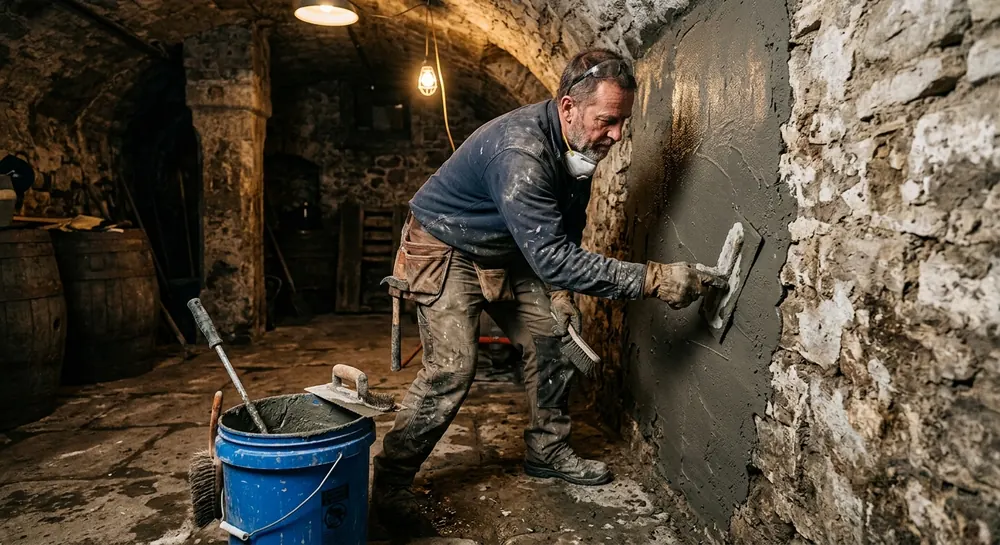
In those thicker, more irregular walls, I generally recommend either an electro-osmotic system, which uses a low-voltage current to repel water molecules downward and works surprisingly well on rubble masonry despite higher upfront costs of 3,000 to 6,000 euros for an average 40 to 60 square metre cellar, or a cavity drain membrane system (lame d'air / membrane à cavités) fixed to the interior face and left to manage residual moisture behind it rather than trying to stop it entering, which suits vaulted cellars near the port or in Antibes' old ramparts area particularly well at around 55 to 85 euros per square metre. Whatever the chosen method, the finishing render is non-negotiable: always use a lime-based, breathable render (mortier de chaux NHL 3.5 or similar) and never trap the wall again under cement or acrylic paint, at roughly 45 to 70 euros per square metre for a proper three-coat lime application including a drainage/rendering base coat.
Working the Job in a Real Nice Building: Permits, Syndics and Timing
Most pre-1960s buildings in central Nice sit inside the secteur sauvegardé or an area with heritage constraints, which mainly affects facade and street-facing work rather than interior cellar treatment, but it is still worth a quick call to the Nice urbanisme department if your intervention touches an exterior wall, a vent, or a soupirail (the small street-level ventilation openings you see along Rue Droite and Rue Pairolière). Interior basement damp-proofing itself rarely needs a permit, but if the cellar is a shared part of the building, and in Nice's older co-ownership structures it almost always partially is, you will need syndic approval and likely a vote at the assemblée générale if the cost is split among co-owners, which is standard practice for common-wall treatment.
Timing matters more here than owners expect. Injection and electro-osmotic treatments need the wall to dry out over months, so starting work in October or November, right before the wettest Riviera weeks typically hit between November and January, undermines the whole process. I push clients toward a spring start, ideally March to May, so the wall has a genuine dry window through summer to demonstrate results before autumn rains test it again. Coordination with neighbouring cellars is the other practical headache: rising damp rarely respects party walls, and I have had jobs in Cimiez and Le Port where treating only one owner's section simply pushed the moisture sideways into the untreated neighbour's wall within a year, so a shared, building-wide approach genuinely pays for itself even though it is harder to organise.
Realistic Budgets and Keeping the Problem From Coming Back
For a typical 50 to 70 square metre basement or cellar level under an old Niçois building, expect a full, correctly specified job, diagnostic report, chosen treatment method, lime render finish and basic ventilation improvements, to land somewhere between 7,500 and 16,000 euros, with the wide range driven mostly by wall thickness, access difficulty, and whether electro-osmosis or membrane systems are needed instead of simple injection. Cheaper quotes under 4,000 euros for a whole cellar almost always mean cement-based render over an untreated wall, which buys you two or three cosmetically dry years before the damp returns with a vengeance, often worse because the trapped moisture has nowhere left to go except upward into the ground-floor walls above.
Prevention afterward is cheap compared to the cure, and it is where most owners drop the ball once the contractor leaves. Install or clear a peripheral French drain (drainage périphérique) where the building's footprint allows it, roughly 120 to 220 euros per linear metre, to intercept groundwater before it reaches the foundation, particularly worthwhile for buildings backing onto the hillside in Cimiez or Fabron. Keep gutters and downpipes genuinely clear, since a blocked gutter feeding water straight down an external wall undoes years of damp-proofing work in a single wet winter, and run a small extractor or passive ventilation grille in the cellar to manage the residual coastal humidity that no amount of masonry treatment will ever fully eliminate. Buildings that maintain this basic routine rarely see rising damp return within the fifteen to twenty-year lifespan most treatments are rated for, and it meaningfully protects resale value, since damp cellars are now a standard, and often deal-breaking, item on any serious pre-purchase survey in the Alpes-Maritimes market.
Frequently asked questions
Rising damp shows a fairly consistent band of moisture and salt staining rarely above 1 to 1.2 metres from the floor, while condensation appears as generalised surface dampness and black mould, especially on cold spots like vaulted ceilings, without salt crystals. A hygrometer reading combined with a visual check for efflorescence usually settles it, and a calcium carbide test from a local pathology specialist gives a definitive answer for around 250 to 400 euros.
Yes, if the wall or cellar space is a common part of the building, which is typical in older Niçois co-ownerships, the work generally needs to be approved at the assemblée générale, particularly when costs are shared among co-owners. It is worth raising it early with your syndic since coordinating treatment across neighbouring cellars, rather than fixing just one owner's section, gives far more durable results.
The most common cause is a cement-based render or acrylic paint applied over the treated wall, which traps residual moisture instead of letting it evaporate the way the original lime-based masonry was designed to. Always finish rising damp treatment with a breathable lime render (mortier de chaux) and check that gutters and any peripheral drainage are actually functioning, since blocked drainage is the second most frequent reason for early failure.