
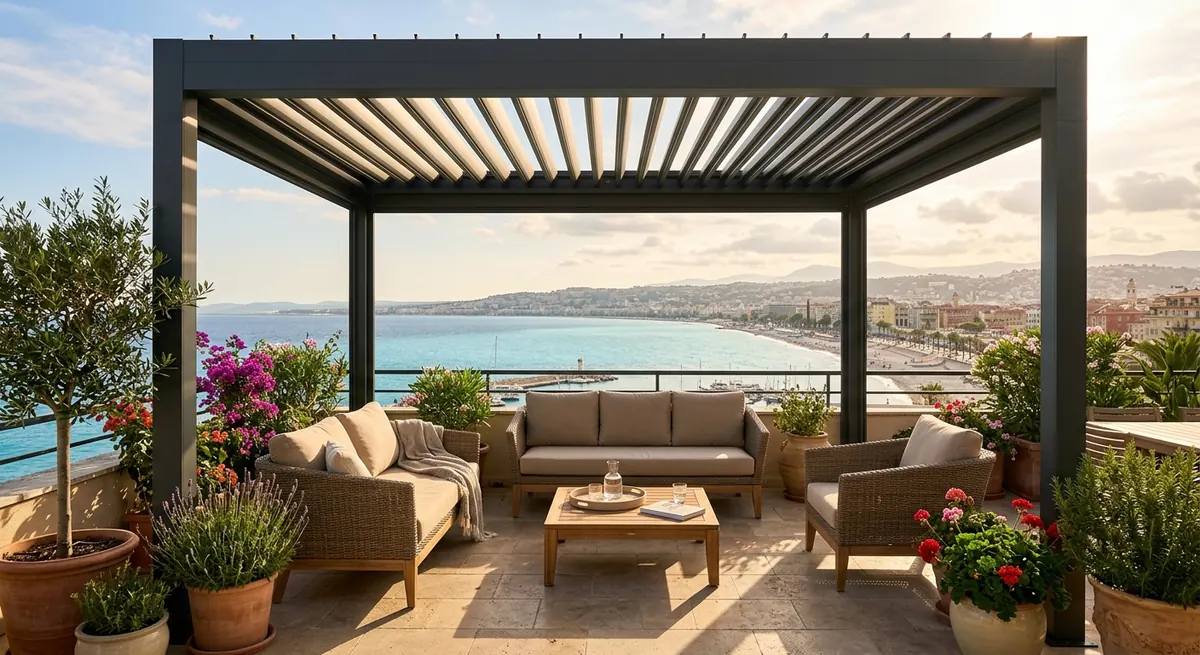
Why Bioclimatic Pergolas Have Taken Over Riviera Terraces
Walk through any Nice neighborhood from Fabron to Saint-Roch on a July afternoon and you will see them everywhere: slatted aluminum roofs tilted just so, throwing shade at 2pm and letting the low autumn sun through in November. Clients ask for them constantly now, and it is not a fad. A traditional pergola or a fixed glass roof either bakes the terrace or blocks it entirely, whereas the rotating-slat bioclimatic version lets you dial in shade by hand or motor, redirect rainwater through the hollow slats, and close the whole thing down in twenty seconds when a summer storm rolls in off the Baie des Anges. On a south-facing terrace in Cannes or Antibes, that flexibility changes how a family actually uses the outdoor space across ten months of the year rather than three.
There is also a very local reason these structures make sense here: the Riviera light is intense and low-angled for much of the year, and glare off the sea bounces up under conventional awnings in a way that a fixed pergola simply cannot manage. I have retrofitted three terraces this year alone where the previous owner had installed a canvas awning that lasted four winters before the fabric shredded in the wind. A well-specified bioclimatic pergola, chosen correctly for this coastline, is built to outlast that by a factor of five or six, provided the material and the fixings are chosen with the sea in mind rather than a catalog spec sheet written for inland France.
Wood or Aluminum: The Real Trade-Off on This Coast
Aluminum dominates new installations in Nice and Monaco for good reason: it does not rot, does not need annual oiling, and modern powder-coating in RAL colors like 7016 anthracite or 9010 white holds up well against UV that would bleach a lesser finish within two summers. A quality bioclimatic aluminum pergola with motorized slats, integrated LED strips and a drainage gutter typically runs 450 to 650 euros per square meter installed, and the profiles are engineered for spans up to 6 or 7 meters without a center post, which matters on a narrow terrace where you do not want a pillar splitting your view of the bay. The downside is aesthetic and thermal: aluminum reads as more technical than warm, and even with a wood-effect thermolacquage finish, it never quite fools anyone standing two meters away.
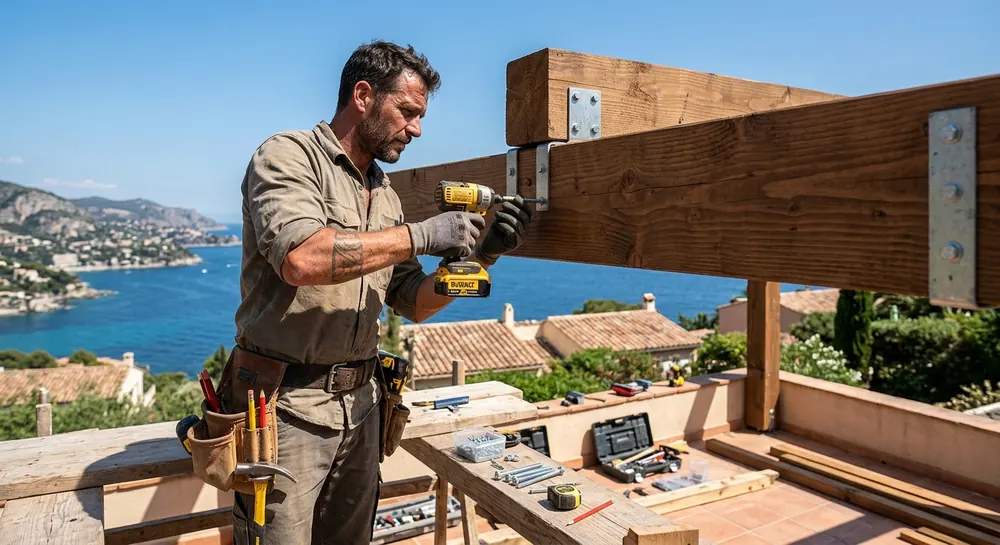
Wood, usually iroko or thermo-treated pine on this coast rather than exotic hardwoods that struggle with humidity swings, gives you that warmth and pairs beautifully with the stone terraces common in Vence and the Antibes old town. But wood on a coastal terrace is a genuine commitment: expect to revarnish or oil the structure every 18 to 24 months, budget 550 to 750 euros per square meter for the initial build with a bioclimatic aluminum slat insert (pure wood slats rarely rotate cleanly enough for true bioclimatic function), and accept that within a decade you will likely be replacing some structural members exposed to driving rain. I generally steer clients within 300 meters of the sea toward aluminum frames with wood-clad uprights as a compromise: you get the warm look where it is seen, and the corrosion-proof structure where it actually matters.
Wind Load and Salt Air: The Two Things Catalog Specs Get Wrong
The mistral and the occasional levant gusting through the Var valley are not decorative weather events; they are structural design inputs. Nice sits in wind zone 2 under the Eurocode classification, and anything installed within a kilometer of the water, particularly on exposed terraces in Cap Ferrat, Villefranche or the hills above Beaulieu, should be specced to withstand gusts of at least 130 km/h without the slats fluttering loose or the legs racking. Cheap imported pergolas sold through big-box stores are frequently tested to inland French standards and simply were not engineered for a terrace catching wind straight off the Mediterranean. Ask any installer for the wind resistance certification and the anchoring detail before signing, not after delivery: proper anchoring here means chemical-anchored bolts into the slab or a reinforced concrete footing, never surface-mounted brackets on pavers.
Salt air is the quieter enemy and the one that shows up eighteen months later as pitting on cheap fixings. Genuine marine-grade hardware means stainless steel A4 (316 grade) bolts and screws, not the A2 grade that is fine forty kilometers inland but will rust-stain your terrace within two seasons on the coast. The aluminum profile itself should carry a corrosion resistance rating suited to C4 or C5 marine environments, and the anodizing or powder coating needs to be a genuine 60 to 80 micron thickness, not the thin 25 micron coating some budget suppliers use to hit a lower price point. I have seen supposedly identical pergolas from two different suppliers age completely differently on the same street in Cagnes-sur-Mer within three years, purely because one used marine-spec fixings and the other did not. It is the single detail worth paying an extra 10 to 15 percent for.
Permits and Rules in Nice: What You Actually Need to File
Most bioclimatic pergolas fall under a déclaration préalable de travaux rather than a full building permit, but the threshold matters and the Nice mairie applies it strictly. A freestanding or attached pergola under 20 square meters of footprint generally needs only the declaration, filed at the Direction du Développement Urbain on Boulevard Jean Jaurès or through the online portal, with a typical processing time of one month if the file is complete. Anything over 20 square meters, or a structure that effectively creates enclosed living space once side panels or glass are added, tips into permis de construire territory and can take two to three months to clear, longer if the property sits within a zone requiring additional review.
The real complication on the Riviera is the number of protected zones layered over ordinary residential areas. Terraces in Vieux Nice, parts of Cimiez, and most of the historic centers of Antibes or Villefranche fall under Architecte des Bâtiments de France oversight, which means color, material and even slat orientation can be subject to ABF approval on top of the standard municipal review, sometimes adding six to eight weeks and occasionally forcing a redesign away from anodized aluminum toward a more discreet RAL finish. Coastal properties within the bande littorale also need to check PLU rules on maximum height and distance from boundary lines, since a pergola that reads as an extension of the house can trigger different setback rules than a simple garden structure. My standing advice is to call the urbanisme department before ordering the pergola, not after, because a rejected declaration after the aluminum has been fabricated to custom dimensions is an expensive mistake I have watched two clients make.
Budgeting the Real Cost, Nice to Monaco
For a standard 4x4 meter freestanding bioclimatic aluminum pergola with motorized slats, integrated rain sensor and basic LED lighting, expect a fully installed price between 8,000 and 13,000 euros in the Nice area, depending on the profile brand, whether you add retractable screens on the sides, and site access difficulty. Terraces on steep hillside properties around Èze or Roquebrune where a crane or manual carrying is needed can add 800 to 1,500 euros just for logistics, which surprises a lot of first-time clients who priced the job from a flat mainland reference. Wood-hybrid structures and larger 6x4 or custom L-shaped configurations for wraparound terraces common in Cap d'Antibes villas push the total into the 18,000 to 28,000 euro range once you factor bespoke fabrication and higher-grade marine fixings.
On top of the structure itself, budget separately for the declaration filing if you use an architect or draftsperson to prepare drawings, typically 400 to 900 euros, plus electrical connection for motorization which an electrician will usually quote at 350 to 700 euros depending on how far the terrace sits from the existing panel. I always recommend getting at least three quotes from installers who can show completed projects specifically on the coast rather than inland showroom examples, and asking pointedly about the fixing grade and wind certification discussed above, since that single line item is where the cheap quotes and the durable ones diverge. A pergola that costs 20 percent less upfront but needs fixing replacement or slat realignment within four years because of salt corrosion ends up the more expensive choice by year six or seven.
Frequently asked questions
Most projects under 20 square meters only require a déclaration préalable filed with the Nice mairie, processed in about a month. Larger structures, or terraces in protected zones like Vieux Nice, may need a full permis de construire and ABF approval, which adds several weeks.
Aluminum with marine-grade A4 stainless fixings and a thick powder coating handles salt air and wind with far less maintenance than wood, which needs re-oiling every 18 to 24 months. Many Riviera installers now use aluminum-framed structures with wood cladding on visible uprights as a practical middle ground.
A standard 4x4 meter motorized aluminum pergola typically costs 8,000 to 13,000 euros fully installed in Nice, rising to 18,000 to 28,000 euros for larger custom or wood-hybrid configurations on hillside or wraparound terraces.