
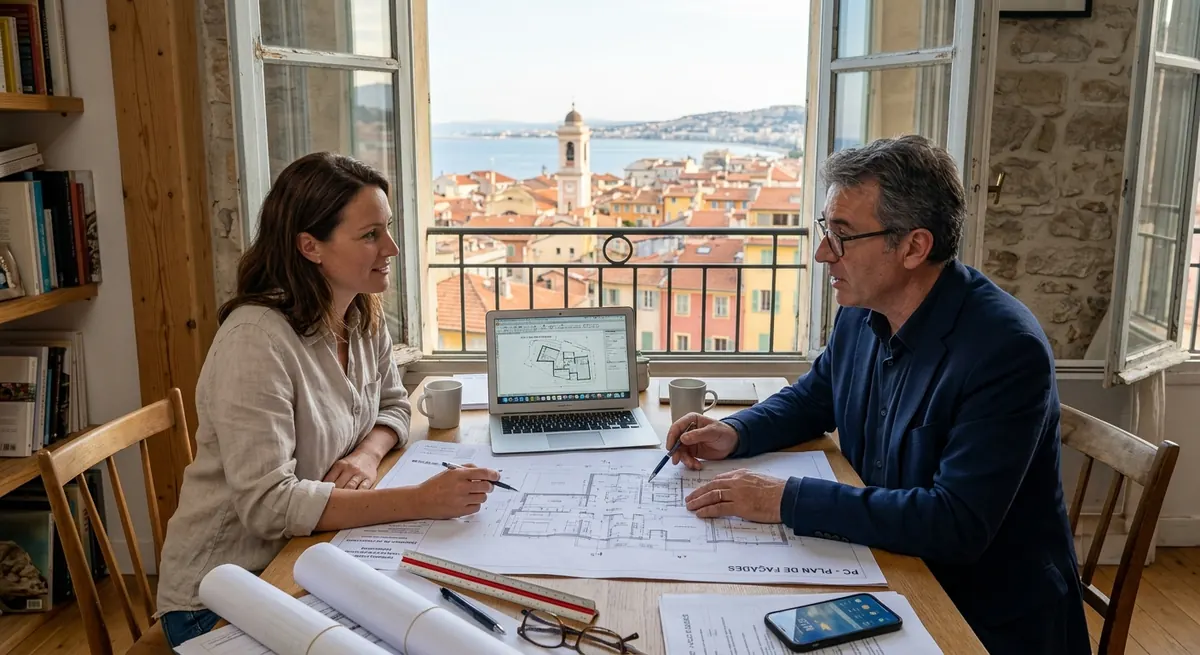
Why the French Permit System Catches Foreign Owners Off Guard
Most foreign buyers I meet in Nice assume that because they own the property outright, they can renovate it as they please. That assumption costs people real money every year. France separates ownership rights from building rights, and the local PLU (Plan Local d'Urbanisme) at the Service de l'Urbanisme on Rue Delfino governs almost everything visible from the street or affecting the building's volume, even on private property you fully own. A British client who bought a three-bedroom apartment near Place Masséna in 2023 learned this the hard way when he swapped his shutters for a different color without checking the règlement local, then had to repaint them at his own cost eighteen months later after a neighbor complaint triggered an inspection.
The confusion multiplies because Nice has several overlapping layers of control depending on the quartier. In secteurs like Vieux Nice, Cimiez, or parts of Mont Boron, you are also dealing with the Architecte des Bâtiments de France (ABF), whose approval sits on top of the standard municipal process and can add two to four months to any timeline. If your building is in a copropriété, which covers roughly 70% of residential property transactions in Nice, you also need syndic and general assembly approval before you can even file municipal paperwork for anything touching common walls, facades, or shared structures. Skipping any one of these three layers, town hall, ABF where applicable, and copropriété, is the single most common and most expensive mistake I see foreign owners make.
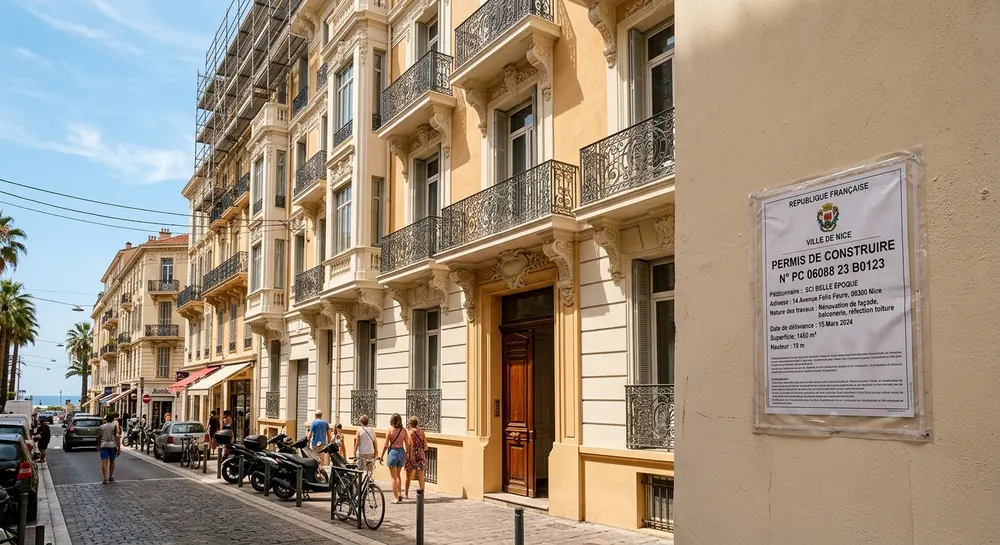
When You Need a Déclaration Préalable (and What It Actually Covers)
A déclaration préalable de travaux, or DP, is the lighter of the two permit types and covers a surprising range of everyday renovation work. Changing windows or shutters, repainting a facade in a different tone, installing a pergola or veranda under 20 square meters, adding a garden wall over 2 meters high, or creating a small extension between 5 and 20 square meters of floor area all fall under DP rather than a full permis de construire. In Nice specifically, any change to a facade visible from a public street, even something as simple as swapping wooden shutters for aluminum ones, requires this declaration because the city enforces strict harmonization rules in most residential zones, particularly along the Promenade des Anglais corridor and in Carré d'Or.
The process itself is not complicated once you understand it, but foreign owners often underestimate the documentation required. You will need a site plan, a floor plan showing before and after, an insertion photo showing how the change looks in context, and sometimes a simple architect's sketch, which typically costs between 400 and 900 euros if you hire a local draftsman rather than a full architect. The town hall has one month to respond, though in practice Nice's understaffed urbanisme office often takes closer to five or six weeks during peak season from March through September. Critically, silence after the deadline generally means tacit approval for a DP, but I always recommend requesting a certificat de non-opposition in writing before starting work, because without it you have no proof of approval if a dispute arises later, and disputes with neighbors over boundary walls or window changes are far more common in dense areas like Liberation or Riquier than people expect.
When You Need a Full Permis de Construire
A permis de construire (PC) becomes mandatory once you cross certain thresholds, and these thresholds trip up foreign owners renovating villas in Mont Boron or Fabron more often than apartment owners in the city center. Any extension creating more than 20 square meters of new floor area requires a PC, dropping to just 5 square meters if your property sits in a zone covered by a PLU with stricter local rules, which applies to several hillside sectors above Nice. Structural work that changes the destination of a building, converting a garage into a habitable studio for rental income, for instance, always requires a PC regardless of size, because you are changing the building's declared use, which affects everything from tax assessment to insurance. Swimming pools over 100 square meters of basin surface also require a full permit rather than a DP, and pools between 10 and 100 square meters still need at least a déclaration préalable, a distinction that catches out a lot of owners installing pools in gardens around Cap de Nice.
Beyond size thresholds, a PC is mandatory if your project changes the exterior appearance significantly, adds a floor, or touches load-bearing walls in a way that alters the building's silhouette. For any project creating more than 150 square meters of total floor surface, French law requires you to hire a registered architect, no exceptions, and this applies even if you personally have architectural training from another country, since French professional insurance and liability rules only recognize architects registered with the Ordre des Architectes. Budget realistically here: a full PC dossier prepared by a local architect in Nice typically runs 3,000 to 7,000 euros depending on project complexity, and the town hall then has two to three months to respond, extended by another month if ABF review applies. I have seen foreign owners budget for a six-week renovation only to discover their villa extension needs five months of pure administrative processing before a single wall comes down, so build that lag into your financing and rental-loss calculations from day one.
The Practical Filing Process, Step by Step
Start by pulling your certificat d'urbanisme from the town hall before you sign any renovation contract, which costs nothing and tells you definitively which zone your property sits in and what restrictions already apply. Next, if you are in a copropriété, get the syndic's minutes from the last three general assemblies, because any prior refusal of similar work by a neighbor sets a precedent that will likely apply to your request too. For anything touching facades, roofs, or shared structural elements, you need formal authorization voted at a general assembly before filing with the town hall, and missing this step is grounds for the mairie to reject your dossier outright or for a neighbor to file a legal challenge even after municipal approval, which happened to an American-owned apartment near the Nice port in 2023 when a bathroom extension onto a shared terrace got contested eight months after completion.
Once you have internal approvals sorted, submit your CERFA form (13703 for DP, 13406 for PC) either online through the national portail or in person at the Service Urbanisme, and always request a récépissé with a dated tracking number, since this is your only proof of the filing date that starts the legal response clock. During the review period, resist any temptation to start preparatory work like demolition or scaffolding installation, because inspectors do occasional site visits in central Nice and Cannes, and being caught working without a validated permit can mean a stop-work order plus fines starting around 1,200 euros per square meter of non-compliant construction, with cases in the Alpes-Maritimes reaching five figures for larger infractions. Once approved, post the permit panel visibly on-site within the legal window, because failure to display it properly resets the two-month period during which neighbors can legally contest your project, effectively doubling your exposure to a late challenge.
Costly Mistakes Foreign Owners Make and How to Avoid Them
The most expensive mistake by far is hiring an artisan or contractor who tells you a permit is not needed when it clearly is, usually because they want to start the job faster and avoid delays that cost them money. I have seen this exact scenario play out with a Scandinavian couple who added a 28-square-meter veranda in Saint-Sylvestre without any filing, only to be forced by the mairie eighteen months later to either demolish it entirely or file a retroactive permis de régularisation, which cost them 4,800 euros in architect fees plus a further 2,000 euros in fines, on top of the original construction cost. Always verify permit requirements independently through the town hall or a local architect rather than relying solely on your contractor's assurance, even when that contractor comes highly recommended by other expatriates in the area.
The second recurring error is underestimating how strictly Nice enforces facade and roofline consistency in historic and coastal zones, an issue that barely exists in many other countries and therefore doesn't occur to foreign owners as something worth checking. Changing roof tile color, adding rooftop terraces visible from the street, or installing air conditioning units on street-facing facades without prior authorization are all violations I encounter regularly, and retrofitting compliance after the fact, removing an already-installed unit and relocating it to a rear facade, typically costs 1,500 to 3,000 euros more than doing it correctly the first time. Finally, always factor a genuine six-to-nine-month runway into any renovation involving structural change or extension in Nice, especially if ABF review applies, because rushing the permit process to meet a rental season deadline or resale timeline is exactly how owners end up cutting corners that surface as legal and financial problems years later.
Frequently asked questions
Generally no, purely interior work like new flooring, kitchen renovation, or non-structural wall removal does not require a déclaration préalable or permis de construire. However, if your building is in a copropriété, you still need syndic approval for anything touching shared plumbing, electrical risers, or load-bearing walls, and structural changes always require a structural engineer's report regardless of visibility from outside.
Budget one to two months for a straightforward déclaration préalable and three to five months for a permis de construire, adding another one to two months if your property falls under Architecte des Bâtiments de France review, which applies in Vieux Nice, Cimiez, and several coastal sectors. Delays are common during the March-to-September peak season, so filing in autumn or winter often moves faster.
The town hall can issue a stop-work order, require demolition of non-compliant work, or demand a retroactive permis de régularisation, which involves added architect fees typically between 2,000 and 6,000 euros plus fines that can exceed 1,200 euros per square meter of unauthorized construction. Unpermitted work also creates serious problems at resale, since notaires routinely request permit documentation before finalizing a sale.