
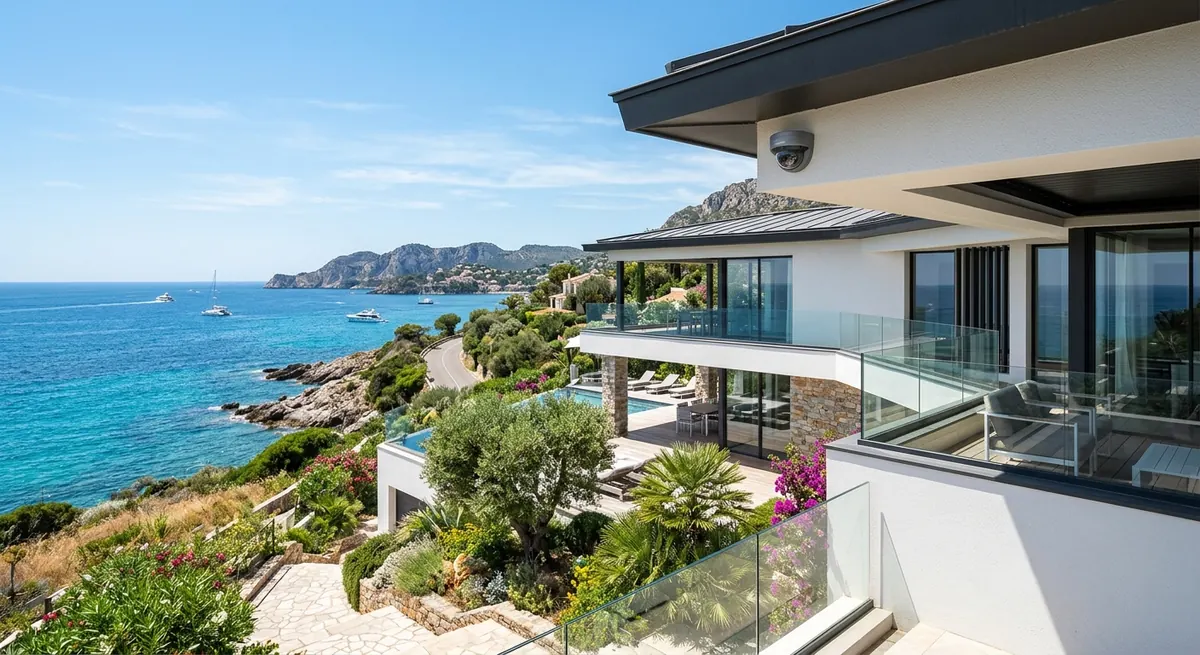
Why a Nice or Antibes villa needs a different approach than a Paris apartment
I have walked onto more than one property in Cap Ferrat or Villefranche-sur-Mer where the previous CCTV installation, bought off a generic e-commerce site and fitted by a handyman, had turned into a rusted, non-functioning eyesore within eighteen months. The combination of salt-laden sea breeze, UV exposure nine months a year and the humidity that settles into coastal gardens overnight is brutal on standard consumer electronics. A camera rated for a suburban house in Lyon simply was not built for a terrace fifty metres from the Mediterranean, and the owners had been paying for a false sense of security the whole time.
On top of the climate problem, there is a legal layer that catches out almost every newcomer to the region, including plenty of French buyers from inland who assume CCTV is purely a technical decision. Villas here often sit close to neighbouring properties, shared driveways, or public footpaths along the corniche, and French law is genuinely strict about what a camera is allowed to see. Get the placement or the paperwork wrong and you are not just risking a fine from the CNIL, you are risking a neighbour dispute that can drag through the local tribunal judiciaire for a year, something I have seen happen twice in the Cannes hills over disagreements about a camera angle.
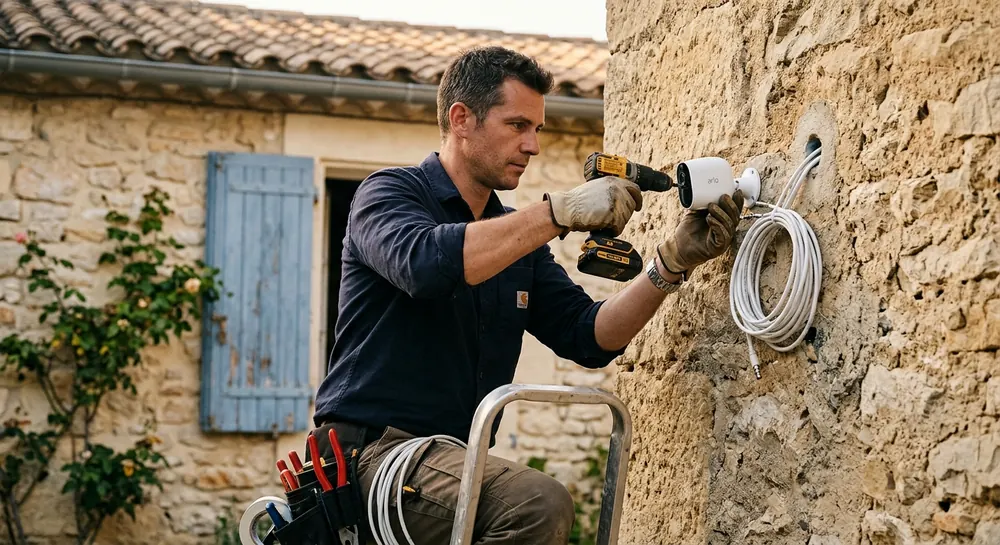
Choosing hardware that survives salt air: materials, specs and realistic prices
For anything within two kilometres of the coast, I now specify nothing below IP66 and, ideally, IP67 or IP68 for units mounted low or near sprinklers. Housing material matters more than the brand name printed on the box: marine-grade aluminium or 316 stainless steel housings resist pitting corrosion far better than the painted zinc-alloy bodies found on budget cameras, which start bubbling and flaking within a season on a Cap d'Antibes terrace. Expect to pay between 180€ and 450€ per camera for a genuinely marine-rated model from brands like Hikvision's corrosion-resistant line, Axis, or Dahua's coastal series, versus 60€ to 120€ for the consumer units that will not last.
A full system for a mid-sized villa, say eight to twelve cameras covering gates, pool area, driveway and perimeter, typically runs 3,500€ to 9,000€ installed, including a network video recorder with at least 4TB of storage, rated between 600€ and 1,800€ depending on channel count and AI analytics such as line-crossing or vehicle detection. I always add cable glands and conformal-coated connectors at every junction box; it adds maybe 150€ to 300€ to the bill but prevents the green corrosion on contacts that causes half the service calls I get in Juan-les-Pins and Golfe-Juan every spring. Solar-powered wireless units have improved a lot and now cost 250€ to 500€ per camera, useful on a Super Cannes property where trenching cable to a remote gate would add another 1,000€ in groundwork.
Placement strategy: covering what matters without creating blind spots
Start with the three zones that actually deter and document intrusions: the main gate and any secondary pedestrian access, the perimeter wall where it is lowest or adjacent to vegetation, and the pool or terrace area that is visible from the water side in villas along the Basse Corniche. In Monaco and Beausoleil, where plots are tiny and vertical, I often mount compact bullet cameras under eaves at 2.8 to 3.2 metres, angled to capture faces at the gate rather than just the tops of heads, a mistake I see constantly on DIY jobs where the camera ends up pointed almost straight down for cable-routing convenience.
The real skill is in eliminating blind spots created by the villa's own architecture: pergolas, palm trees that grow noticeably in a single Riviera summer, and pool houses all shift sightlines over time, so I schedule a placement review for clients after the first growing season, usually at no extra cost if it was part of the original contract. For larger domaines near Mougins or in the hills above Grasse, a combination of fixed cameras at chokepoints and one or two PTZ (pan-tilt-zoom) units covering open lawn works better than a dozen fixed cameras trying to cover the same ground; a decent outdoor PTZ runs 500€ to 1,200€ but replaces three or four static units and their separate cable runs.
Staying on the right side of French privacy law and the CNIL
French law draws a firm line between filming your own private property, which requires no declaration at all, and filming anything beyond your boundary, including the street, a shared driveway, or a neighbour's garden, which is heavily restricted and can expose you to real penalties from the CNIL as well as civil claims for invasion of privacy. The rule I give every client on the Riviera is simple: if a camera's field of view includes even a sliver of the public road or the neighbour's terrace, either mask that zone digitally in the camera settings (most NVR software from Hikvision or Dahua allows privacy masking in a few clicks) or physically reposition the unit. I have had to retroactively mask footage zones for clients in Cagnes-sur-Mer and Antibes after a neighbour complained, and it is far cheaper to get this right during installation than to argue about it afterward.
If your cameras only cover your own enclosed property, there is no formal declaration needed for a private home, unlike commercial premises which must notify the CNIL and sometimes the local prefecture. You should still post a small, visible notice at the entrance stating that the property is under video surveillance, required even for private use once footage could reasonably capture visitors or tradespeople, and you must limit recording retention to a reasonable period, generally accepted as thirty days unless there is an ongoing investigation. Keep a simple written note of who can access the footage and for what purpose; it sounds bureaucratic for a private villa, but if there is ever a break-in and you need to hand footage to the gendarmerie in Grasse or Nice, having that basic documentation makes the process far smoother and protects you from liability questions later.
Working with local installers, maintenance contracts and realistic timelines
On the Riviera, I steer clients toward installers who already service coastal properties rather than generalists from further inland, because the former know to use dielectric grease on connections, route cable away from salt spray paths, and schedule a first maintenance visit within six months rather than waiting a full year. A straightforward villa installation, eight to ten cameras plus NVR and basic network configuration, usually takes two full working days for a two-person crew, pricing labour at roughly 150€ to 220€ per camera depending on cable runs and whether trenching or wall-chasing is needed. More complex properties in Monaco or on gated domaines in Mougins, with long driveways and multiple structures, can run four to six days and push total project cost toward 10,000€ to 18,000€ once gate integration and intercom tie-ins are included.
Because salt corrosion is cumulative rather than sudden, I recommend a maintenance contract from the outset rather than waiting for a camera to fail: expect 300€ to 650€ per year for a villa system, covering lens cleaning, connector inspection, firmware updates and a physical check of housing seals twice annually. This is not padding the invoice, it genuinely extends hardware life from an average of three years for an unmaintained coastal installation to seven or eight years with proper care, which on a 6,000€ system works out far cheaper over a decade. If you are buying a villa that already has CCTV installed, budget an inspection before closing; I have found systems in Cap Ferrat properties that looked fine on camera footage but had corroded mounting brackets one strong mistral away from dropping a unit onto the terrace below.
Frequently asked questions
No formal CNIL declaration is required for a private home where cameras only cover your own enclosed property. You do need visible signage informing visitors of surveillance, and you must avoid filming public roads or neighbouring land unless that footage is masked in the recording software.
Generally no. French law restricts filming anything beyond your own property boundary, including shared driveways, public footpaths and a neighbour's terrace. Use privacy masking in the camera or NVR settings, or physically reangle the unit, to stay compliant and avoid disputes.
For properties within a couple of kilometres of the coast, schedule maintenance twice a year rather than the standard annual visit inland. Salt-air corrosion attacks seals, connectors and mounting brackets well before the camera lens itself shows any visible damage.