
Why Nice's Century-Old Screeds Crack and Sag in the First Place
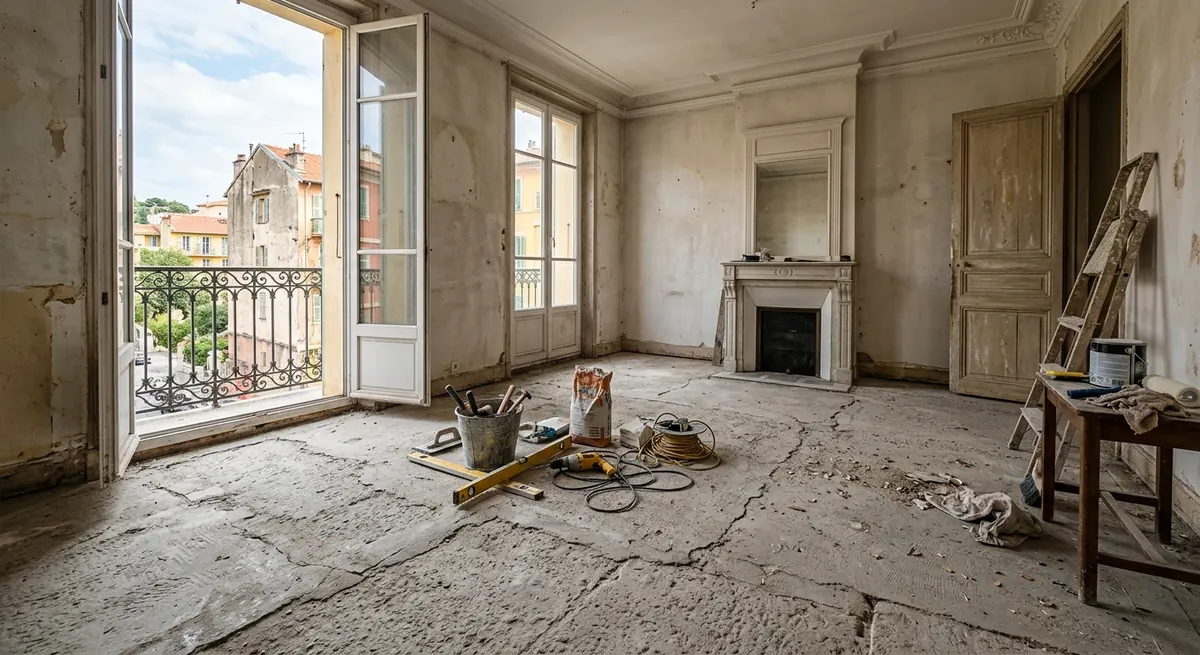
Walk into almost any building in Vieux Nice, the Carré d'Or, or the lower streets of Cimiez built between 1880 and 1930, and you will find the same construction logic: timber or metal joists (solives), a layer of hourdis or rubble infill, and a thin lime-and-sand or early cement screed poured directly on top, often no more than 3 to 4 centimetres thick. This was never designed to carry modern loads like heavy porcelain tiles, underfloor heating, or a cast-iron bathtub. Over a century, seasonal humidity swings coming off the Baie des Anges, salt-laden air, and the sheer number of renovations layered one on top of another have left these screeds brittle, hollow in places, and often cracked along the joist lines where movement concentrates.
Add to that the reality of Nice's soil and seismic microzone status — this part of the Alpes-Maritimes sees regular small tremors and the ground itself shifts slightly with the water table near the Paillon river bed — and you understand why so many apartments between Rue de la Préfecture and Boulevard Dubouchage show diagonal cracking patterns rather than simple straight lines. I have opened up floors in Antibes' old town and in Monaco's Le Rocher district with the exact same symptoms: a screed that sounds hollow under a hammer tap, a visible dip of 1.5 to 3 centimetres over two metres, and old patch repairs from the 1970s using incompatible cement that has since debonded. None of this is unusual for buildings of this age, but it does mean you cannot simply glue new tiles over what is there and hope for the best.
Diagnosing the Real Problem Before You Call Anyone
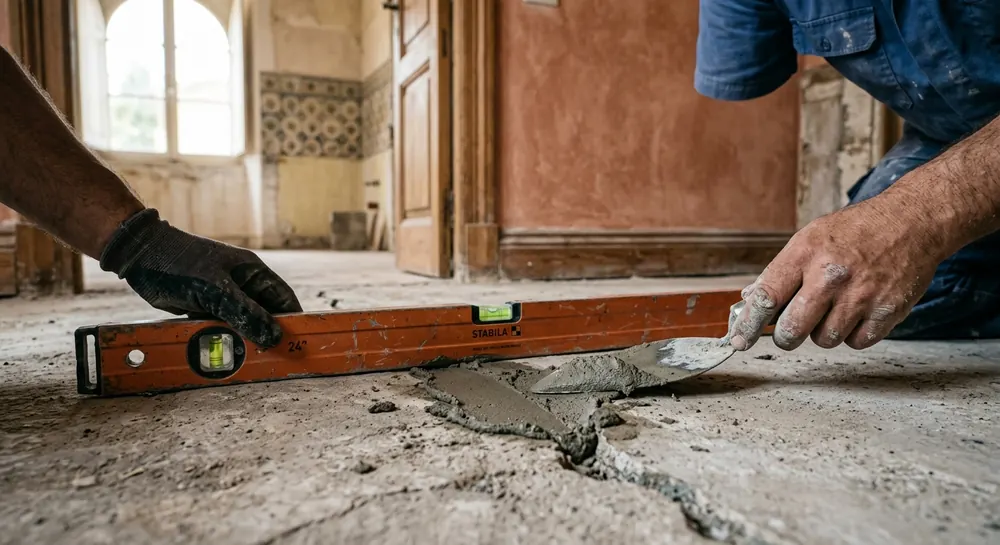
The first test costs nothing: a hammer or the back of a screwdriver handle, tapped every 40 to 50 centimetres across the whole floor surface, listening for a change from a solid thud to a hollow, drum-like sound. Mark every hollow zone with chalk. In a typical 60 square metre Nice apartment I would expect to find between 15 and 30 percent of the surface delaminated in buildings that have never been touched structurally, and closer to 40 percent in apartments near Place Garibaldi where old tram vibrations and decades of foot traffic have done extra damage. Next, use a 2-metre aluminium level or straightedge laid in several directions — diagonally is important, not just parallel to the walls — to measure dips and humps. Anything beyond 5 millimetres under a 2-metre rule is generally considered out of tolerance for tile or engineered wood installation without correction.
Beyond the visual and acoustic checks, a moisture meter is worth the 80 to 150 euros it costs to rent or buy, because ground-floor and rez-de-jardin apartments in areas like the Port area or along the old riverbed of the Paillon frequently show residual dampness from rising capillary moisture, especially if the original tomettes were laid on a lime bed rather than a proper damp-proof membrane. A reading above 4.5 percent CM (calcium carbide method) means you have a moisture problem to solve before any repair, not just a flatness problem — otherwise you will trap humidity under a new resin or self-levelling compound and cause blistering within a year or two. If you are not confident doing these checks yourself, a local artisan chapiste or a bureau d'études like those operating out of Nice or Cannes will do a full diagnostic report for 250 to 450 euros, and honestly, for a purchase of this importance, that money is well spent before you commit to a full flooring budget.
Repair Techniques That Actually Work on Old Nice Screeds
For hollow but not badly cracked zones, resin injection is usually the first line of defense — a two-component epoxy or polyurethane resin injected through small drilled holes to rebond the screed to its substrate. This runs roughly 25 to 45 euros per square metre depending on how many injection points are needed, and it is far less invasive than demolition, which matters in older buildings where you want to avoid disturbing party walls or shared joists that belong to the copropriété. For cracks wider than 2 millimetres that show active movement — check by placing a strip of masking tape across the crack and coming back in two weeks — the crack needs to be routed out into a V-groove, cleaned, and filled with a flexible polyurethane sealant before any resurfacing, otherwise it will telegraph straight through your new tile joints within a season.
Where the unevenness is more than about 15 millimetres over the room, which is common in apartments that have had partial screeds redone over the decades, a self-levelling compound (ragréage) is the standard fix, applied in one or two passes depending on thickness, at 12 to 20 euros per square metre for materials and labour combined for a competent artisan working in central Nice. For genuinely bad cases — I have seen this in a few Belle Époque buildings near the Promenade des Anglais where the original screed had essentially disintegrated — full removal and a new fibre-reinforced screed poured at 5 to 7 centimetres is the only honest answer, and that moves the budget to 45 to 70 euros per square metre including debris removal, which in Nice's historic centre often needs to go out through a window via a small crane or monte-charge because the stairwells are too narrow, adding another 300 to 600 euros depending on floor level and street access restrictions in the Vieux Nice pedestrian zone.
Budgeting Realistically for a Full Apartment and Sequencing the Work
For a typical 55 to 70 square metre apartment in Nice — say in the Libération neighbourhood or just off Avenue Jean Médecin — a full screed diagnostic and repair campaign combining localized resin injection, crack treatment, and self-levelling compound across the whole floor generally lands between 3,500 and 7,500 euros, before any new floor covering goes down. If you are unlucky enough to need a full screed replacement in one or two rooms, add another 2,000 to 4,000 euros for those specific areas. Compare that to the cost of skipping this step: I have seen owners lay 80 euro-per-square-metre Italian porcelain tile directly over an untreated cracked screed, only to have hairline cracks reappear in the grout lines within 18 months, forcing a full tear-out and redo that cost nearly double the original job.
Sequencing matters as much as budget. Always complete screed repair and let self-levelling compound cure fully — a minimum of 7 to 10 days for standard compounds, longer in humid ground-floor apartments — before ordering your final floor covering, because moving dates around based on an optimistic drying schedule is one of the most common mistakes I see with owners managing renovations remotely from London, Geneva, or further afield. If you are installing engineered oak or underfloor heating, budget an extra week for a compatibility test and a proper heating cycle protocol (chauffe de dalle) before the finish floor goes down, since Riviera buildings with south-facing rooms along the coast heat up and expand differently than interior rooms, and rushing this step is exactly how new parquet ends up cupping by the following summer.
Frequently asked questions
If hollow zones from tapping cover more than roughly 10 to 15 percent of the floor, or if any crack is wider than 2 millimetres and still moving when tested with tape over two weeks, get a professional diagnostic. Below that, localized resin injection you organize yourself with a competent artisan is often sufficient.
Yes, once the compound has cured fully, generally 7 to 10 days for standard products and longer in humid ground-floor units, and once a moisture reading confirms the screed is below about 4.5 percent CM. Skipping the cure time is the single most common cause of failed floors in historic buildings here.
For a standard 55 to 70 square metre apartment, expect 3,500 to 7,500 euros for a full repair campaign combining crack treatment, resin injection, and self-levelling compound, rising to 8,000 to 11,000 euros if one or more rooms need full screed replacement.