
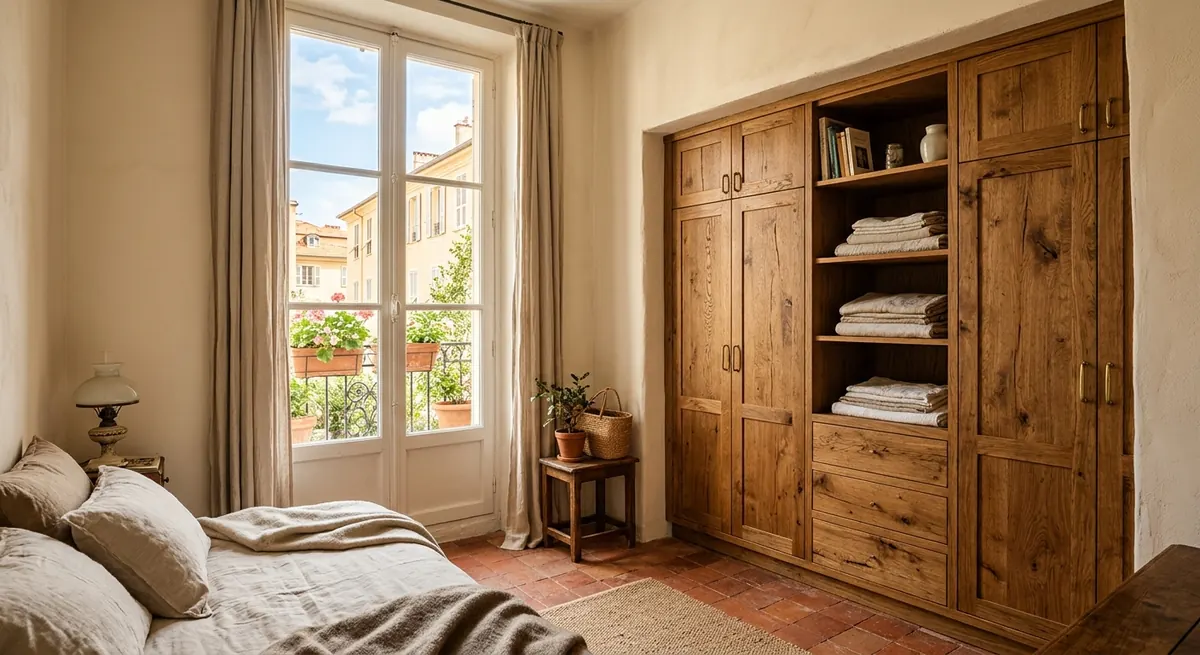
Why Belle Époque Apartments in Nice Fight Their Own Walls
I have opened up more cupboards in Vieux Nice and the Carré d'Or than I can count, and the pattern repeats: a beautiful 1895 stone building, 55 to 65 centimeter thick exterior walls, lime-based render instead of modern plaster, and almost zero mechanical ventilation. Walk three streets back from the Promenade des Anglais or down toward the Port, and you are often within 400 meters of the sea. Salt-laden air gets pulled into these old masonry walls by capillary action, and on a ground floor or first floor apartment without a proper damp course, I routinely measure 68 to 78 percent relative humidity against the party wall in winter, even when the living room itself reads a comfortable 55 percent on a hygrometer sitting on the coffee table.
That gap between the room air and the wall surface is exactly where built-in storage gets into trouble. A wardrobe built flush against a cold, slightly damp stone wall creates a dead air pocket with no circulation, and within eighteen months you will see grey-black mottling on the back panel, swollen chipboard shelves, and a musty smell that no amount of febreze fixes. I have torn out IKEA-style melamine units installed by well-meaning owners in Cimiez and in the older blocks near Liberation that looked structurally fine on the outside but had disintegrated from the back forward. The fix is not complicated, but it has to be designed in from day one rather than bolted on as an afterthought.
Choosing Wood That Actually Survives the Riviera Damp
Forget standard particleboard and raw MDF for anything touching or facing an exterior wall in these buildings — it swells, delaminates at the edges, and loses screw-holding strength within two or three humid winters. What I specify instead for carcasses and backs is marine-grade okoumé plywood, locally available through suppliers around the Nice and Antibes industrial zones for roughly 45 to 65 euros per square meter at 18mm thickness. It uses a phenolic glue line that shrugs off the kind of cyclical dampness you get from a mistral-driven rain event followed by three dry, sunny days. For visible fronts and shelving edges where you want a warmer look, châtaignier (chestnut) is the regional favorite: it is naturally rich in tannins that resist rot and insects, it machines beautifully, and a solid chestnut door front runs around 180 to 260 euros per square meter supply-only, finished with a breathable oil rather than a sealed varnish.
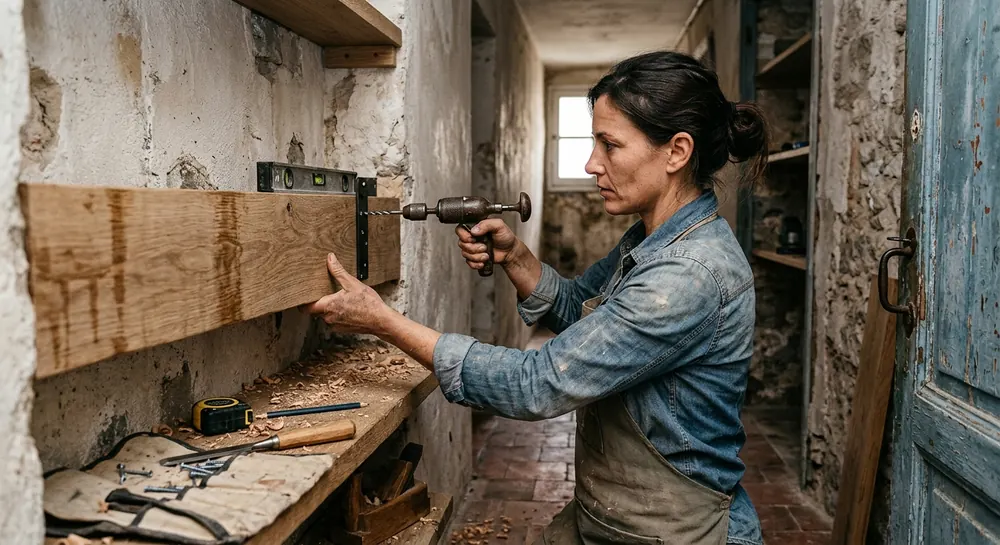
Red cedar and thermally-treated pine are the other two options I reach for, particularly for shelving that sits inside a dressing room carved out of a former maid's room or chambre de bonne, a very common conversion in these apartments. Thermo-treated pine, heated to around 180 to 212 degrees in a kiln without any chemical additive, loses most of its hygroscopic swelling behavior and costs maybe 20 percent more than standard pine but a third less than cedar — a good middle ground around 35 to 50 euros per linear meter for 20x200mm boards. What you absolutely want to avoid, whatever species you choose, is a fully sealed polyurethane varnish on both faces of the wood. That traps moisture inside the timber the moment any gets in, and it will eventually bubble and crack. A penetrating oil or a hard wax oil lets the wood breathe in both directions, which matters enormously fifty centimeters from a stone wall that is still partially wicking seawater up from the foundations a century after it was built.
Joinery Details That Actually Stop Mold Before It Starts
The single most useful trick I use on every built-in against an exterior or party wall in Nice is a simple air gap: rather than screwing the back panel directly to the masonry, I mount the whole unit on a French cleat system set 18 to 22mm proud of the wall, with the back panel itself perforated or left as a slatted rather than solid surface over at least 30 percent of its area. This lets the stale, humid air trapped behind the cabinet mix with the room air instead of sitting stagnant against cold stone. Combine that with a raised plinth — I build mine at 80 to 100mm with discreet ventilation slots cut into the kick panel — and you get a genuine chimney effect of slow air movement from bottom to top that keeps the dew point from ever forming directly on the wood.
Hardware matters just as much as the timber. Standard zinc-plated hinges and drawer runners corrode within two to three years in these conditions; I now specify stainless steel or nickel-plated fittings exclusively, which costs maybe 15 to 20 euros more per door but saves a service call down the line. For sliding wardrobe doors, which I prefer in narrow Nice corridors anyway, look for track systems rated for humid environments — Häfele and Hettich both make versions with corrosion-resistant coatings that run about 25 to 35 percent above the standard line but are worth every cent. One more detail that clients rarely think about: never caulk the entire perimeter of a built-in with silicone. Leave the top few centimeters, right under the cornice, as an open joint. That single gap is often what separates a wardrobe that stays dry for fifteen years from one that needs stripping out after five.
Space-Saving Layouts That Work in 25 to 45 Square Meter Rooms
Most of the apartments I work on in the Carré d'Or and around Cours Saleya have bedrooms between 10 and 14 square meters, sometimes with a sloped ceiling if you are up under the roof near Cimiez. The move that gains the most usable volume is building full height, floor to the underside of the cornice, rather than stopping at the standard 2.40m wardrobe height — that top 30 to 40cm band, accessed with a step stool, easily swallows seasonal items like suitcases and winter duvets and effectively adds 15 to 20 percent extra storage for almost no additional footprint. I also shave wardrobe depth down from the typical 60cm to 56 or 58cm wherever the room is tight; it sounds trivial, but in a 2.80m wide bedroom that reclaims enough floor space to fit a proper bedside table, and clothes on hangers do not actually need the full 60cm once you angle the hanging rail slightly or use slimline hangers.
Corners and awkward recesses around old chimney breasts, extremely common in these buildings since most rooms still have a redundant fireplace flue boxed into one wall, are where I build L-shaped or diagonal units with a mix of hanging space, open cubbies, and a pull-out ironing or laundry basket drawer. Sliding doors instead of hinged ones recover another 60 to 70cm of swing clearance in a small room, which in Nice pricing terms is often the difference between a layout that works and one that blocks the only door to the bathroom. For a full-height, full-width custom wardrobe built and installed on the Côte d'Azur in 2026, expect realistic pricing of 950 to 1,600 euros per linear meter depending on wood species, number of sliding doors, and internal fittings — a simple melamine-faced version with solid wood accents sits at the lower end, while all-chestnut with soft-close sliding gear and internal lighting pushes toward the top.
Finding the Right Menuisier and Keeping the Build Dry Long-Term
For this kind of work I always push clients toward a menuisier d'agencement rather than a generic handyman — someone who builds furniture-grade joinery on site or in a local atelier, which around Nice usually means a small workshop somewhere between Saint-Laurent-du-Var and Carros. Ask to see photos of a project at least three years old, specifically in an older building, and ask directly what wood and finish they used on the back panel against the wall; a serious craftsman will have an answer ready without hesitating. Built-in storage inside an apartment generally does not require copropriété authorization since it touches no shared structure or facade, but it is still worth mentioning the project at the next assemblée générale if you are opening up a chimney breast recess, since some older règlements have odd clauses about flue access.
Once it is installed, maintenance is refreshingly simple: keep a small hygrometer inside the wardrobe for the first year and check it monthly, aiming to stay under 65 percent; if it creeps higher, a 12-liter dehumidifier run a few hours a week in that room during the wettest winter months, costing maybe 90 to 150 euros to buy and a few euros a month to run, usually solves it without any structural intervention. Re-oil solid wood door fronts roughly every two to three years, a half-day job you can do yourself with 20 euros of hard wax oil and a lint-free cloth. Done this way, with the right species chosen up front and the air gap built into the carcass rather than added as an afterthought, a well-made built-in in a Nice Belle Époque apartment should comfortably outlast the original owner's mortgage, which is more than can be said for most flat-pack alternatives I have been called in to remove.
Frequently asked questions
Marine-grade okoumé plywood for the carcass and back panel, combined with solid chestnut or thermally-treated pine for visible fronts and shelves, gives the best balance of moisture resistance and cost. Avoid standard particleboard or raw MDF against any exterior-facing wall.
Expect 950 to 1,600 euros per linear meter installed for a full-height custom wardrobe, depending on wood species, number of sliding doors, and internal fittings like drawers or lighting. Simple melamine-and-wood combinations sit at the lower end of that range.
Yes, but only if you leave an 18 to 22mm ventilated air gap behind the unit using a French cleat mount, build a vented plinth at the base, and use a perforated rather than fully solid back panel so humid air can circulate instead of sitting trapped against the cold masonry.