
Why A2P certification matters more here than almost anywhere else in France
Insurers on the Cote d'Azur have gotten strict, and for good reason. Burglary rates in dense coastal towns like Nice, Cannes, and Antibes run well above the national average, particularly in ground-floor and first-floor apartments near the old town or the port. When I sit down with clients preparing a multirisque habitation contract with MAAF, AXA, or Groupama, the first question the insurer's checklist asks is whether the entrance door carries A2P certification from CNPP, the independent French testing body. Without it, some contracts simply refuse coverage above a certain declared value of contents, and I have seen claims reduced by 30 to 40 percent because the door in place was a standard hollow-core unit with a basic cylinder lock.
The A2P scale runs BP1, BP2, and BP3, corresponding to resistance times of 5, 10, and 15 minutes against a burglar using hand tools, then power tools at the top tier. For a rented studio in Nice's Liberation district, BP1 usually satisfies the insurer and the budget. For a family apartment in Cannes La Californie or a pied-a-terre in Monaco holding jewelry, art, or serious cash reserves, insurers increasingly ask for BP2 or BP3, and some will shave 10 to 20 percent off the annual premium once the certified door and matching A2P lock are documented with an installation certificate. Keep that certificate — the invoice alone rarely satisfies an adjuster after a break-in.
Salt air, humidity, and why a Paris-spec door fails on the coast within five years
A door engineered and tested inland doesn't automatically survive a Riviera balcony corridor. I've pulled apart entrance doors in Antibes and Villefranche-sur-Mer that were barely eight years old, where the galvanized steel core had started weeping rust through the paint at the hinge line, and where the multipoint lock mechanism had gone stiff from oxidized internals. Salt-laden air off the Mediterranean, combined with humidity that regularly sits above 75 percent from June through September, attacks unprotected steel and cheap zinc-plated hardware far faster than manufacturers' inland warranties assume. This is not a theoretical risk — it is the single most common callback I get on doors installed less than a decade ago in exposed coastal buildings.
The fix is specifying marine-grade components from day one rather than retrofitting later. Look for hinges and strike plates in 316L stainless steel, the same grade used on boat fittings, rather than the cheaper 304 grade that still pits near open water. Aluminum-clad doors with a powder-coated finish rated for C4 or C5 corrosion classes (the EN ISO 12944 marine exposure categories) hold up far better on exposed facades in Cap d'Antibes or along the Promenade des Anglais than raw steel doors, even certified ones. Ask your supplier directly for the corrosion class rating — most reputable brands like Fichet, Picard, and Bricard publish it, and if a quote doesn't mention it, that's a red flag worth pressing on before you sign.
What to actually buy: door types, brands, and realistic 2026 pricing
For a standard one- or two-bedroom apartment in central Nice, a BP1-certified steel security door with a 3-point lock and reinforced frame typically runs 1,800 to 2,600 euros installed, depending on width and whether the existing frame needs full replacement or just reinforcement. Step up to BP2 with a 5-point lock, anti-drill cylinder, and marine-treated hardware, and you're looking at 2,900 to 4,300 euros — this is the sweet spot most of my Cannes and Antibes clients land on, since it satisfies both insurer requirements and realistic burglary risk for a mid-range apartment. BP3 doors, built for high-value Monaco or Cap Ferrat properties with reinforced multi-lock systems and certified anti-ram frames, start around 4,800 euros and can climb past 7,500 euros once you add biometric access, a video peephole, and custom finishes matching a marble entrance hall.
Brand-wise, Fichet Bauche and Picard dominate the high-security segment on the Riviera, largely because their regional distributors in Nice and Sophia Antipolis stock parts and offer faster service callouts than doors imported from northern France or abroad. Bricard makes solid mid-range BP2 doors at a slightly lower price point, often 15 to 20 percent cheaper than equivalent Fichet models, which matters on a rental property where the returns need to make financial sense. Whatever brand you choose, insist on seeing the actual A2P certificate number for the specific door-and-lock combination, not just a general brand certification — insurers have started cross-checking this after a spate of disputed claims in Var and Alpes-Maritimes over the past couple of renewal cycles.
Installation realities: copropriété rules, lead times, and what installation day looks like
Before ordering anything, check your reglement de copropriete. Most Nice and Cannes buildings classify the entrance door facing the common corridor as part of the building's aesthetic envelope, which means the syndic — sometimes the full general assembly — must approve color, finish, and sometimes brand before you install. I've had projects delayed six weeks in a Cannes Croisette building simply because the syndic required matching the existing mahogany-effect finish across all units on the floor. Budget for this administrative step from the start; submitting photos and a technical spec sheet to the syndic manager two to three months ahead of your target date avoids scrambling later, especially since custom BP2/BP3 doors from Fichet or Picard often carry six-to-ten-week manufacturing lead times once ordered.
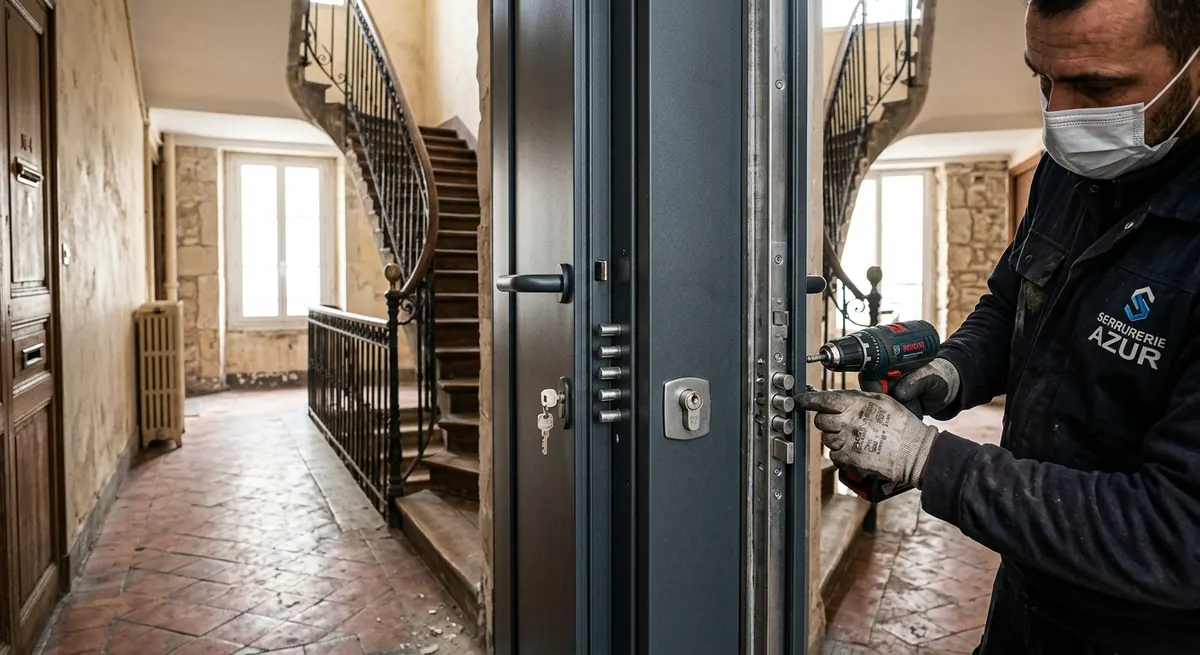
Installation itself, once the door arrives, is usually a half-day to full-day job for an experienced fitter — expect 4 to 7 hours depending on whether the existing frame is being reinforced or fully replaced. A good installer checks the wall structure first; older Nice buildings from the 1930s often have plaster-over-brick partitions that need additional anchoring plates to properly seat a heavy BP2 or BP3 frame, adding perhaps 200 to 400 euros to the quote but preventing the frame from working loose within a year or two. Always ask for the A2P installation certificate signed on the day, dated, and stamped by the installer — this single document is what your insurer will ask for if you ever need to file a burglary claim, and without it even a genuinely certified door can be treated as unverified.
Long-term maintenance to protect your investment and your insurance coverage
A2P doors are engineered to perform for decades, but only if the moving parts get attention in a salt-air environment. I recommend lubricating the multipoint lock mechanism and hinges twice a year with a marine-grade, non-acidic grease — standard household WD-40 style products actually attract grit and salt residue over time rather than repelling it, which accelerates wear on the very mechanisms you're relying on. Check the door seals every autumn before the rainy season hits Nice and the Var coast; a degraded seal doesn't just let in drafts, it lets in the humidity that eventually reaches the steel core from the inside, where you can't see it happening until the paint starts bubbling.
Keep every document tied to the door — the A2P certificate, the installation invoice, and any maintenance records — in a single folder, ideally scanned and stored digitally as well, since paper degrades fast in a humid coastal apartment. Insurers reviewing a claim after a break-in or attempted break-in will ask for this paperwork, and gaps in the record have genuinely cost clients partial claim denials even when the door itself performed exactly as certified. If you're ever unsure whether a decade-old door still meets current standards, a quick inspection by the original installer or a CNPP-approved technician, typically 80 to 150 euros for a service call in the Nice-Cannes-Antibes corridor, is far cheaper than discovering a coverage gap after the fact.
Frequently asked questions
There's no French law mandating A2P doors for every apartment, but most major insurers now require BP1 or higher certification to cover contents above roughly 15,000 to 20,000 euros in declared value, and many Riviera policies for higher-value coastal properties in Cannes or Monaco specify BP2 or BP3 explicitly in the contract terms.
The classifications reflect tested resistance time against forced entry: BP1 withstands roughly 5 minutes of hand-tool attack, BP2 around 10 minutes including some power tools, and BP3 about 15 minutes against sustained power-tool assault, with pricing and hardware complexity increasing accordingly.
Expect 1,800 to 2,600 euros installed for a BP1 door, 2,900 to 4,300 euros for BP2 with marine-grade hardware suited to coastal humidity, and 4,800 euros upward for BP3 doors used in high-value Monaco or Cap Ferrat properties.