
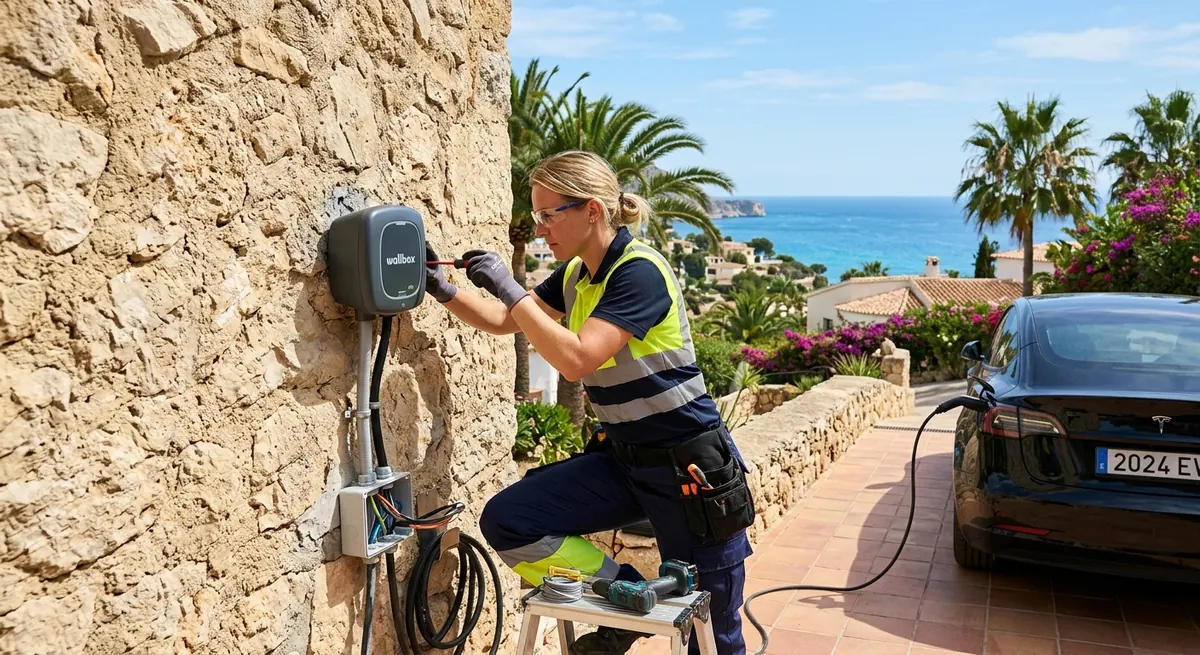
Why home charging makes sense on the Côte d'Azur
Public charging along the coast has improved but remains patchy and expensive during peak season, when tourist traffic clogs the fast chargers at Cannes' underground car parks or along the Promenade des Anglais. Villa owners in Mougins, Valbonne or Saint-Jean-Cap-Ferrat who bought an electric SUV quickly discover that relying on public infrastructure means queuing behind rental Teslas in July, or paying 0.55-0.70€/kWh at a motorway-adjacent fast charger versus roughly 0.20€/kWh charging overnight at home on an EDF Tempo or Heures Creuses contract. For anyone driving daily between Nice and Monaco for work, that difference adds up to hundreds of euros a year.
The region's housing stock adds its own wrinkles. A 1930s villa in Cimiez with an old electrical panel is a very different job from a modern apartment building in Antibes' Le Fort Carré neighborhood with an underground collective car park. Older Riviera properties frequently run on monophasé (single-phase) 6-9 kVA subscriptions never designed for anything beyond lighting and a washing machine, while newer builds near Sophia Antipolis often already have triphasé service. Understanding your starting point before calling an installer saves a wasted first quote and helps you budget realistically for what is, in most cases, a one-day job once the paperwork is sorted.
French regulations you cannot skip: IRVE, Consuel and the droit à la prise
Since 2017, any charging station rated above 3.7 kW must legally be installed by an electrician holding the IRVE qualification (Infrastructures de Recharge pour Véhicules Électriques) — insurers and Enedis will refuse to connect or cover an installation done otherwise, and I have seen at least two Cannes homeowners forced to redo work carried out by a generalist électricien who was not certified. Once installed, the system needs a Consuel green sticker (the same electrical safety certification used for new builds), which typically costs 130-180€ and involves an inspector checking earthing, differential protection (30mA type A or B depending on the charger), and cable sizing before Enedis will activate the meter for the new circuit.
For apartment owners, the droit à la prise (right to plug in), formalized by decree in 2011 and reinforced since, gives any resident with a private parking space the legal right to install a charger, even against a reluctant syndic — the copropriété can object only on genuine technical or safety grounds within three months, otherwise the request is tacitly approved. In practice, buildings around Cannes La Bocca or Nice Ariane increasingly prefer a collective pre-equipment solution, where the syndicat votes to install a shared electrical backbone with individual submeters, spreading costs and avoiding a patchwork of ad-hoc cables across the parking level. If you sit on a conseil syndical, pushing for this collective approach now saves every future EV-owning neighbor a separate, more expensive individual project.
Permits, historic zones and villa-specific constraints
Most indoor or garage-mounted home chargers need no planning permission at all — it is purely an electrical installation, not a construction project. Complications appear when the charger sits on an exterior wall visible from the street or in a secteur protégé, which covers much of Vieux Nice, the old town of Antibes, and parts of Cannes near Le Suquet. There, the Architectes des Bâtiments de France (ABF) can require a déclaration préalable de travaux if the charging point or its housing alters the facade, and processing typically takes one to two months through the mairie. I always recommend photographing the intended mounting location and sending it to the local urbanisme office before ordering equipment, since ABF preferences for cable routing and box color vary noticeably between Antibes and Nice.
Villa owners with detached garages or carports generally have an easier path, but properties in gated domaines around Cap d'Antibes or Mougins sometimes carry private covenants requiring approval from an association syndicale libre before any exterior electrical work, separate from municipal rules. Monaco itself operates under its own regulatory framework rather than French law, and the SMEG (Monaco's utility) has a distinct approval and metering process that surprises many Cap-d'Ail or Beausoleil residents who assume French rules apply just because the border is a few hundred meters away. Whatever the location, keep every document — Consuel certificate, Enedis connection confirmation, and any mairie correspondence — in the property file, since it becomes essential paperwork at resale and for home insurance claims.
What it actually costs in 2026
A straightforward 7 kW wallbox installation in a villa garage with an accessible panel typically runs 900-1,600€ all-in, including the IRVE labor, Consuel certification and a mid-range charger from Wallbox, Schneider or Legrand. Where the existing panel needs upgrading, or the run from panel to charger exceeds 15-20 meters (common in larger Mougins or Valbonne properties), expect 1,800-2,800€. An 11 kW triphasé installation, now the most requested option among owners of Renault Megane E-Tech, Peugeot e-3008 or Tesla Model 3 buyers wanting faster overnight charging, adds roughly 300-600€ over the monophasé equivalent, plus the cost of upgrading your Enedis subscription to a triphasé tariff if you do not already have one — typically 900-1,500€ through Enedis' raccordement service, with a wait of four to eight weeks for the intervention.
The Advenir program, still active in 2026 for individual and collective housing, covers up to 50% of equipment and installation costs for shared or workplace charging points, capped around 600€ per point for standard residential cases and higher for collective parking installations in copropriétés — well worth claiming through your installer, who usually handles the paperwork directly. Note that the national crédit d'impôt borne de recharge that ran through 2025 has now ended, so most individual villa owners installing a private charger in 2026 will rely on Advenir where eligible, or negotiate directly with EDF or Enedis for any local PACA regional incentives, which have varied year to year and are worth checking with your mairie's transition énergétique office before signing a quote.
Choosing the right charger power for your car and your panel
The instinct to buy the most powerful charger available is usually wrong for Riviera homes. A 7.4 kW monophasé charger fully replenishes a typical 50-60 kWh battery overnight in 7-9 hours, which comfortably covers anyone charging while asleep — genuinely the majority of Nice, Antibes and Cannes commuters. Stepping up to 11 kW or 22 kW triphasé only helps if your car's onboard charger can actually accept that power (many EVs cap AC charging at 11 kW regardless of what the wallbox delivers) and if your electrical subscription and panel can handle the draw without tripping the main breaker when the air conditioning and pool pump run simultaneously in August — a genuinely common scenario in villa properties with a Marina pool or spa installed.
Before choosing, check your car's onboard AC charger spec (Tesla Model 3 Standard tops out around 11 kW, some Zoe and older PHEVs cap at 7.4 kW or even 3.7 kW single-phase), and have your installer run a load calculation (bilan de puissance) factoring in existing appliances — this is standard IRVE practice and prevents the all-too-common problem of a disjoncteur tripping every time the charger and the four-plaque induction hob run together. For anyone also considering solar panels on a Grasse or Vence roof, ask specifically about chargers with dynamic load management or solar-surplus charging modes, since these let the wallbox automatically throttle down when household solar production dips, avoiding unnecessary grid draw and maximizing self-consumption — a feature increasingly requested by clients doing a combined rénovation énergétique and EV charger project in a single work order.
Frequently asked questions
In most cases no — installing a wallbox in a garage or on an interior wall is purely electrical work and needs no planning permission. You only need a déclaration préalable if the charger or its casing changes an exterior facade visible from the street, particularly in protected historic zones like Vieux Nice or old Antibes, where the ABF may review the request through the mairie.
Generally no. Under the droit à la prise, a syndic has three months to raise a genuine technical objection to an individual installation request; if they do not respond, approval is considered granted. Many buildings now prefer a collective pre-equipment project instead of individual installs, so it is worth raising the topic at the next assemblée générale.
A standard 7 kW installation typically costs 900-1,600€ including the IRVE-certified labor and Consuel certification, rising to 1,800-2,800€ if panel upgrades or long cable runs are needed. An 11 kW triphasé setup adds 300-600€ plus a possible 900-1,500€ Enedis subscription upgrade if you do not already have three-phase power.