
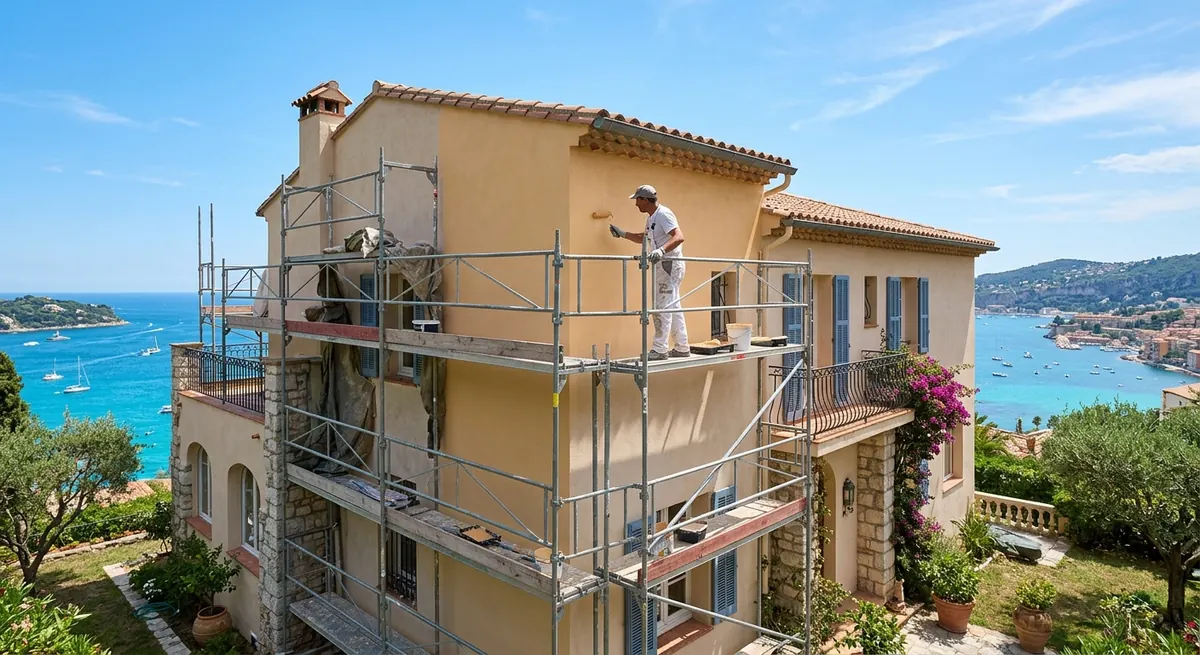
Why Riviera Facades Age Three Times Faster Than Inland Homes
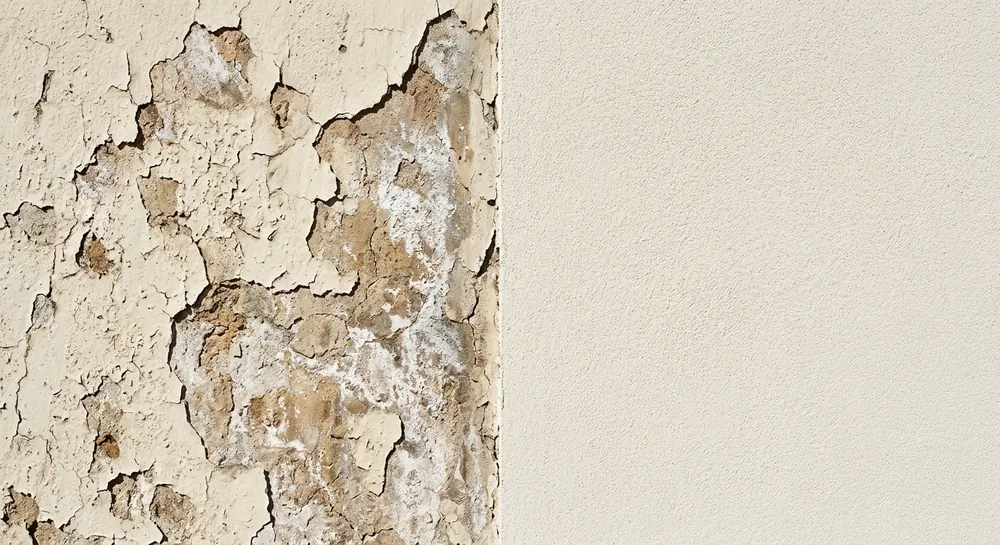
Drive along the Basse Corniche between Nice and Monaco and you will see it everywhere: chalking paint, hairline cracks fanning out from window corners, and that chalky white salt bloom called efflorescence creeping up from the base of walls. A standard acrylic facade paint rated for 10-12 years inland often starts failing within four to five years on a property facing the Baie des Anges or the open sea in Cap d'Antibes. The culprit is a triple assault: airborne chloride salts carried on sea spray penetrate microscopic pores in the render, UV exposure here runs roughly 2,700 hours of sunshine a year — among the highest in metropolitan France — and then the mistral or the easterly Levant winds drive that salty moisture sideways into every joint and crack at 80-100 km/h gusts.
I have opened up facades in Villefranche-sur-Mer where the original 1970s mortar had turned almost sandy to the touch, not from poor workmanship but from forty years of salt crystallisation cycles. Salt crystals expand and contract with humidity changes, and on a south or southeast-facing wall that gets both the spray and the sun, that cycle can repeat dozens of times a month. This is why a coating system that performs beautifully in Lyon or even inland Grasse can blister and peel within three winters on a seafront villa in Cannes. Understanding this mechanism is the first step to choosing a product that is built for it, rather than simply buying whatever the local hardware store in Saint-Laurent-du-Var has on the shelf.
Lime Render, Traditional Crépi, or Modern Siloxane Paint: Making the Right Choice
For genuinely historic Niçois or Provençal buildings — the ochre and pastel facades around Vieux Nice or the bastides above Mougins — a breathable lime-based render (enduit à la chaux) remains the gold standard. Lime is vapour-permeable, meaning trapped moisture and salt can migrate out through the wall rather than getting sealed in behind a rigid film, which is exactly what causes blistering with cheaper acrylics. A quality NHL 3.5 or NHL 5 lime render application runs about 55-85€ per m² installed, depending on finish texture (taloché, gratté, or lissé) and number of coats, and when properly maintained with a lime wash refresh every 6-8 years, it can last 25-30 years without major failure.
Traditional crépi — the textured mineral render so common on 1960s-1990s Riviera villas — is cheaper to apply (roughly 35-50€/m² for a full recoat) but needs the right topcoat to survive salt exposure; a standard acrylic crépi paint will chalk and fade within 5-6 years on an exposed facade in Antibes or Golfe-Juan. This is where siloxane (also called silicone) facade paints earn their premium: their water-repellent, breathable molecular structure sheds salt-laden moisture before it penetrates, while still letting the wall breathe. Expect to pay 45-70€/m² for a two-coat siloxane system from brands like Weber, Parex, or Zolpan's marine range, but on a genuinely sea-exposed wall in Beaulieu-sur-Mer or Saint-Jean-Cap-Ferrat, that investment typically buys 12-15 years before a full repaint is needed, versus 6-8 for standard acrylic — the math favours siloxane every time within five kilometres of the coastline.
Surface Preparation: Where Most Riviera Facade Jobs Actually Fail
I would estimate that eight out of ten premature facade paint failures I get called to diagnose trace back to inadequate preparation, not the product itself. On a salt-affected wall, the render must first be tested for residual chloride contamination — a simple conductivity test any decent applicator should run — because painting over salt-saturated masonry guarantees blistering within 18 months regardless of how good the paint is. Any render showing sandy, friable texture needs to be mechanically removed back to sound substrate, sometimes a full 2-3cm depth on badly affected ground-floor walls near Golfe-Juan or Villeneuve-Loubet where spray and splashback are constant. This demolition and re-rendering work alone can run 60-100€/m² before any paint is even considered, which is why cutting corners here is the single most common false economy I see owners fall into.
Once the substrate is sound, a proper cycle involves a high-pressure wash (not sandblasting, which damages lime and soft stone), a drying period of at least five to seven dry days — tricky to schedule between mistral spells and Riviera humidity — followed by a salt-blocking or stabilising primer on anything previously contaminated. Only then should the chosen system, whether lime wash or siloxane paint, go on in two coats minimum, with the second coat applied perpendicular to the first for even coverage. On a typical 180m² villa facade in the Cannes backcountry, this full preparation-to-finish cycle takes a competent three-person crew 10-14 working days, and rushing it to save two or three days is exactly how I end up getting called back eighteen months later to fix bubbling paint that should have lasted a decade.
Real Costs and Maintenance Schedules by Coastal Exposure
Pricing varies more by exposure than by postcode alone — a villa set back 500 metres from the water in the Cannes hills pays less in long-term maintenance than an identical house directly on the Croisette seafront, even though both are technically in Cannes. As a rough budget guide for 2026: a full facade renovation (prep plus two-coat siloxane) on an average 150-200m² villa runs 9,000-16,000€ depending on scaffolding needs, render condition, and architectural detailing like corniches or shutters requiring masking. Lime-based systems on protected or historic properties, which sometimes require sign-off from the Architecte des Bâtiments de France in zones like Vieux Antibes, typically add 15-20% to that budget but come with longevity and authenticity that acrylic simply cannot match.
Maintenance schedules should be exposure-specific rather than generic: a direct-seafront property in Cap Ferrat or Beaulieu genuinely benefits from an annual rinse with fresh water (a garden hose down of the facade after major storms removes accumulated salt before it crystallises) and a professional inspection every two years looking for hairline cracks around openings. A villa 1-2km inland in areas like Valbonne or the Cannes hinterland can stretch professional inspections to every three to four years. Budget roughly 3-5€/m²/year in ongoing maintenance reserve for a siloxane-coated exposed facade, versus 1-2€/m²/year for a well-maintained lime render set back from direct salt exposure — small numbers that add up to real savings when you are not facing a full emergency re-render because degradation went unnoticed for a decade.
Common Mistakes and Knowing When to Call In a Specialist
The most expensive mistake I see repeatedly is owners painting over existing failure rather than addressing its cause — slapping a fresh coat of acrylic over chalking, salt-bloomed render because it looks fine for the first six months, only to watch it bubble again within a year. Another frequent error is choosing a glossy or semi-gloss finish for aesthetic reasons on an exposed coastal wall; these finishes trap moisture vapour behind the film and are almost guaranteed to blister on anything facing the open Mediterranean, whereas a matte mineral or silicate finish allows proper vapour transmission. I also regularly see DIY attempts at colour-matching traditional Provençal ochre and terracotta tones using standard tinting systems that fade within two Riviera summers because they lack UV-stable mineral pigments — the good pigment ranges from suppliers like Sto or Keim cost perhaps 10-15% more per litre but hold true colour for a decade rather than three years.
Knowing when to bring in a specialist rather than a general painter matters more here than almost anywhere else in France. If your villa sits within 300 metres of the sea, has visible salt staining, or is a listed or historic property requiring lime compatibility, you want a facade specialist (façadier) with documented experience in marine environments, not a general painting contractor working from a standard mainland spec sheet. Ask to see photos of their work on comparable exposed properties in Cannes, Antibes, or Menton that are at least five years old — any contractor confident in their system will have this on hand. A proper quote should itemise substrate testing, preparation depth, primer type, and product technical data sheets referencing salt and UV resistance ratings; if a quote is a single vague line item for painting a facade, that is a sign to get a second opinion before committing a five-figure sum to a job that needs to survive another thirty mistral seasons.
Frequently asked questions
It depends heavily on exposure. A seafront property in Antibes or Nice directly exposed to salt spray typically needs a full repaint every 6-8 years with standard acrylic, or 12-15 years with a quality siloxane system. Properties set back from the coast or shielded by surrounding buildings can often stretch to 10-12 years even with a mid-range product.
Both work well if applied correctly because they share one key trait: breathability. Lime render suits historic or traditional buildings and offers excellent longevity with periodic lime-wash refreshes, while siloxane paint is better suited to modern crépi finishes and offers strong water-repellency with less maintenance. The wrong choice is a sealed, non-breathable acrylic film, which traps salt moisture and fails fastest near the sea.
For 2026, budget roughly 9,000-16,000€ for a full 150-200m² facade job including proper salt-affected render preparation, scaffolding, and a two-coat siloxane finish. Lime-based systems on historic properties typically run 15-20% higher. Get at least two itemised quotes referencing substrate testing and salt resistance, not just a flat per-m² painting price.