
Why DFCI Rules Matter More Than Ever on the Nice Hillsides
If your villa sits above Villefranche-sur-Mer, on the slopes of Mont Boron, or up toward Èze and Tourrettes-sur-Loup, you already know the wind can turn a garden fire into a house fire in under ten minutes. The Alpes-Maritimes préfecture treats this seriously through the OLD, the obligation légale de débroussaillement, which requires clearing vegetation within 50 metres of any structure, sometimes extended to the full property boundary in classified massif zones. I have walked properties in Saint-Jean-Cap-Ferrat where owners assumed their lush bamboo screen and towering Aleppo pines were an asset, only to learn during a mairie inspection that they were the single biggest liability on the plot.
Non-compliance is not a theoretical risk. Fines run from 30 euros per square metre of unclreared land in some communes, and after the Var and Alpes-Maritimes fires of recent summers, insurers now cross-reference OLD compliance certificates before renewing policies on hillside villas. I have seen clients lose a favourable premium — sometimes a 15 to 20 percent reduction — simply because nobody kept the débroussaillement attestation on file. The good news is that compliance and beauty are not opposites. A well-zoned Mediterranean garden with olive groves, dry-stone terracing, and drought-tolerant perennials can satisfy every DFCI requirement while looking better than the overgrown cypress hedge it replaces.
The Three Defensible Zones: How to Actually Plan the Layout
Think of your garden in three concentric bands radiating from the house, because that is exactly how DFCI inspectors and firefighters assess it. Zone 1, from 0 to 3 metres off the façade, should be nearly incombustible: gravel, decomposed granite, or paved terraces, with only low, well-irrigated succulents like sedum or low agapanthus clumps. No woodpiles, no resin-rich shrubs, no wooden pergolas draped in dry jasmine against the wall — I have seen that exact combination ignite a roofline near Cagnes-sur-Mer during a mistral event. Zone 2, from 3 to 10 metres, allows more planting but demands spacing: mature shrubs should sit at least 3 metres apart canopy-to-canopy, and nothing should touch or overhang the roof or gutters.
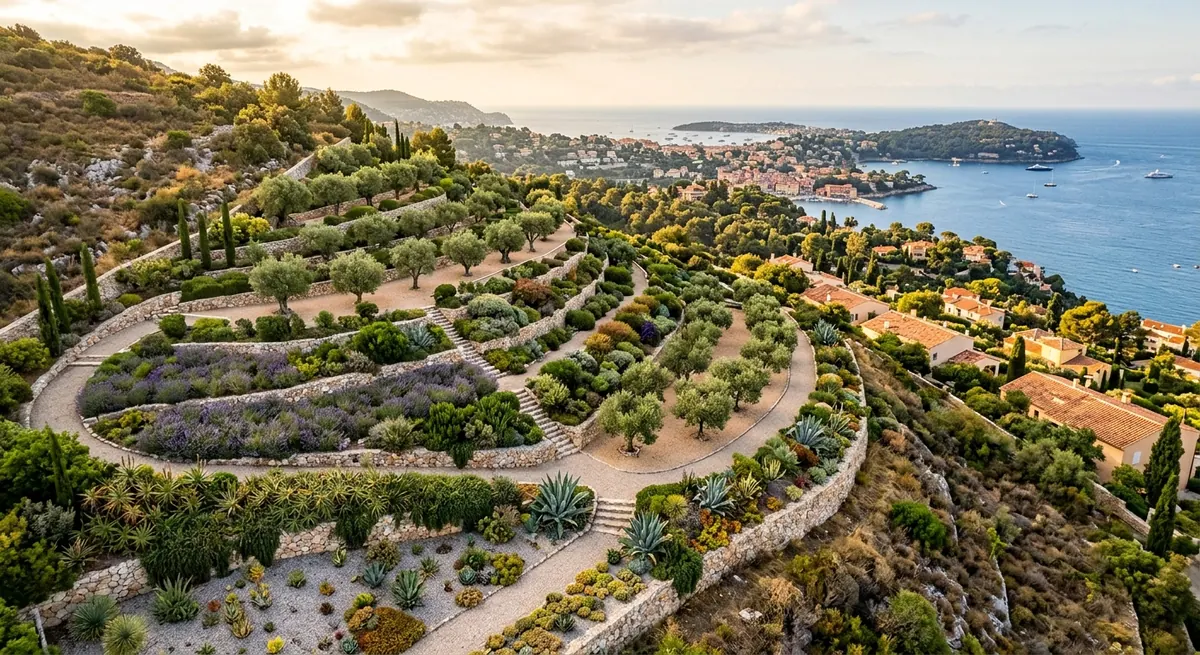
Zone 3, from 10 out to 50 metres (or your parcel boundary), is where the real Mediterranean character can live — olive terraces, drifts of lavender and rosemary, holm oaks pruned up from the base — but it still needs horizontal and vertical discontinuity. That means breaking continuous vegetation with gravel paths, dry-stone retaining walls, or mown grass strips every 8 to 10 metres so fire cannot run uninterrupted uphill toward the house. On a typical 2,500 m² hillside parcel near Cabris or above Grasse, professional zoning and a first clearing pass usually costs between 3,500 and 9,000 euros depending on slope and existing overgrowth, with annual maintenance thereafter running 1,200 to 2,800 euros if you contract it out rather than doing it yourself.
Choosing a Plant Palette That Is Both Fire-Smart and Genuinely Mediterranean
The instinct to rip out everything green and replace it with gravel is understandable but unnecessary and, frankly, a shame given what grows well here. Olive trees (Olea europaea) are excellent: low resin content, high water content in leaves, and they can be limbed up so no foliage sits within a metre of the ground. Cistus (rockrose), santolina, lavender, and Phlomis fruticosa all hold moisture well through the dry season and burn slowly if they do catch, unlike the resinous horrors of rosemary hedges planted wall-to-wall or dense Pinus halepensis stands. Agapanthus, Iris germanica, and low-growing Teucrium make excellent groundcover in Zone 1 and 2 because they stay green and low without needing constant irrigation.
What you want to eliminate, or at least isolate, are the classic Riviera villains: Cupressus sempervirens planted in continuous hedgerows (they torch like candles), untrimmed eucalyptus with peeling bark litter beneath, dense pampas grass, and any juniper variety allowed to grow woody and dry at its base. I always tell clients near Mougins or Antibes-backcountry properties to keep any pine or cypress specimens as isolated accent trees, never as a continuous screen, and to strip dead lower branches every spring — a task a local gardener will do for 25 to 40 euros per tree per year. Budget roughly 45 to 90 euros per square metre for a full replanting of a Zone 2/3 area with fire-conscious Mediterranean species, including soil prep and drip irrigation lines, which is comparable to conventional Riviera landscaping costs but with a far better long-term risk profile.
Hardscape, Irrigation, and Water Reserves: The Infrastructure That Actually Stops Fire
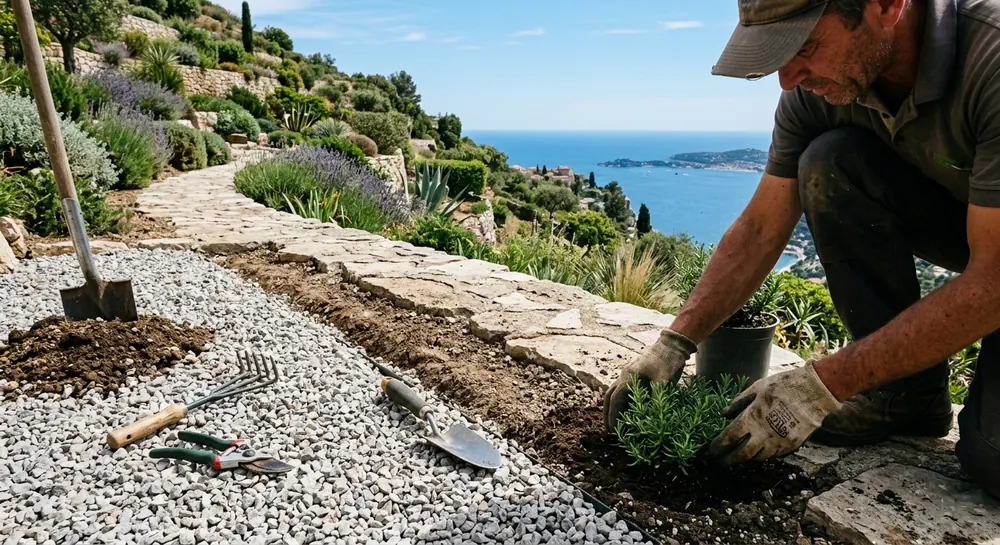
Plants alone will not save a hillside villa; the hard infrastructure does most of the real work. Gravel or decomposed-granite paths at least 1.2 metres wide, positioned to ring the house and cut through Zone 3 planting, act as genuine firebreaks and typically cost 40 to 75 euros per square metre installed, including a compacted base that also handles the winter rains common around Nice's backcountry. Dry-stone or mortared retaining walls, so characteristic of terraced properties near Peille or Coaraze, do double duty as structural terracing and non-combustible barriers; expect 280 to 480 euros per linear metre depending on height and stone sourcing, with local calcareous stone from the Var costing noticeably less than imported granite.
Irrigation is the other half of the equation, because a drought-stressed Mediterranean garden is a garden that burns. A properly zoned drip system with a smart controller, sized to the three defensible zones, runs 18 to 30 euros per square metre installed on a typical hillside plot, and I strongly recommend an independent water reserve — a buried cistern of 5,000 to 15,000 litres, costing 3,500 to 9,000 euros depending on capacity and excavation difficulty on rocky sites near Peillon or Falicon. Many communes in the Alpes-Maritimes will actually subsidise part of this cost through DFCI grant schemes if you can show the reserve also serves as a firefighting water point accessible to a pump truck; check with your mairie's service DFCI before you dig, since accessibility requirements (a hardstanding pad, a minimum pipe diameter) affect the design.
Maintenance, Documentation, and Insurance: Keeping Compliance Alive Year After Year
A DFCI-compliant garden is not a one-time installation, it is an ongoing discipline, and this is where I see the most owners slip. Vegetation regrows fast on the Riviera's warm slopes — a cleared Zone 3 can look overgrown again within 18 months if left untouched. Most serious properties near Nice contract an annual débroussaillement pass, typically 0.90 to 1.60 euros per square metre for straightforward terrain, rising to 2.50 euros or more on steep, rocky parcels above Villefranche or Eze that require hand-clearing rather than machine access. Keep every invoice and photo-dated report; these become your attestation de débroussaillement, which some mairies now require to be renewed and filed annually, not just produced on request during an inspection.
On the insurance side, French insurers writing policies for villas in classified massif forestier zones increasingly ask for this documentation before renewal, and a handful now offer explicit premium reductions, often in the 10 to 20 percent range, for properties that can demonstrate full OLD compliance plus a water reserve accessible to fire services. I always advise clients to loop their insurance broker in at the design stage, not after the fact, because a garden designed with the broker's checklist in mind — clear access for a pump truck, a hydrant or cistern within reasonable hose-reach, defensible zones properly documented — can shave real money off both premiums and potential liability if the worst happens during a summer mistral event.
Frequently asked questions
The standard obligation is 50 metres around any building, though some Alpes-Maritimes communes in classified massif zones extend this to the full property boundary if it is smaller than 50 metres, or require clearing along access roads too. Always confirm the exact radius with your mairie's service DFCI, since local arrêtés can add specific requirements.
Yes, but only as isolated specimens, never as a continuous hedge or grove touching the house or each other. Limb them up so no foliage sits within a metre of the ground, remove dead needles and bark litter annually, and keep at least 3 metres of clearance from any structure or other tall vegetation.
For a mid-size 2,000 to 3,000 m² parcel, expect a combined budget of roughly 15,000 to 35,000 euros covering initial clearing, replanting with fire-conscious Mediterranean species, gravel firebreaks, drip irrigation, and a small water reserve, with annual maintenance thereafter around 1,500 to 3,000 euros.