
Why Nice's Flat Roofs Fail Faster Than You'd Think
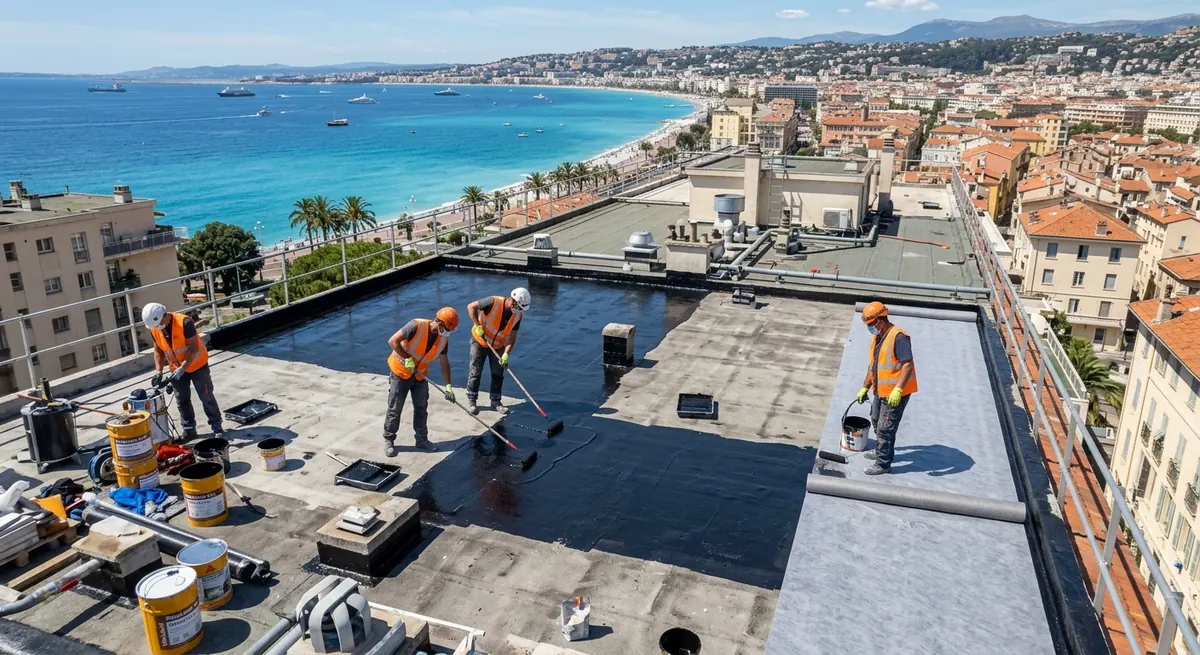
Walk through any 1960s or 1970s building in Nice — the kind with a flat roof terrace shared by four or five apartments, or a villa in Saint-Jean-Cap-Ferrat with a rooftop solarium — and you'll find waterproofing membranes that are cracking, bubbling, or simply gone brittle well before their theoretical twenty-year lifespan. The culprit isn't one single thing; it's the combination. UV index on the Riviera regularly tops 8 from May through September, baking bitumen membranes and degrading the plasticizers in cheaper PVC sheets. Add in the autumn deluges — Nice can drop 100mm of rain in a single October afternoon — and you get standing water sitting on a roof that was never built with enough slope to drain it. Pooling water doesn't just look bad; it accelerates UV breakdown because standing water acts like a magnifying lens under certain angles, and it adds dead load that stresses old substrates.
Then there's foot traffic, which is the variable most owners underestimate. A roof terrace in Nice isn't just a roof anymore — it's an outdoor room with a dining table, potted olive trees, sometimes a small plunge pool, and guests walking across it in espadrilles or stiletto heels all summer. Standard roofing membranes were never designed to be walked on directly; they need a protective layer, whether that's pavers on pedestals, a wood deck system, or a reinforced wear coat. I've inspected terraces in the Carré d'Or where the membrane itself was sound but had been punctured by a dragged planter or a poorly set furniture foot, and that single puncture let three winters of rain migrate sideways under the covering before anyone noticed the stain on the ceiling below. On the Riviera, waterproofing isn't just about the product you choose — it's about designing for the specific abuse a usable terrace takes.
Membrane Systems: Bitumen, PVC and TPO on Real Nice Roofs
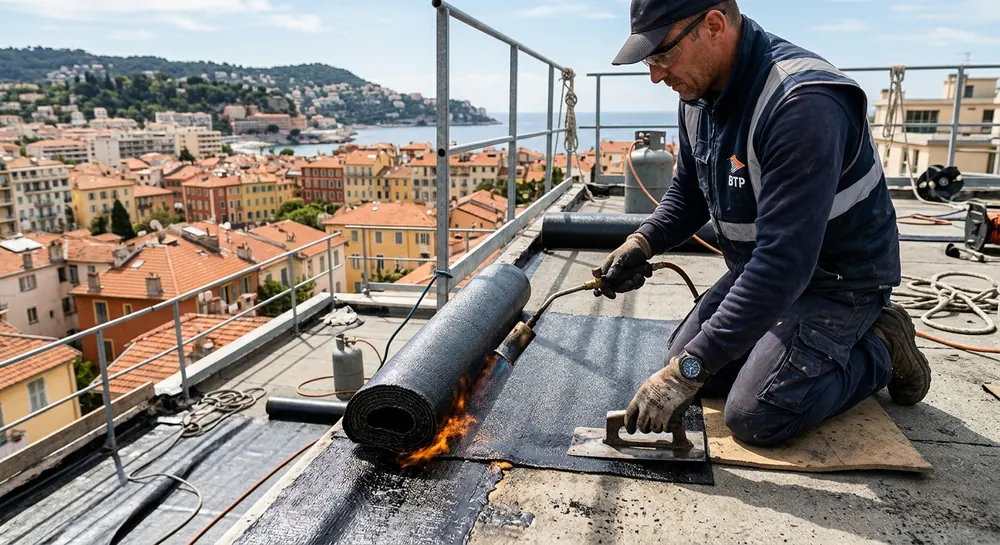
Bitumen membranes (what French roofers call étanchéité bitumineuse) remain the default choice for apartment buildings in Nice, largely because syndics know them, insurers accept them, and they're relatively forgiving to install on older concrete slabs that aren't perfectly flat. A proper two-layer self-protected or gravel-ballasted bitumen system runs roughly €65 to €95 per square meter installed, including the old covering removal and a new insulation layer if the existing one is waterlogged — and on older buildings it often is, which only shows up once the roofers pull up the first layer. The weak point of bitumen in our climate is UV and thermal cycling: dark membranes can hit surface temperatures above 70°C on a July afternoon in Cannes, then cool rapidly during a summer thunderstorm, and that thermal shock is what eventually causes the alligator cracking you see on aging roofs. A reflective, light-colored cap sheet adds maybe €8 to €12 per m² but meaningfully extends service life and cuts the apartment's cooling load underneath.
Single-ply membranes — PVC or TPO, heat-welded at the seams — are increasingly what I specify on villas in Antibes and Mougins where the roof will also carry a timber deck or paver system. They cost more upfront, typically €90 to €130 per m² installed, but the welded seams are more reliable than bitumen's torched joints over the long run, and TPO in particular handles UV exposure better without the added membrane needing constant recoating. The catch is installer skill: a poorly welded TPO seam fails faster and less visibly than a bitumen seam, so I always ask contractors for photos of previous welds and, ideally, a site visit to a terrace they finished two or three years ago. On a terrace open to foot traffic, whichever membrane you choose, budget separately for the wear layer — concrete pavers on adjustable pedestals run another €70 to €110 per m², and they have the added benefit of leaving the membrane fully inspectable and replaceable without destroying the finished surface above it.
Liquid Waterproofing: PMMA and Polyurethane Resins
Liquid-applied systems have become the go-to solution for the tricky geometries so common on Nice's older buildings — roof terraces with multiple skylights, parapets, drainage outlets, and awkward corners where a prefabricated membrane would need dozens of seams. PMMA (methacrylate) resin, applied cold in two or three coats with reinforcing fleece at junctions, cures in under an hour per coat and bonds seamlessly around any penetration, which makes it ideal for the rooftop AC condenser units and solar panel mounts that have multiplied across Nice roofs in the past few years. Expect to pay €85 to €140 per m² depending on substrate prep, with the higher end applying to roofs needing significant crack-stitching or old membrane removal first. Polyurethane liquid systems cost somewhat less, around €70 to €110 per m², and flex better over hairline movement cracks in concrete, which makes them a sound choice for older villa roofs in Cimiez or Le Ray that have settled slightly over sixty or seventy years.
The real advantage of liquid systems on the Riviera is UV stability when the right top coat is used — a quality aliphatic polyurethane or PMMA finish resists chalking and color fade far longer than a standard bitumen cap sheet, and most carry a genuine 10 to 15-year warranty when installed by a certified applicator rather than a generalist painter. The risk, and it's a real one, is that liquid systems are entirely dependent on surface preparation and weather conditions at the time of application — apply PMMA on a humid September morning with the tramontane bringing in moisture off the sea, and adhesion suffers in ways that won't show up for two years. I always insist on a moisture-meter reading of the substrate before work starts and a minimum 48-hour dry weather window in the forecast; reputable applicators in Nice and Monaco build this into their scheduling and won't rush a job just to hit a deadline, which is one more reason to choose a specialist over a general roofer chasing volume.
Matching the System to How You Actually Use the Terrace
The right choice depends far less on brand preference than on how hard the terrace gets used and what sits on top of it. A rarely-visited technical roof — the kind accessed twice a year to service a water tank in a Monaco apartment building — can reasonably use a simpler bitumen or liquid system with minimal wear protection, since foot traffic is negligible and the main enemies are UV and standing water. A lived-in terrace with a dining set, a barbecue, and a dozen potted citrus trees needs a wear-rated solution from day one: PVC or TPO membrane under pavers on pedestals, or a reinforced liquid system with an anti-slip aggregate broadcast into the top coat, which typically adds €10 to €18 per m² but prevents the fine cracking that comes from chair legs and planter feet grinding against an unprotected surface.
Rooftop pools and plunge pools, increasingly popular on villa projects from Cap d'Antibes to the hills above Villefranche, are a different animal entirely and deserve their own waterproofing detail separate from the surrounding deck — the pool shell needs a dedicated membrane rated for permanent water immersion, not just splash resistance, and the junction between pool coping and deck membrane is where I see the most expensive failures, because water finds that seam and travels sideways under the deck for months before staining a ceiling two floors below. If you're planning a rooftop addition like this, get the waterproofing designer involved before the pool contractor pours anything — retrofitting a proper membrane transition after the pool shell is finished can cost more than building it right the first time, sometimes an extra €3,000 to €6,000 just to correct a detail that would have cost a few hundred euros to specify correctly at the design stage.
Budgeting, Warranties and Getting the Paperwork Right
For a typical 60 to 100 m² Nice apartment terrace, full re-waterproofing including removal of the old system, minor insulation renewal, and a walkable finish generally lands between €8,000 and €16,000 all-in, with villas running proportionally higher once you factor in scaffolding access and more complex rooflines around chimneys and dormers. Always get at least three quotes and make sure each one specifies the exact product reference, not just 'étanchéité bitumineuse' or 'résine liquide' as a generic line item — reputable suppliers like Soprema, Sika, or Derbigum have technical data sheets your contractor should be able to hand over, and the warranty is only as good as the paperwork proving which product was actually used. A decennale (ten-year structural) insurance certificate from the contractor is non-negotiable in France for this kind of work; ask to see it before signing, not after the deposit is paid.
If your terrace is part of a copropriété, check the règlement de copropriété and get the syndic's sign-off before work starts, especially if the terrace is classified as a 'partie commune à jouissance privative' — a common situation in Nice's older buildings where you have exclusive use but the structure technically belongs to the collective. Skipping this step is the single most common hold-up I see on these projects, sometimes delaying work by months while an assemblée générale vote gets scheduled. On villas, if the terrace sits within view of a protected site or falls under local PLU rules around the Colline du Château or near the coastline in places like Eze or Beaulieu-sur-Mer, a simple déclaration préalable at the mairie is often required even for like-for-like waterproofing renewal, particularly if the finished color or material changes — it's a one-page form, but skipping it can mean a stop-work order right when your roofer has the terrace torn open and exposed to the next rain system.
Frequently asked questions
Expect €65 to €95 per m² for a standard bitumen membrane, €90 to €130 per m² for welded PVC or TPO, and €70 to €140 per m² for liquid PMMA or polyurethane systems, depending on substrate condition and access. Add €70 to €110 per m² if you want pavers on pedestals as a walkable wear layer on top.
Both can reach 15 to 20 years if properly specified, but liquid systems with a quality aliphatic top coat generally resist UV chalking and color fade better over time than standard bitumen caps. Single-ply TPO membranes perform similarly well, though installation quality at the seams matters more for long-term reliability than the material choice itself.
If the terrace is a 'partie commune à jouissance privative', yes — check your règlement de copropriété and get sign-off at an assemblée générale before starting, since this is the most common cause of project delays. Even on private villas, a déclaration préalable at the mairie may be required if the finish or color changes, especially near protected coastal or heritage zones.