
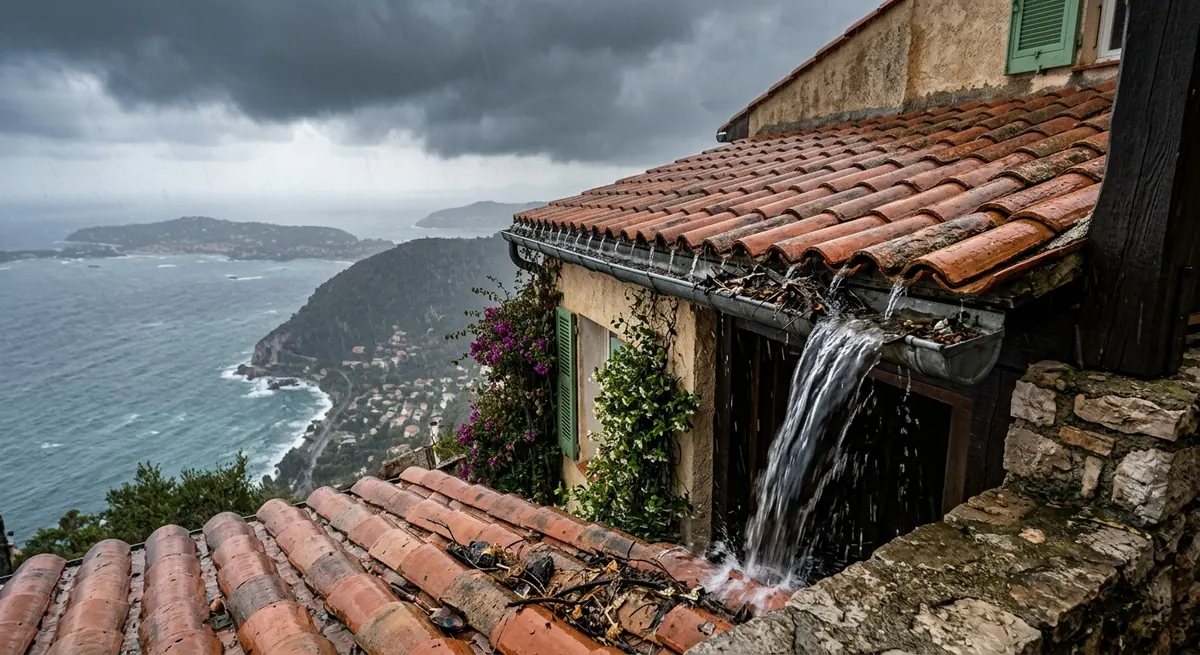
Why a Mediterranean storm destroys an ordinary gutter system
I have stood in enough flooded garages in Cimiez and Mont Boron at two in the morning to know that the problem is rarely the roof itself. It is almost always the gutter. Nice can receive 60 to 100mm of rain in under an hour during an autumn episode, the kind of storm that rolls in off the sea in September and October with almost no warning. A gutter system designed for gentle northern-European drizzle simply cannot swallow that volume, and the water finds the path of least resistance, which is usually straight down a rendered facade or through a badly sealed skylight upstand.
What makes the Riviera particularly unforgiving is the combination of intense rainfall with roofs that were often built, or extended, decades ago under very different rules. A villa in Cap d'Antibes with a classic Provençal tiled roof and a single 80mm downpipe serving 40 square metres of catchment area was fine in 1975. Add a garage extension, a pool house, and thirty more years of pine needle and plane tree litter falling from the boulevard, and that same downpipe becomes a bottleneck the moment a real orage hits. I have seen water back up over the gutter lip and pour directly behind the fascia board within about four minutes of a downpour starting, simply because nothing downstream could keep pace.

Sizing gutters and downpipes for Riviera rainfall, not a generic catalogue chart
Most gutter suppliers still size systems off average annual rainfall, which is close to meaningless here. What matters is peak intensity, and on the coast between Menton and Cannes that intensity regularly exceeds 100mm per hour during cevenol-type events that drift east along the coast. As a rule of thumb I use on site, a half-round gutter of 150mm handles roughly 40 to 50 square metres of roof plan area safely in Nice conditions, not the 65-70 square metres quoted in standard French DTU tables for calmer regions. For anything larger, whether it is a Cannes villa with a sweeping hipped roof or a Monaco terrace apartment feeding into a shared rainwater riser, I push clients toward 180mm gutters with at least two 100mm downpipes rather than one oversized single pipe, because redundancy matters when one outlet inevitably clogs mid-storm.
Downpipe placement is just as important as diameter, and this is where I see the most costly mistakes. Builders often run a single downpipe down a highly visible corner for aesthetic reasons, ignoring that it now serves an entire roof slope facing the prevailing southeast weather. On a recent job above Villefranche-sur-Mer we split one overloaded 100mm downpipe into two 80mm pipes on opposite corners of the villa, which cost around 950€ including new brackets, a discharge collar, and reconnection to the existing drainage, but it eliminated a recurring puddle at the front entrance that had been forming for three winters running. If you are unsure whether your setup is adequate, a roofer can calculate catchment area and expected peak intensity in under half an hour on site, and that assessment typically runs 90 to 150€, money well spent before the November storms arrive.
A cleaning schedule that actually matches the local calendar
Twice a year is the minimum I recommend for any Riviera villa with mature trees nearby, and the timing matters more than most owners realise. The first clean should happen in late September, just before the autumn storm season starts, clearing out the accumulated pine needles, umbrella pine cones and plane tree leaves that have built up all summer while nobody was thinking about gutters. The second should happen in late January or February, after the mistral winds of December have stripped whatever foliage survived and dumped it straight into your downpipes. Skipping the autumn clean is the single most common reason I get emergency calls in October, usually from villa owners in Antibes or Le Cannet who assumed their roof was fine because it had not rained in four months.
Pricing for a standard cleaning visit on a typical 200 to 300 square metre villa runs 150 to 280€ if access is straightforward from a ladder or a small platform, rising to 350-450€ where a cherry picker is needed for a tall Belle Epoque facade in central Nice or a cliffside property near Eze. Gutter guards can reduce the frequency needed, but I am cautious recommending mesh guards under heavy pine cover, since fine needles pass straight through standard mesh and clog the gutter bed anyway, just more slowly and less visibly, which paradoxically makes the problem harder to spot until it overflows. A better investment on pine-heavy plots is often a slightly oversized gutter combined with strainer baskets fitted directly over each downpipe outlet, at roughly 25-40€ per outlet, which catch the bulk of debris exactly where it is easiest to remove.
Waterproofing joints and choosing materials that survive salt air and UV
Salt-laden air from the Baie des Anges is brutal on cheap fixings and unsealed joints, and this is where I see more failures than on the gutters themselves. PVC gutters, common on budget villa builds from the 1980s and 90s, become brittle within 12 to 15 years under Riviera sun exposure, and their solvent-welded joints crack quietly long before the discolouration becomes obvious from ground level. Zinc remains my default recommendation for most properties here, offering 40-plus years of service if properly ventilated and installed with expansion joints every three metres or so, at an installed cost of roughly 55-85€ per linear metre depending on profile and access difficulty. For higher-end properties in Cap Ferrat or the Monaco hinterland, seamless aluminium or even copper gutters are increasingly popular, copper especially for its resistance to salt corrosion, though budget 120-160€ per linear metre installed.
Whatever the material, the joints and end caps are where water actually escapes, and a proper waterproofing check should happen every two to three years regardless of the gutter's apparent condition. I use a butyl-based sealant rather than standard silicone for outdoor gutter joints on the coast, since silicone tends to lose adhesion faster under sustained UV and salt exposure, typically needing reapplication within three to four years versus six to eight for a quality butyl or polyurethane product. Re-sealing a full villa's worth of joints, brackets and end caps generally costs 300-600€ in materials and labour depending on gutter length, and it is far cheaper than the alternative: a rendered facade stained with calcium streaks and, worse, water tracking down inside a cavity wall where it can sit against timber lintels or electrical conduits for months before anyone notices the smell of damp.
When maintenance comes too late: recognising and repairing storm damage
By the time you see a brown tide line on an interior ceiling or bubbling paint near a window reveal, water has usually been finding its way in for weeks, not hours. The most common damage pattern I encounter on Riviera villas is not dramatic flooding but slow saturation of render around a downpipe junction that has been leaking quietly since the previous winter. Left unaddressed, this leads to spalled render, corroded rebar in older concrete-frame villas from the 1960s and 70s, and in the worst cases I have seen near Nice's Fabron district, structural cracking that required 8,000€ of facade repair that a 400€ gutter fix would have prevented entirely three years earlier.
If you suspect storm damage after a bad episode, act within 48 hours: photograph any staining or pooling, check attic spaces and roof void insulation for dampness, and call a roofer before the next rain event rather than waiting for a dry spell to make the problem feel less urgent. Most home insurance policies on the French Riviera, whether through Axa, MAIF or a local courtier, cover degat des eaux from storm-related gutter failure, but only if you can demonstrate the system was reasonably maintained, which is exactly why keeping receipts from your twice-yearly cleaning visits matters far beyond the immediate cost saving. A villa owner in Cagnes-sur-Mer I worked with last winter had her 6,200€ ceiling and insulation repair fully reimbursed within six weeks precisely because she had two years of dated cleaning invoices to show the assessor that the failure was a genuine storm event and not simple neglect.
Frequently asked questions
Twice a year minimum, ideally late September before the autumn storm season and again in late January or February after mistral winds have stripped remaining foliage. Properties directly under mature pines sometimes need a third check in June.
As a working guide, budget one 100mm downpipe per 40 to 50 square metres of roof catchment given local rainfall intensity, and prefer two smaller downpipes on opposite corners over one large one, since redundancy matters when a single outlet clogs during a storm.
Most policies cover degat des eaux from storm-related gutter failure, but insurers typically require proof of reasonable maintenance, so keeping dated invoices from cleaning and inspection visits significantly improves your chances of a full payout.