
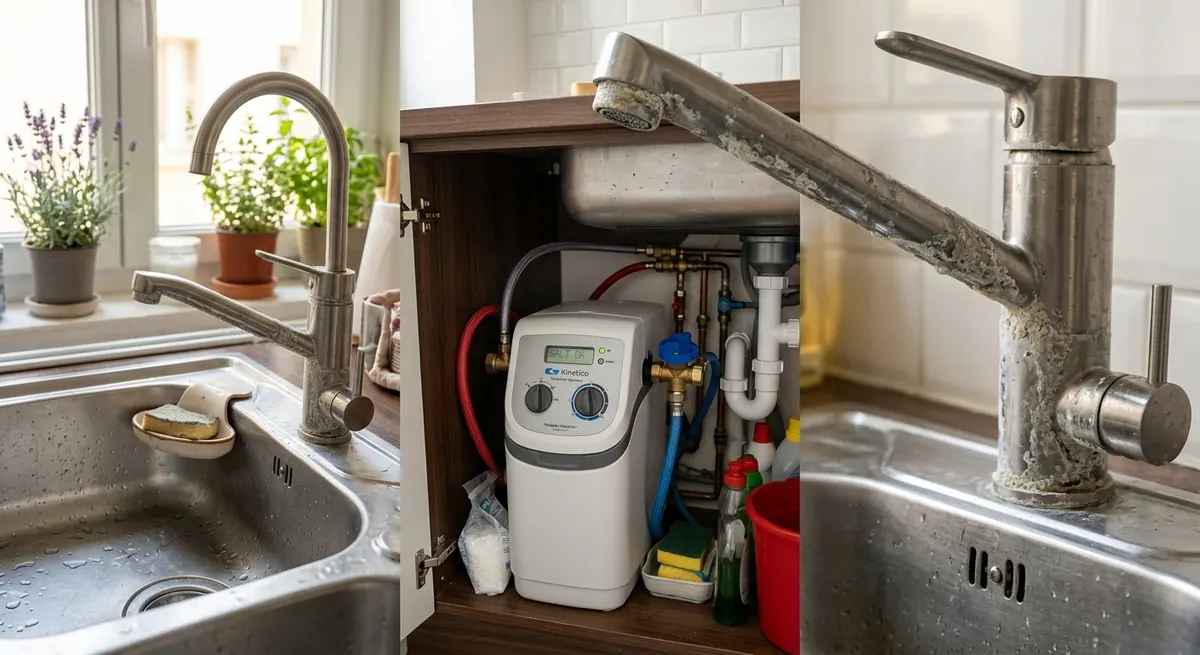
Why Limescale Is a Bigger Problem in Nice Than People Admit
I've opened up more dead water heaters in Nice and Cagnes-sur-Mer than I care to count, and the pattern is almost always the same: a thick, chalky crust coating the resistance element, sometimes two centimetres deep after only seven or eight years of service. The Régie Eau d'Azur, which supplies most of Nice, Saint-Laurent-du-Var and parts of the Baie des Anges, draws from the Vésubie and Var river basins, and the water typically tests between 24 and 32 degrees French hardness (°f). That puts it firmly in the 'hard' category, though not as extreme as Aix-en-Provence or the Luberon, where you can see 40°f plus. Cannes and Antibes, drawing partly from the Siagne and Canal de la Siagne network, often run slightly softer, closer to 20-26°f, which is why a boiler in Le Cannet sometimes lasts noticeably longer than an identical model in Nice's Libération district.
What makes this worse for apartment owners specifically is the plumbing itself. A huge share of Nice's residential stock dates from the 1900s Belle Époque boom or the 1960s-70s building wave along the Promenade and in Fabron, and those buildings still have long horizontal copper or galvanized steel runs feeding each unit. Limescale doesn't just clog your kettle - it deposits along the entire internal diameter of these old risers, gradually narrowing them until you notice pressure dropping on the top floors first. I've measured pressure losses of 0.5 to 1 bar in sixth-floor apartments in older buildings purely from decades of scale buildup inside shared vertical pipework that nobody thought to descale during renovations.
Reading the Warning Signs Before the Boiler Dies
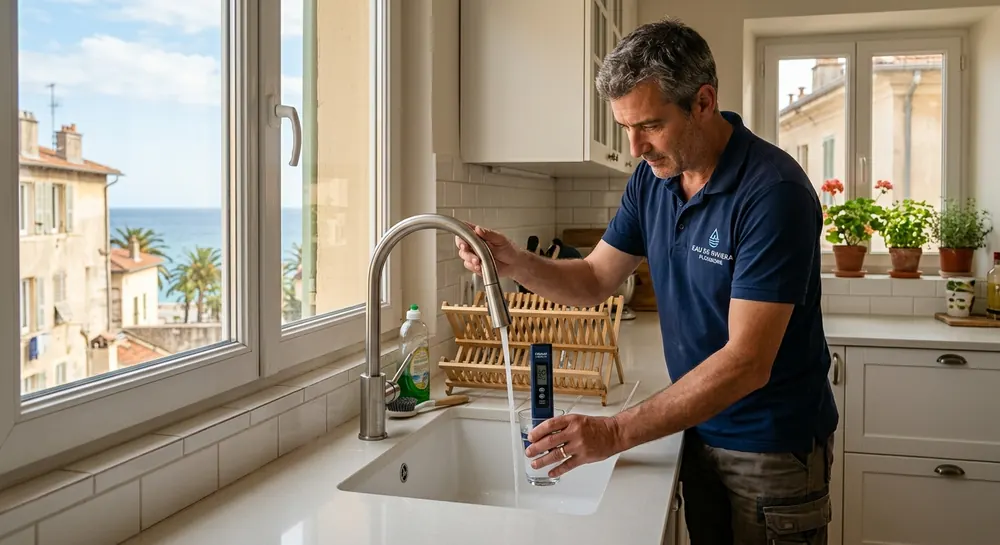
The most reliable diagnostic tool costs nothing: look at your kettle and your shower glass. If you see a white, crunchy ring forming inside the kettle within two to three weeks, or if shower screens develop a hazy film that resists standard glass cleaner within a month, you're dealing with water solidly above 25°f. A cheap test strip kit, sold for around 8 to 12 euros at Nice's Weldom on Route de Grenoble or any Leroy Merlin in the region, gives you a number in thirty seconds and is worth doing before you spend a euro on equipment. I always tell clients to test twice, once from the kitchen tap and once from the bathroom, because internal plumbing age can shift the reading by several degrees between rooms in older buildings.
Beyond visual cues, listen to your water heater. A healthy 200-litre cumulus should heat quietly; a scaled one develops a distinct popping or crackling sound as steam bubbles escape through crusted deposits, and that's usually eighteen months to two years before failure in Nice's water conditions. I've also seen washing machines in Antibes apartments lose 30 to 40 percent of their heating efficiency from element scaling, which shows up as unexpectedly high electricity bills rather than an obvious fault. If your syndic has recent invoices for plumber call-outs citing 'entartrage' or reduced flow in the common risers, treat that as a serious signal that the whole building's supply needs addressing, not just your unit.
Inline Anti-Scale Filters: The Budget-Friendly First Line of Defense
For most one or two-bedroom apartments in Nice, an inline anti-scale filter installed just after the water meter is the sensible starting point, and it's what I recommend to roughly seven out of ten clients who call me about limescale. These come in two main technologies: polyphosphate dosing filters, which coat mineral particles so they stay suspended rather than crystallizing on surfaces, and TAC (template assisted crystallization) filters, which convert calcium into microscopic crystals that pass through the pipe without adhering. A decent TAC unit like the Aquabion or BWT Infinity, sized for an apartment, runs between 250 and 450 euros for the cartridge system itself, plus 150 to 250 euros for professional installation given the tight under-sink or cave spaces typical of Nice's older buildings.
The real advantage of these filters is that they need almost no maintenance and don't add salt or sodium to your drinking water, which matters if your building's plumbing feeds directly into a shared kitchen line. Cartridges typically need replacing every 12 to 18 months at a cost of 60 to 120 euros depending on the model, and I always schedule that alongside the annual boiler service so it doesn't get forgotten. The limitation is capacity: polyphosphate and TAC systems handle moderate hardness well, in the 20-30°f range common to Nice, but they don't meaningfully reduce the mineral content itself, so if you're already seeing heavy limescale on shower tiles, a filter alone won't fully solve cosmetic buildup - it mainly protects the pipework and heating elements going forward.
Water Softeners: When You Need to Actually Remove the Calcium
If your water tests above 30°f, or if you've already replaced one boiler prematurely and want a permanent fix, a salt-based ion exchange softener is worth the investment despite the higher upfront cost. A softener physically swaps calcium and magnesium ions for sodium ions using a resin bed, which genuinely reduces hardness rather than just preventing deposition. For a typical Nice apartment of 60 to 90 square metres, expect to pay 1,500 to 3,000 euros installed for a quality compact unit from brands like Culligan, BWT or Cillit, with installation complicated somewhat by the need to find space for the resin tank and brine tank, often tucked into a bathroom cupboard or the cave if the apartment lacks a utility room. In Monaco and the more premium Cap d'Antibes properties, I've fitted larger whole-building systems running 4,000 to 6,000 euros where the syndic agreed to treat water at the point it enters the building.
The trade-off owners need to understand upfront is maintenance and sodium content. Softeners need salt tablets topped up roughly every four to six weeks, costing about 5 to 10 euros a month, and the resin bed itself needs replacing after 8 to 10 years. More importantly, softened water carries slightly elevated sodium, which is why I always recommend keeping at least one untreated cold tap in the kitchen for drinking and cooking water, especially in households with infants or anyone on a sodium-restricted diet. Co-ownership rules in many Nice buildings also require syndic approval before altering shared plumbing lines, so if you're on a floor served by a communal riser rather than an independent supply, get that authorization in writing before ordering equipment, because retrofitting after installation has caused expensive disputes I've had to help mediate more than once.
Building a Practical Protection Plan for Pipes, Boilers and Appliances
My standard recommendation for a Nice apartment is a layered approach rather than betting everything on one device. Start with the inline filter or softener at the main entry point, then add a smaller in-line scale inhibitor directly on the boiler's cold feed if the unit is more than five years old, which costs an additional 80 to 150 euros and buys real protection for the heating element specifically. Pair that with an annual descaling service for the water heater itself, using food-grade citric acid rather than harsh industrial descalers, which a competent plumber will do for 90 to 150 euros and which typically extends a cumulus lifespan from the region's average of 8-10 years toward 12-15 years.
For appliances, don't overlook the simple fixes: running a monthly citric acid or dedicated descaling cycle in washing machines and dishwashers costs almost nothing and prevents the silent efficiency loss I mentioned earlier, particularly in older buildings around Vieux Nice and Riquier where plumbing hasn't been touched since the 1970s. If you're planning a full bathroom or kitchen renovation anyway, this is the moment to budget for a proper softener installation, since opening walls and replacing pipe runs gives you access you won't have again for years. Get at least two quotes from local plumbers registered with the Chambre des Métiers, ask specifically whether they've worked with Régie Eau d'Azur's water profile before, and always request the post-installation hardness reading in writing so you have a baseline to check against if problems recur.
Frequently asked questions
Nice typically measures 24 to 32 degrees French hardness (°f), supplied by Régie Eau d'Azur from the Vésubie and Var basins. Cannes and Antibes, fed partly by the Siagne network, often run slightly softer at 20 to 26°f, while inland Provence towns can exceed 40°f.
If your water tests below 30°f and you mainly want to protect pipes and appliances, an inline TAC or polyphosphate filter (roughly 400-700 euros installed) is usually sufficient. Above 30°f, or if you've already lost a boiler early, a salt-based softener (1,500-3,000 euros installed) gives a more permanent reduction in hardness.
Softened water has slightly higher sodium content due to the ion exchange process, which is safe for most people but worth avoiding for infant formula or strict low-sodium diets. Most installers recommend keeping one untreated cold tap in the kitchen specifically for drinking and cooking.