
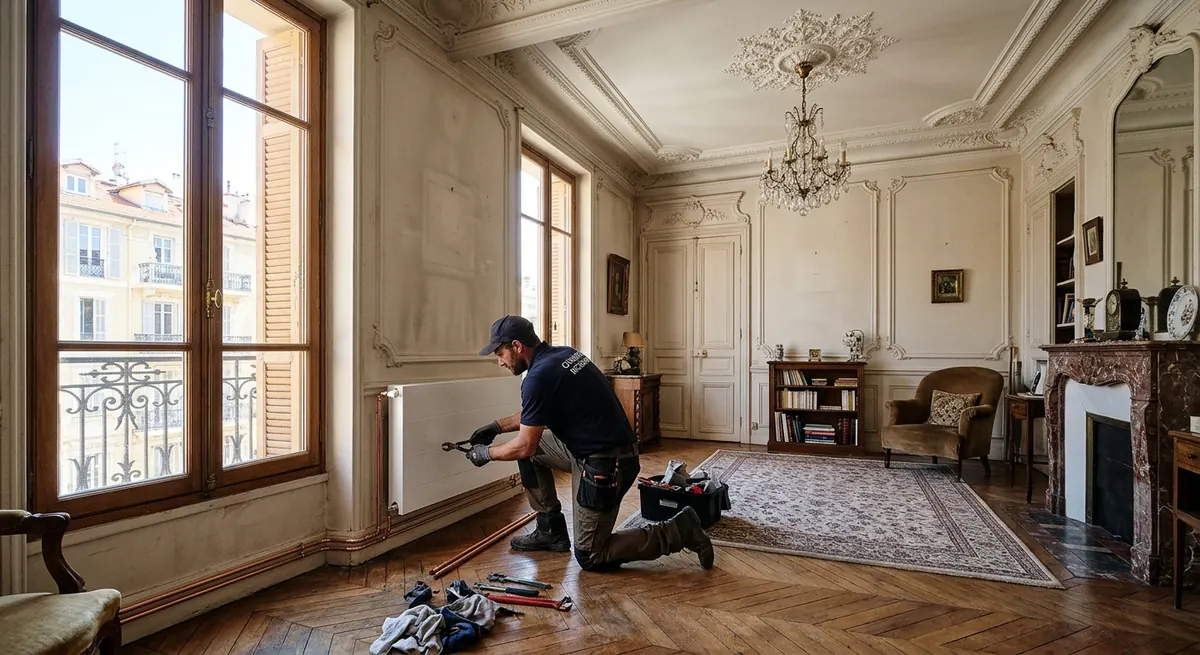
The Specific Headache of Heating a Haussmannian or Belle Époque Flat in Nice
Walk through any building on Rue de France, Avenue Jean Médecin or the back streets of Vieux Nice and you will find the same bones: 3.2 to 3.6 metre ceilings, single-glazed windows behind shutters that the mairie will not let you touch, and flues built for coal or early gas chaudières that have been patched a dozen times since the 1950s. These apartments were never designed around a heating system that needs outdoor units, large pipe runs or a dedicated technical room. Every decision you make about heating has to pass through that filter first, before you even get to the energy bill.
I have walked into more than one chantier in Cimiez where the owner had already bought a heat pump online before checking whether the copropriété would authorise an outdoor unit on a classified facade, or whether the existing gas flue could even be reused for a new condensing boiler. In these buildings, the technical constraint usually decides the project long before the energy calculation does. Get a chauffagiste and, if the building sits in a secteur sauvegardé, the copropriété syndic involved at the very first site visit, not after you have signed a quote.
Upgrading the Gas Boiler: Still the Path of Least Resistance, For Now
If your building already has a gas connection and a working flue, replacing an old chaudière classique with a condensing model remains the quickest and least disruptive fix. In a 65 m² flat on Boulevard Gambetta, a straightforward swap for a wall-hung condensing boiler (12-24 kW depending on hot water needs) typically runs between 4 500 and 7 500 euros installed, flue adaptation included. Where the existing conduit is shared vertically across floors - common in 1900s buildings near Place Garibaldi - you may need a ventouse concentrique kit or a full requalification of the collective flue, which can push costs toward 9 000 euros and requires the agreement of other owners sharing the same duct.
The regulatory ground has shifted underneath gas, though, and owners need to know this before committing. Since 2023, MaPrimeRénov no longer subsidises any gas boiler, condensing or not, which removes what used to be a 2 500 to 4 000 euro cushion. The loi Climat et Résilience bans new gas hookups in newly constructed buildings but does not force you to abandon an existing connection in a pre-war flat, so replacement is still legal and, in many syndic-managed buildings with collective gas chaudières, it remains the only realistic option for another decade. The honest calculation: a condensing boiler gives you 15 to 20 years of reliable heat for a known price, but you are investing in a technology that will have zero public financial support going forward and whose running cost depends entirely on gas prices that have swung by 30% or more in the last few winters.
Switching to a Heat Pump: What Actually Fits in an Old Nice Building
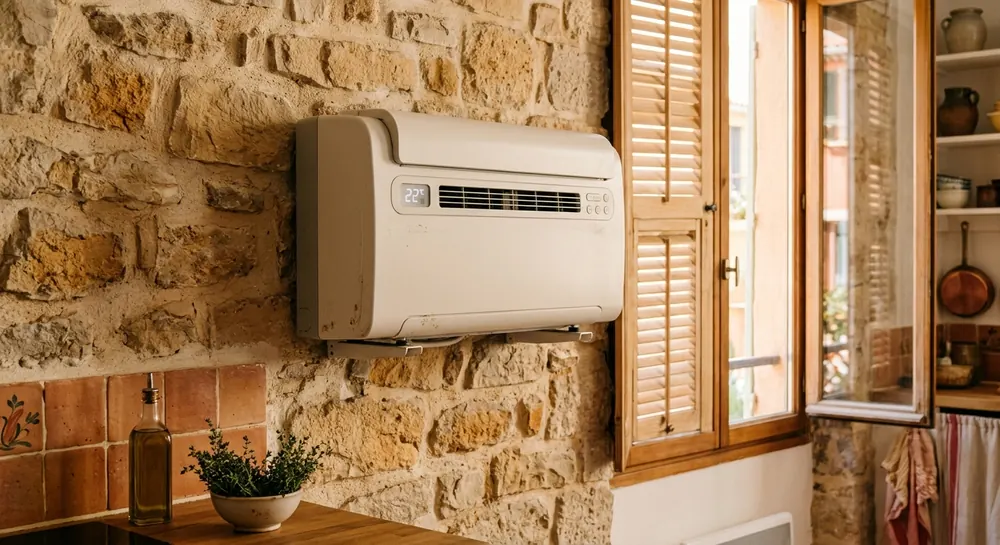
Heat pumps come in two families that behave very differently inside a pre-war shell. Air-to-air multisplit systems (one outdoor unit, two to four indoor units) are the realistic option for most Nice apartments because they need no hydraulic circuit and minimal wall penetration - installation for a 70 m² flat typically costs 7 000 to 11 000 euros, with the main obstacle being where to hang the outdoor unit. On a street-facing facade in Vieux Nice or on the Promenade des Anglais side of town, the Architecte des Bâtiments de France or the copropriété will often refuse a visible unit, forcing you toward a courtyard placement, a technical balcony, or in some cases outright refusal, which kills the project before it starts.
Air-to-water heat pumps, which feed existing radiators, are more elegant on paper because they reuse your current distribution, but they demand a real technical space for the unit plus a buffer tank, something most 19th-century apartments simply do not have without sacrificing a storage room or a chambre de bonne. Expect 12 000 to 18 000 euros installed for a 70-90 m² flat, and factor in that many pre-war radiator networks were sized for 70-80°C water from an old gas boiler; a heat pump runs more efficiently at 45-55°C, so you may need larger radiators in one or two rooms to maintain comfort, adding another 1 500 to 3 000 euros. The upside is real: MaPrimeRénov can still cover 4 000 to 10 000 euros of an air-water heat pump install for owner-occupiers under income thresholds, and running costs on electricity in a well-insulated flat often come in 30 to 40% below an equivalent gas setup.
What French Regulation Actually Requires From You in 2026
Two separate rulebooks matter here and owners regularly confuse them. The DPE (diagnostic de performance énergétique) now carries real teeth: flats rated F or G cannot be re-let as of 2025 without rénovation, and E-rated flats face the same restriction from 2028, which means a surprising number of Nice studios and two-pieces in older buildings are already unrentable until heating and insulation work is done. A gas boiler swap alone rarely moves the DPE letter more than one notch; a heat pump combined with even modest window or wall insulation work can shift a flat from F to D, which is often the difference between a rentable asset and a frozen one.
The second rulebook is the copropriété. Any heating change that touches the building's common parts - a new flue penetration, an outdoor unit on a facade, even running a new electrical feed through a shared gaine technique - requires a vote in assemblée générale, typically needing a simple majority under article 25 or 24 depending on the specifics. In practice this means budgeting six to twelve months of lead time before you can even start work, because most syndics only hold one or two AG sessions per year. I have seen Antibes and Cannes projects stall an entire winter because the heating decision was made in October, after that year's AG had already passed. If your building has collective gas heating with individual sub-metering, converting your own lot to a heat pump is usually possible but needs explicit syndic sign-off on disconnecting from the shared network, plus proof you will not affect pressure or flow for neighbouring flats.
Making the Call: A Practical Decision Framework for Owners
If you are renting out a small flat in the Riquier or Libération neighbourhoods and your gas boiler still works, a straightforward condensing swap at 5 000 to 7 000 euros is often the pragmatic move to buy five to ten years while the subsidy and copropriété landscape for heat pumps matures - especially if facade access for an outdoor unit is genuinely impossible. For owner-occupied flats you plan to keep for fifteen-plus years, particularly ones already facing a DPE deadline, the heat pump route makes more financial sense despite the higher upfront cost, because the combination of MaPrimeRénov support, lower running costs and the DPE improvement adds up faster than people expect, usually paying back the price difference within seven to nine years.
A middle path worth considering in genuinely constrained buildings - think fourth-floor flats in Vieux Nice with zero outdoor space and an ABF perimeter - is a hybrid system: keep a small gas or electric backup for the coldest weeks and run a compact air-to-air unit for 80% of the heating season. It is not the purist's answer, but it sidesteps the facade battle entirely and still cuts gas consumption by half. Whatever you choose, get three quotes from chauffagistes who have specifically worked on pre-war Nice buildings rather than generic regional installers; the ones who know which streets fall under ABF jurisdiction and which syndics are heat-pump-friendly will save you months of back-and-forth and, often, several thousand euros in redesign costs.
Frequently asked questions
No. Any unit visible from the street in a protected perimeter needs approval from the Architecte des Bâtiments de France and, separately, a vote from your copropriété since the facade is a common part. Courtyard-facing placements are approved far more often and should be your first option.
If your flat already has a working gas connection and flue, and outdoor space for a heat pump is impossible or blocked by the copropriété, a condensing boiler swap at 4 500 to 7 500 euros remains a sound short-to-medium-term fix. For long-term owner-occupiers facing DPE deadlines, a heat pump generally pays off better despite the higher initial cost.
Usually yes, often by one to two letter grades, especially when combined with basic window or wall insulation. A heat pump alone rarely fixes a poorly insulated F-rated flat completely, but it is typically the single most effective change you can make before a rental deadline.