
Why the Coast Changes the Rules
Inland in Grasse or the hills above Vence, I can spec almost any stone or wood without a second thought. On the seafront strip from Villefranche-sur-Mer to Menton, the calculus shifts. Salt-laden air carried on the tramontane and the easterly swells works its way into kitchens through open windows and terrace doors, especially in apartments on the Promenade des Anglais or villas in Cap Ferrat sitting fifty metres from the water. That salt settles as a fine film on every horizontal surface, and over years it can etch unsealed natural stone, pit certain metals, and accelerate the breakdown of some finishes that would last decades in Lyon or Paris.
Add to that the Riviera sun pouring through the floor-to-ceiling glazing so many clients now want for sea views, and you get a second stress: UV and heat cycling on surfaces that sit directly under a skylight or facing south-west toward Cannes and the Lerins islands. A countertop near a bay window in Antibes can swing from 18°C on a January morning to over 45°C in direct August sun. Combine that with winter humidity levels that regularly hit 75-80% along the coast, and you understand why a material that performs beautifully in a Parisian kitchen can disappoint within five years here. I have redone more than one kitchen in Juan-les-Pins where the original low-cost laminate had already delaminated at the sink edge after three winters.
Natural Stone: Timeless Look, Real Maintenance Commitment
Granite remains the classic choice for Riviera kitchens, and for good reason: it is dense, scratch-resistant, and handles heat from a pan straight off the stove without flinching. Installed prices for a mid-range granite like a Blue Pearl or a local Estérel-toned granite typically run €450 to €900 per square metre, fabricated and fitted, depending on edge detailing and whether you need a waterfall end panel, which is popular on the big kitchen islands clients want in new-build villas around Mougins. The catch on the coast is porosity: granite needs resealing roughly every 12 to 18 months here, versus every two to three years inland, because salt residue combined with humidity speeds up mineral staining around the sink and hob.
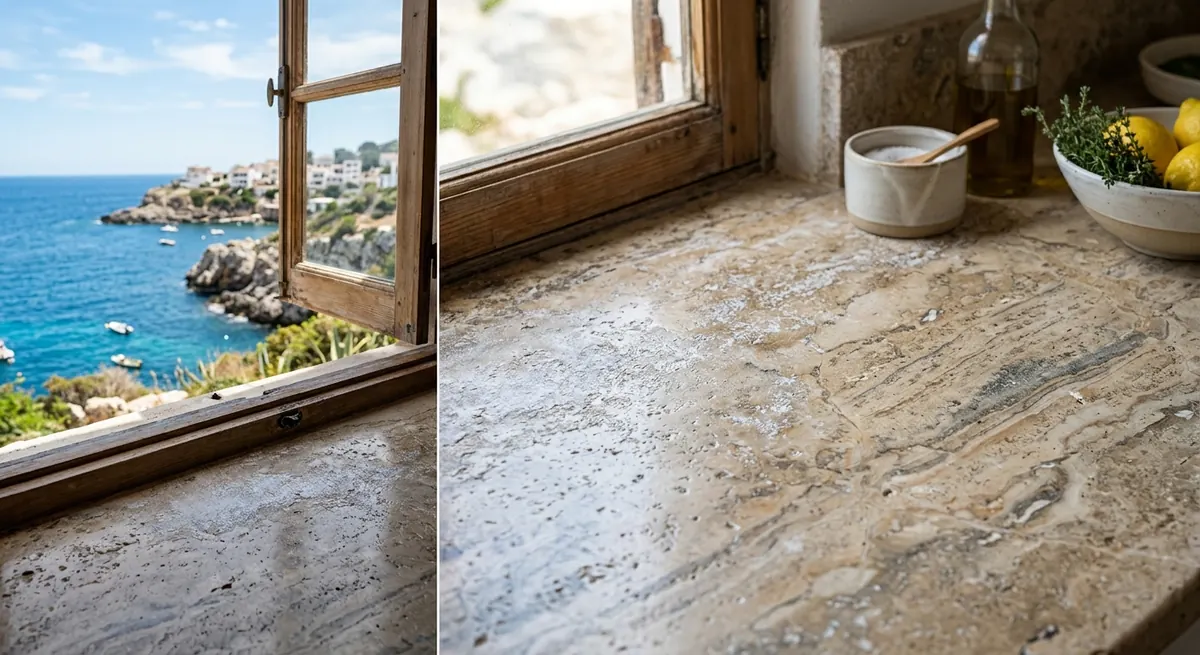
Limestone and travertine look stunning against the pale stone villas typical of the Alpes-Maritimes hinterland style, but I steer most coastal clients away from them for kitchen counters specifically. Both are noticeably softer and more porous than granite, and I have seen a honed limestone top in a Beaulieu-sur-Mer kitchen develop dull salt-etching rings within eighteen months despite regular sealing. Marble has the same vulnerability plus a tendency to etch from lemon juice and vinegar, both kitchen staples in Provençal cooking. If a client insists on the marble look for its visual warmth, I now usually recommend a quartzite instead, which shares the veining aesthetic but is considerably harder and less reactive, for roughly €600 to €1,100 per square metre installed from fabricators around Nice and Mandelieu.
Quartz: The Practical Default, With One Sun-Related Caveat
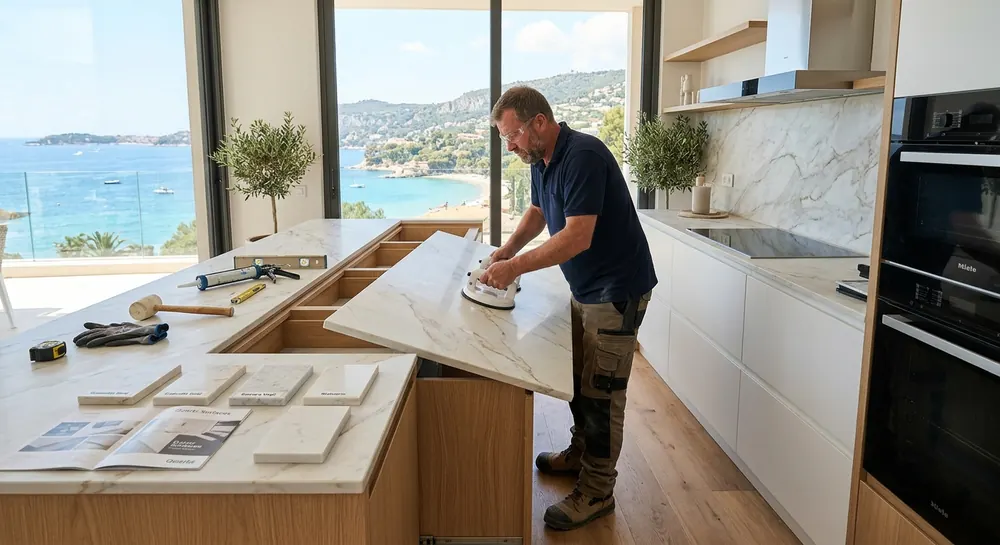
Engineered quartz has become the default recommendation for perhaps six out of ten Riviera kitchen renovations I manage, and the reasoning is straightforward. It is non-porous, so it never needs sealing, resists salt staining completely, and shrugs off the humidity swings that worry homeowners in beachfront apartments in Cagnes-sur-Mer or Golfe-Juan. Installed pricing generally sits between €400 and €750 per square metre for mainstream brands, rising to €900-plus for premium large-format slabs that minimise visible seams, which matters a lot on the long islands now standard in renovated villas near Mougins and Valbonne. Maintenance is essentially wiping it down; there is no annual resealing ritual to forget.
The one genuine limitation is UV sensitivity in resin-bound quartz. Direct, sustained sun exposure, the kind you get on a kitchen counter sitting under a glazed roof lantern or facing unobstructed south toward the Baie des Anges, can cause gradual yellowing or fading over eight to ten years on lighter colours. I learned this the hard way on a Cap d'Antibes project where a bright white quartz run under a large skylight showed a visible tone shift after about seven summers, while the same counter away from direct light stayed pristine. For south-facing, heavily glazed kitchens, I now specify either darker, pigment-stable quartz colours, a UV-rated outdoor-grade quartz line, or switch that specific zone to porcelain, which has none of this vulnerability and now runs a similar €450 to €800 per square metre installed.
Wood Countertops: Warmth That Needs Real Discipline Near the Sea
Wood brings a warmth that stone and quartz simply cannot replicate, and on the Riviera it pairs beautifully with the Provençal and mid-century villa styles common from Golfe-Juan to Roquebrune. Oiled oak or iroko butcher-block counters run €250 to €500 per square metre for materials and fabrication, with teak, which handles humidity noticeably better, climbing to €450-€600. The appeal is real: nothing softens an all-white or all-stone kitchen faster than a single wood run on an island or a breakfast bar. I have used it successfully as an accent material in a dozen Riviera kitchens, almost always on the island rather than the full perimeter.
The honest trade-off is maintenance discipline, and coastal humidity makes this stricter than it would be in Aix or Avignon. Wood near a sink or dishwasher in a seafront apartment needs oiling every two to three months rather than the twice-yearly schedule that works fine twenty kilometres inland, because ambient moisture and salt air both accelerate wood movement and raise grain faster. Skip that maintenance and you will see graying, slight cupping at the edges, or water rings within a single season, which is exactly what happened to a client's teak counter in a ground-floor Nice apartment two summers back before we caught it and refinished the surface. My rule for the coast: wood works wonderfully on a dry island away from direct splash zones, but I rarely recommend it as the sole material around a working sink in a true seafront property.
Building a Smart, Mixed-Material Kitchen
The best Riviera kitchens I design today rarely use a single countertop material throughout, and that is a deliberate strategy rather than a compromise. A common configuration I now propose for villas in Mougins or apartments in Cannes is quartz around the sink, hob, and high-traffic prep zones where non-porosity and zero maintenance matter most, combined with a warm wood run on the island end used for dining and casual seating where moisture exposure is minimal. For clients wanting a genuine stone look, pairing a hardy granite or quartzite perimeter with a quartz island, or vice versa, lets you balance authenticity against long-term upkeep without doubling your maintenance calendar.
Whichever combination you choose, build a simple maintenance rhythm into your calendar rather than relying on memory: reseal natural stone every 12-18 months near the coast, re-oil any wood section every two to three months if it sits within a metre of water, and wipe down quartz weekly with a mild, non-abrasive cleaner to prevent salt film buildup around edges and seams. Budget-wise, for a typical 10-12 square metre Riviera kitchen counter run, expect €4,500 to €9,000 all-in for a quality quartz installation, €5,500 to €11,000 for granite or quartzite with proper edge detailing, and €2,500 to €6,000 for a wood-dominant layout, figures I have seen hold fairly consistently across fabricators working between Nice and Monaco over the past couple of renovation seasons. Get quotes from at least two local stone yards, since slab availability and transport from Italian or Portuguese quarries can shift pricing by 10-15% depending on the month.
Frequently asked questions
Engineered quartz is generally the most durable choice for seafront properties because it is non-porous and completely resistant to salt staining, unlike granite or limestone which need regular resealing in humid, salty air. The only caveat is choosing a darker or UV-stable quartz colour if the counter sits under direct, unobstructed sun for many hours a day.
Yes, but treat it as an accent rather than a full perimeter solution near the coast. Oiled teak or iroko on a dry island, away from the sink and dishwasher splash zone, performs well if re-oiled every two to three months; wood placed directly around a working sink in a humid seafront kitchen will show graying or cupping much faster than inland.
For a typical 10-12 square metre run, budget roughly €4,500 to €9,000 for quartz, €5,500 to €11,000 for granite or quartzite, and €2,500 to €6,000 for a wood-dominant layout, including fabrication and installation by a local stone yard or carpenter.