
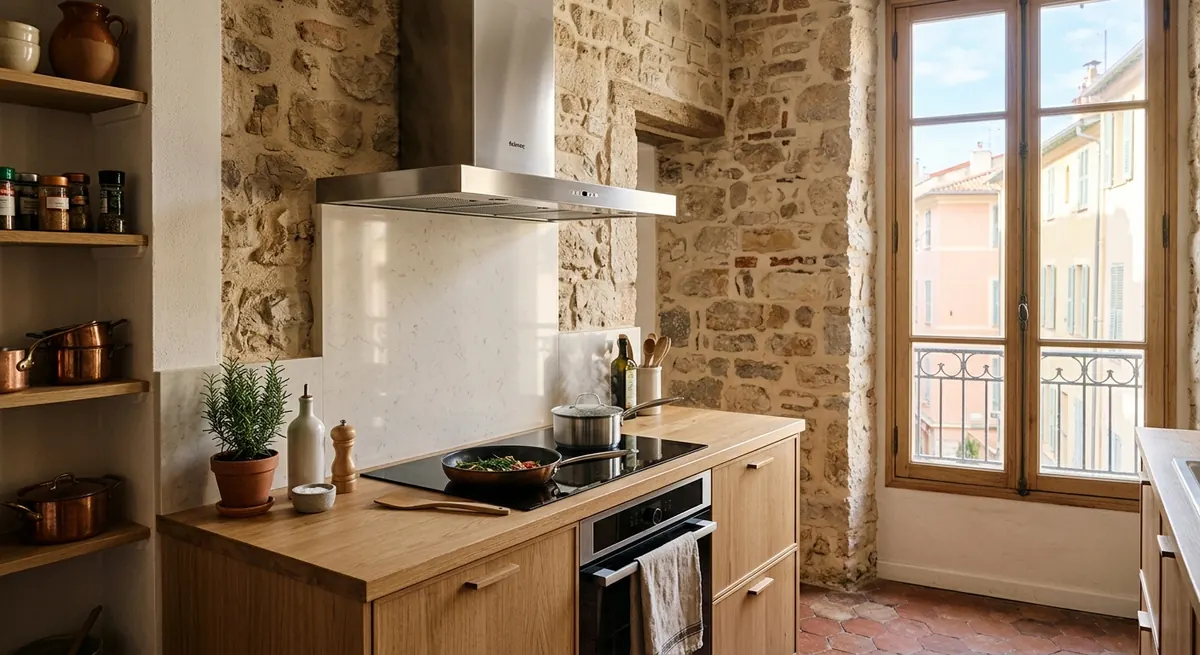
Why Pre-War Nice Apartments Rarely Have a Ready-Made Shaft
Buildings going up between 1880 and 1939 in Vieux Nice, the Carré d'Or, or around Place Garibaldi were simply not designed with kitchen extraction in mind. Cooking happened on wood or coal stoves vented, if at all, through a chimney flue shared with the fireplace in the salon. When those flats were later carved up or modernised in the 1960s and 1970s, kitchens often moved into interior rooms or former maid's quarters with zero connection to the facade or roof. I have opened more than thirty of these kitchens over the years and found an existing usable shaft in maybe one case out of five, usually where a chimney breast survived intact.
The practical consequence is that you cannot assume ducting will simply drop into a pre-built channel the way it might in a 1990s Antibes residence. You are usually looking at either drilling a new path through a 40 to 60 cm thick stone or rubble-filled party wall, running ducting across a false ceiling to an existing chimney stack, or accepting a recirculation hood with carbon filters if structural options are exhausted. Each of these choices has very different cost, noise, and approval implications, which is why the diagnostic visit before any quote matters more here than in newer construction.
The Three Realistic Routing Options and What They Cost
Option one, and the cleanest when feasible, is tapping into an old disused chimney flue that runs from the kitchen up through the roof. A ramoneur or heating engineer needs to confirm the flue is not shared with another dwelling's active appliance and is structurally sound, which typically costs 150 to 250 euros for the inspection with a camera. If it checks out, connecting a 150mm duct with a tee adaptor and running flexible aluminium or rigid galvanised ducting up the flue runs 900 to 1,800 euros including a proper cowl at roof level, which in Nice co-ownerships almost always needs sign-off since you are touching a shared structure visible from outside.
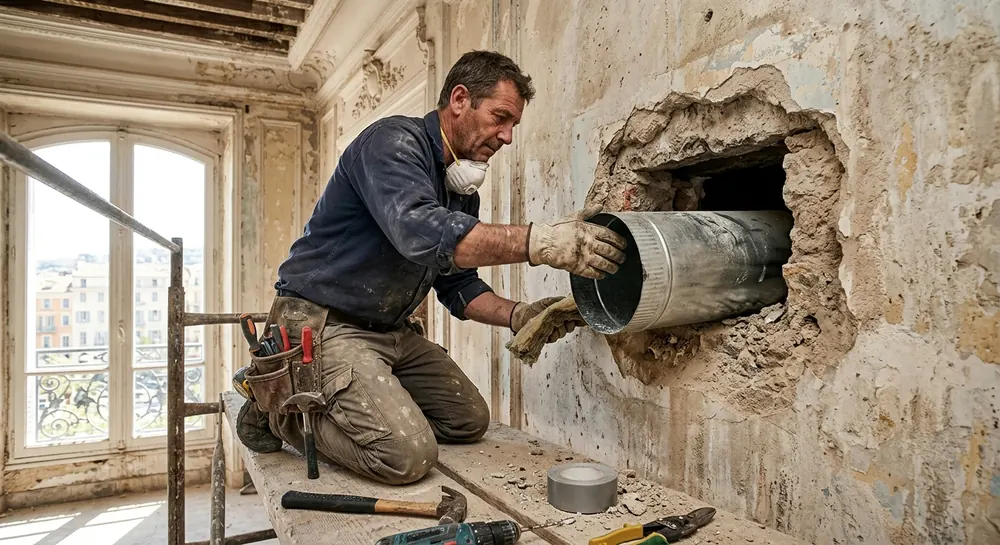
Option two is coring through an exterior wall directly behind the hob, often the solution in ground and first-floor flats in Riquier or Saint-Roch where the kitchen backs onto a courtyard rather than the street facade. A core drill through 50cm of old stone and lime mortar costs 200 to 450 euros depending on wall thickness and access, plus 150 to 300 euros for an aesthetic exterior grille that satisfies both ventilation and the facade's protected appearance if you are in a secteur sauvegardé zone. Option three, routing horizontally through a false ceiling to an existing collective ventilation shaft (VMC) shared by several flats, is common in Cimiez's 1930s buildings but requires written confirmation from the syndic that the shaft is rated for kitchen extraction rather than just bathroom humidity, since cross-contamination complaints from neighbours are a frequent source of disputes.
Getting Co-Ownership Approval Before You Touch Anything
Any work piercing a party wall, facade, or shared duct in a French copropriété falls under the règlement de copropriété and generally needs at minimum informing the syndic, and in most cases a vote at the assemblée générale. In Nice, where buildings along Rue de France or in the Carré d'Or often carry heritage constraints tied to the Site Patrimonial Remarquable, facade penetrations for extraction grilles almost always require an article 25 majority vote rather than simple notification, because you are modifying the common parts' external appearance. I always recommend requesting the agenda item at least two AGs in advance since these meetings happen once a year for most syndics and emergency extraordinary AGs cost owners 300 to 600 euros to convene.
Bring a one-page technical note from your installer specifying the grille's diameter, material finish, and exact location, plus photos showing how it compares to any existing vents on the same facade, because boards are far more likely to approve something visually unobtrusive. Expect to budget three to six months between first approaching your syndic and getting a signed procès-verbal authorising the work, longer if your building sits within view of the Colline du Château or Vieux Nice's protected perimeter where the Architecte des Bâtiments de France may also need to weigh in, adding another one to two months and sometimes a modest fee for the dossier. Owners who skip this step and drill anyway risk a mise en demeure from the syndic demanding restoration at their own cost, which I have seen run to 2,000 euros once render repair and repainting of the facade section are included.
Execution on Site: Contractors, Sequencing, and Realistic Costs
Once approval is in hand, sequence the work so the core drilling and ducting happen before kitchen cabinetry goes in, not after, which sounds obvious but is the single most common scheduling mistake I see in Nice kitchen projects. A specialist in old stone and rubble wall coring, rather than a general plumber, will charge more per hour (typically 55 to 75 euros) but works faster and causes less collateral cracking in lime-based walls that do not behave like modern concrete blocks. For a full installation including a 90cm induction-compatible ducted hood, 3 metres of insulated rigid ducting, the wall coring, and the exterior grille, total costs in central Nice run 1,800 to 3,200 euros, meaningfully higher than the 900 to 1,400 euros typical for the same job in a post-war Cagnes-sur-Mer or Antibes building with an existing shaft.
Noise and vibration transmission through old party walls deserve attention too: insulated ducting with acoustic lagging adds perhaps 15 to 25 euros per metre but prevents the extraction fan from becoming audible in a neighbour's bedroom on the other side of a 30cm wall, a complaint that can resurface at the next AG and sour relations for your entire ownership tenure. I also always specify a condensation trap or slight downward slope away from the hood on any horizontal run, since humid kitchen air condensing inside a cold stone-wall duct run is a slow but real cause of staining and mould that only shows up eighteen months after installation. Budget a contingency of 10 to 15 percent above quotes specifically for old-building surprises, usually buried electrical conduit or an unexpected second layer of stone encountered mid-core.
Frequently asked questions
Yes, if the duct passes through a party wall, facade, or shared ventilation shaft, since these are common parts under French co-ownership law. A recirculation hood needing no ducting generally does not require approval, but any penetration of shared structure typically needs an article 25 vote at the assemblée générale.
Often yes, provided a professional confirms the flue is structurally intact, unshared with another active appliance, and fitted with a proper roof cowl. Inspection costs 150 to 250 euros and the connection work typically runs 900 to 1,800 euros depending on flue height and condition.
Core drilling through 40 to 60cm of old stone and lime mortar typically costs 200 to 450 euros, plus 150 to 300 euros for an exterior grille suited to the building's facade, often with additional lead time if the building sits in a protected heritage perimeter.