
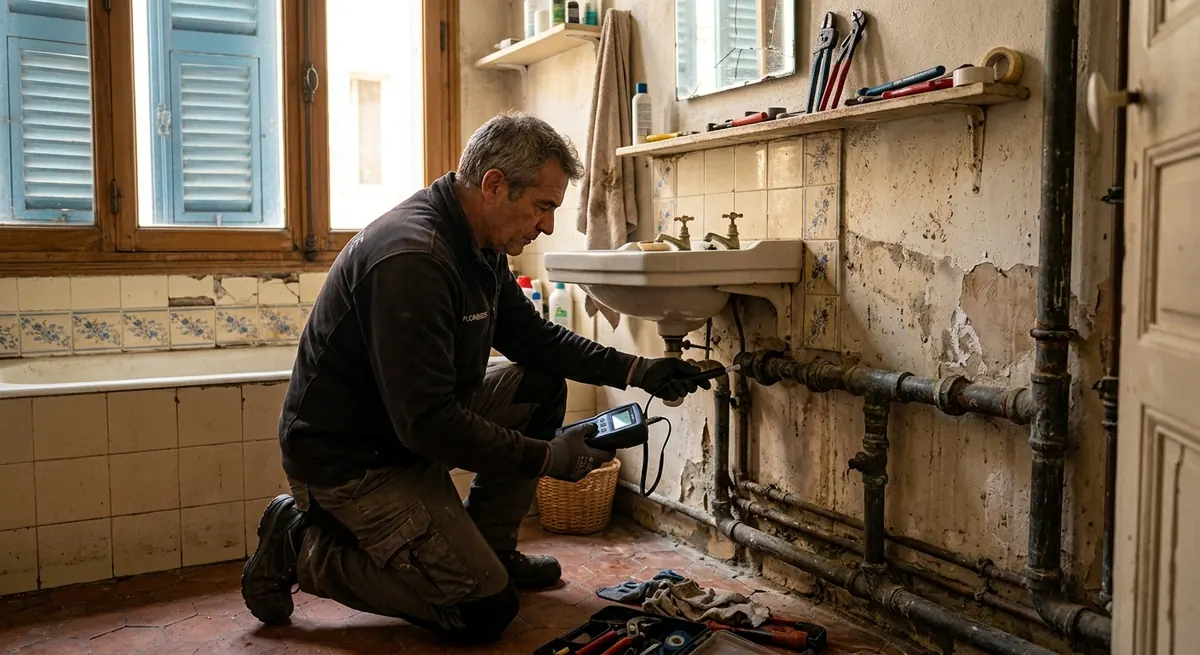
Why Pre-1960 Nice Apartments Are a Lead Pipe Hot Spot
Nice grew in distinct waves — the Belle Époque boom along the Promenade and in Cimiez, the dense tenement building of Vieux Nice and Le Port in the 1800s, and the interwar expansion around Riquier and Saint-Roch. Almost all of this housing stock was plumbed with lead, which was the standard material for both the public branchement (the pipe running from the street main to the water meter) and the internal distribution pipes right up until the 1950s, and in some poorer or less-renovated buildings, well into the 1960s. If your copropriété dates its façade or acte de propriété to before 1960, there is a genuinely high probability that at least part of the water circuit between the street and your tap is still original lead, even if the kitchen and bathroom have been remodelled twice since.
I have walked into more than one Cimiez apartment with a freshly retiled bathroom, induction hob and a 2,400-euro Italian shower screen sitting on top of a soft grey lead riser that nobody had ever looked at behind the washing machine. Renovation tends to stop at what's visible. Syndics often replaced common risers in buildings that did heavy 1980s-90s works, but plenty of smaller copropriétés in the Vieux Nice pedestrian streets, around Place Garibaldi, or in the modest four-storey buildings of Riquier never touched the plumbing because nobody complained and the water still came out of the tap. That's the trap: lead contamination is invisible, odourless and tasteless, and a building can look entirely renovated while still delivering water through forty metres of century-old pipe.
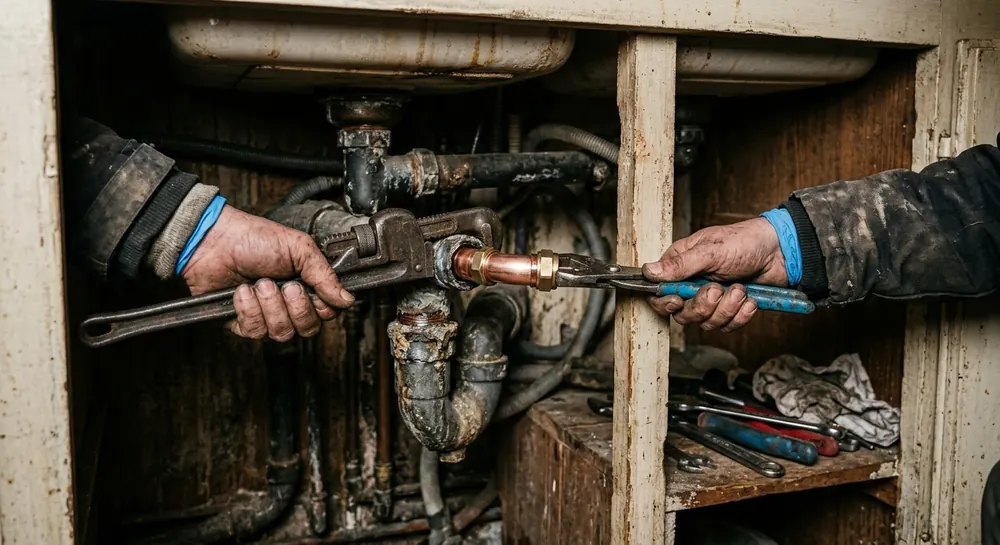
How to Spot Lead Pipe Yourself Before Calling a Professional
Lead pipe has a distinctive look once you know what to check. It's a dull, bluish-grey colour, noticeably softer than copper or steel — you can usually dent it slightly with a coin or the back of a spoon, and a small scratch reveals a bright, shiny silver surface underneath rather than the orange-brown of copper or the darker grey of galvanized steel. Crucially, lead is not magnetic, so a simple fridge magnet is one of the fastest field tests: if a magnet sticks firmly, you're looking at galvanized steel (which has its own issues, mainly corrosion and reduced flow, but not lead toxicity). Lead pipe joints are also a giveaway — they're typically wiped or bulged, almost sculpted by hand, because they were joined with molten lead-tin solder rather than threaded or soldered the way modern copper and PER fittings are.
Go looking in the obvious places first: right where the pipe enters the apartment near the water meter (compteur), under kitchen and bathroom sinks before any visible renovation, inside the gaine technique or utility cupboard shared by several floors, and in cellars or caves where the colonne montante often runs exposed along the wall. In Vieux Nice buildings with shared courtyards, the branchement sometimes runs externally along a wall before entering the building, and you can often see an old lead stub even if the rest was upgraded. If you're a buyer visiting with the agent, ask directly to see the compteur and the first metre of pipe — a good-faith seller or agent won't mind, and a reluctance to show you is itself informative. Don't rely purely on age of the building, either; I've seen 1920s buildings near the port fully repiped in copper during a 1990s heating system overhaul, and far newer 1958 blocks in Fabron that still have untouched lead because the original plumber used up old stock.
Testing Properly: Thresholds, Who Pays, and What a CREP Actually Covers
There's a common confusion worth clearing up immediately: the CREP (Constat de Risque d'Exposition au Plomb), which is legally required for the sale of any housing built before 1949 in France, tests for lead in paint and coatings — not in drinking water. It won't tell you anything about your pipes. What you actually need is a water lead analysis, and the French regulatory limit has been 10 micrograms per litre since 25 December 2013, a tightening down from the 25 µg/L standard that applied through the 2000s. Testing is done by taking a sample after the water has stagnated overnight (the «premier litre» or first-draw sample, which best reflects contact time with lead pipe) and sending it to an accredited lab such as Carso or Eurofins; expect to pay roughly 35 to 70 euros for a single-parameter lead test, or closer to 100-150 euros for a fuller potability panel covering nitrates, bacteria and other metals at the same time.
Responsibility splits cleanly along the pipe's route, and this matters enormously for who foots the bill. The public network and the branchement up to the water meter fall under Régie Eau d'Azur in Nice (or Veolia and SCP in some neighbouring communes like Cagnes-sur-Mer or Villeneuve-Loubet), and these operators have been running systematic lead-service-line replacement campaigns for years, often at no direct cost to the resident when the line is confirmed as lead — it's worth calling them directly to check if your street has already been treated or is scheduled. Everything from the meter into the building, including the colonne montante if it serves several apartments, is typically the copropriété's responsibility and gets voted at assemblée générale; the final stretch from the riser into your private kitchen or bathroom is yours alone as the owner. For tenants, French law (decree n°2002-120 on logement décent) obliges the landlord to supply water meeting potability standards, so if a test comes back above 10 µg/L, you can formally request remediation through a registered letter, and in persistent cases involve the ARS PACA (Agence Régionale de Santé), which can order works.
Replacement Work: Realistic Costs and How the Job Actually Runs
Once lead is confirmed, replacement is usually done with PER (polyéthylène réticulé) for concealed runs or copper where pipework stays visible or where higher temperature tolerance matters, such as near a chaudière. For a single apartment of 50-70m² in central Nice — say a typical Riquier or Libération two-bedroom — a full internal repipe replacing kitchen, bathroom and all branch lines back to the entry point typically runs 3,500 to 7,000 euros depending on wall access, whether you're willing to have chases cut into plaster (more mess, lower cost) or prefer pipes run in protective gaines along skirting and false ceilings (cleaner, pricier). A more targeted job — just the lead riser section feeding a single kitchen and bathroom, leaving the rest of a recently-renovated circuit intact — can come in at 1,200 to 2,500 euros if the plumber has straightforward access through an existing gaine technique.
Shared risers serving multiple floors are a different animal because they require a vote at the assemblée générale and coordinated access to several apartments, which is exactly the kind of project that drags on in older Nice copropriétés with absentee owners or seasonal residents in Cannes and Monaco-adjacent buildings. Realistic budget for replacing a full colonne montante in a six-storey building is often 15,000 to 35,000 euros split across the lots according to the tantièmes, and getting it onto the agenda can take two or three AG cycles unless there's a documented health risk forcing the syndic's hand — a lab report showing lead above the legal limit is the single most effective way I've seen to accelerate that vote. Always ask for at least two devis from artisans with assurance décennale, confirm they're doing a pressure test after the work, and get a certificate or facture detailing the materials used (PER brand, diamètre, DTU 60.11 compliance) — this paperwork matters again the day you resell.
A Practical Roadmap: Buyers, Renters and Interim Protection
If you're buying, build the lead question into your négociation from the first visit, not after the compromis de vente. Ask the notaire or agent for any existing water analysis, request to inspect the meter area yourself, and if nothing exists, make your offer conditional on a water lead test during the due-diligence period — it costs you under 100 euros and can justify a genuine price reduction of several thousand euros if lead is confirmed, since the buyer will be the one paying for replacement. Don't be swayed by a renovated kitchen alone; always ask specifically «est-ce que la colonne montante et l'arrivée d'eau ont été refaites, et en quelle année» (has the riser and water inlet been redone, and when), because that's the question agents rarely volunteer an answer to unprompted.
If you're renting, you have fewer levers but real ones: send a courrier recommandé requesting a water lead test if you have any doubt, particularly if you're pregnant, have young children, or the water runs with a noticeable metallic taste or slight discolouration after standing overnight — both are classic, if not definitive, indicators. While you wait for landlord action or if a rapid fix isn't feasible, two interim measures genuinely reduce exposure: run the cold tap for 30 to 60 seconds each morning before using water for drinking or cooking (lead concentration rises with stagnation time, so a brief flush meaningfully cuts exposure), and never use hot tap water for cooking or baby formula, since hot water leaches lead more readily. A certified carbon or reverse-osmosis filter rated for lead removal (check NF or NSF/ANSI 53 certification) costs 80 to 300 euros and is a sensible stopgap, but it's a bridge, not a substitute for getting the actual pipe replaced.
Frequently asked questions
No, there is no mandatory water-lead diagnostic for property sales in France, unlike the CREP for lead paint on pre-1949 buildings. A water lead test is strongly recommended but remains optional, so buyers need to request it themselves or negotiate it as a condition in the compromis de vente.
That section, the branchement, falls under Régie Eau d'Azur or the relevant local water operator, and most have active programmes replacing confirmed lead service lines, often at no direct cost to the resident. Contact them directly with your address to check if your street section has already been scheduled or completed.
Check accessible sections near the water meter, under sinks and in the cellar or gaine technique: lead is dull grey, soft enough to dent with a coin, not magnetic, and has hand-wiped bulging joints rather than threaded or soldered fittings. If visual inspection is inconclusive, a 35-70 euro accredited water lead test is the definitive answer.