
Why Pre-War Nice Buildings Lose Pressure in the First Place
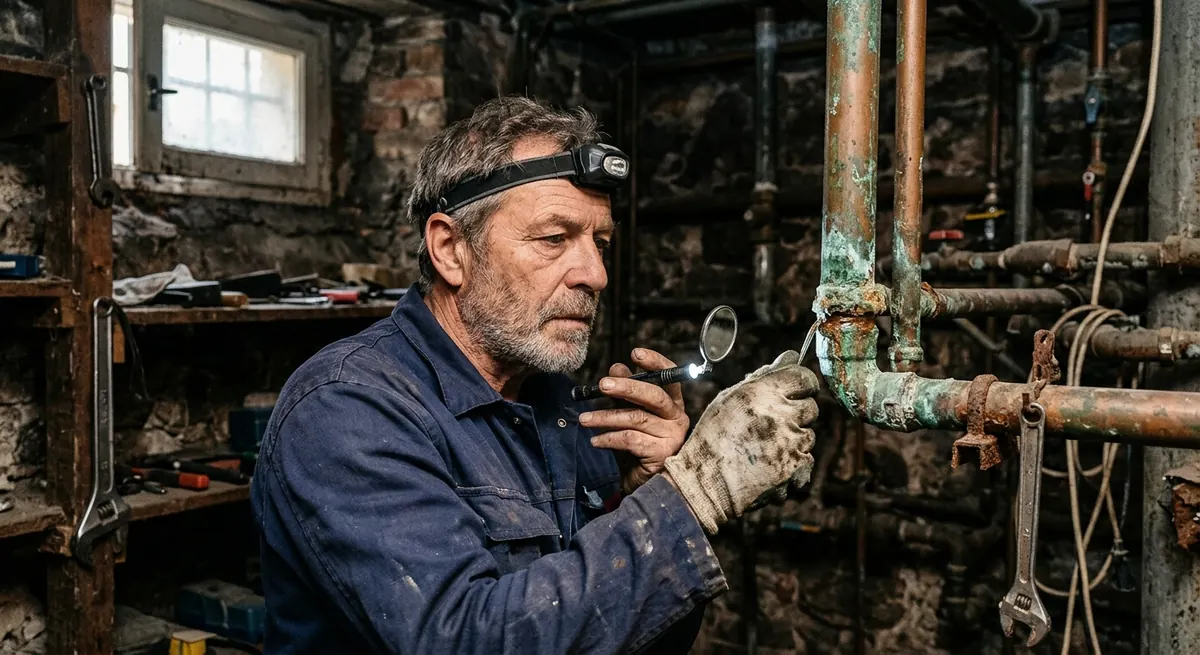
I have crawled through more colonnes montantes in Vieux Nice and Cimiez than I can count, and the pattern repeats itself building after building: a galvanized steel riser installed between 1900 and 1935, never fully replaced, slowly closing in on itself like an artery. Riviera water is hard, loaded with calcium, and over eighty or ninety years that mineral film thickens on the inside of the pipe wall. A riser that started life with a 20mm internal bore can end up functioning like a 10 or 12mm one, and physics does not negotiate: half the diameter means a fraction of the flow, especially once you are asking that pipe to feed six floors instead of two or three the way it originally did after later subdivisions.
The second culprit is architectural rather than chemical. Many of these buildings, from the Liberation district to the Port and up into Cimiez, were built with a single colonne montante and a single compteur general serving every apartment, sometimes fifteen or twenty units off one riser barely 25mm wide. Add a top-floor conversion of old chambres de bonne into rentable apartments in the 1980s or 1990s, and you have doubled the number of draw points without touching the supply pipe. Combine scaled-down bore with more simultaneous demand at 7:30am and 7pm, and the top two floors are the ones who feel it first and worst — often down to 0.5 or 1 bar at the tap when they should see 2.5 to 3 bar.
How to Actually Diagnose the Problem Before Spending a Euro
Do not start with a plumber invoice — start with a manometer, which costs about 15 to 25€ at any Nice quincaillerie or on a hardware site, and screws directly onto an outdoor tap or washing machine valve. Test at different times: 8am, 1pm, 8pm, and late at night around 11pm when nobody else is drawing water. If your pressure swings from 0.8 bar at peak hours to 2.5 bar at midnight, that is a strong signature of an undersized or scaled shared riser rather than a fault specific to your apartment. If it stays flat and low no matter the hour, suspect either a private branch problem, a stuck reducer valve inside your own unit, or genuinely low pressure arriving from the street main serving that block, which does happen in a few pockets around Riquier and parts of the old town.
It is worth a phone call to Régie Eau d'Azur, who manage the network for Nice, Cagnes-sur-Mer and several neighboring communes; they can tell you the nominal pressure at your street's connection point, typically between 3 and 4.5 bar in central Nice. If that number is healthy but your tap pressure is not, the loss is happening inside the building, which points squarely at the syndic's responsibility for the colonne montante rather than your own installation. I also always ask neighbors on different floors to test simultaneously with a WhatsApp group — it takes fifteen minutes and instantly tells you whether this is a building-wide fault or isolated to one stack, which changes the entire solution and who pays for it.
The Two Real Fixes: Booster Pumps and Pressure Reducers, and When to Use Which
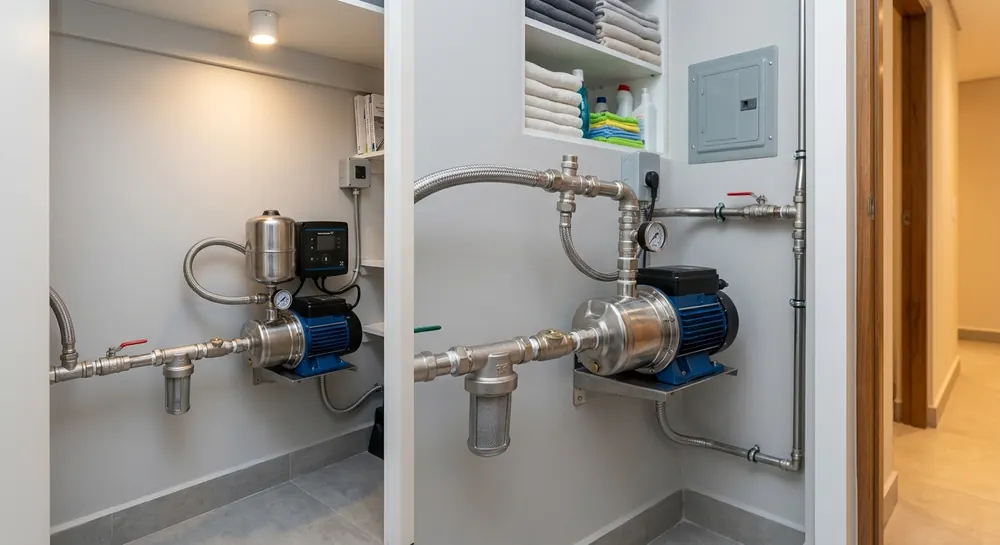
A pressure reducer, or reducteur de pression, solves the opposite problem — pressure that is too high, over 5 bar, which causes banging pipes and premature failure of joints. If your issue is genuinely low pressure, a reducer will not help and may even make things marginally worse; you need a surpresseur, a booster pump that actively raises pressure rather than limiting it. For a single apartment, a compact domestic booster like a Wilo-Sub or a small Calpeda unit installed just after your private stopcock runs about 600 to 1,200€ fitted, and can lift a weak shower from 0.8 bar to a comfortable 2.5 bar within a day, no copropriété vote needed since it only touches your own installation. I have fitted a dozen of these in fourth and fifth floor Nice apartments in the last two years and the satisfaction rate is high, provided the incoming water at your meter is at least somewhat present rather than near zero.
When the problem affects the whole stack, the durable answer is a collective booster pump installed at the base of the building, feeding all floors, sized to the number of apartments and floors — for a six-story building with fifteen units this typically runs 8,000 to 18,000€ including the pressure tank, control panel and installation, rising toward 25,000€ if electrical upgrades or a dedicated technical room are needed. This requires a vote at the assemblée générale of the copropriété, usually passed at simple majority since it is considered maintenance rather than improvement, and costs are split by tantièmes. If the riser itself is badly scaled rather than just under-pressured, replacing the colonne montante in copper or PER is the more radical but more permanent fix, typically 15,000 to 45,000€ for a five or six floor building depending on wall access and whether it can be run in existing gaines or requires opening plaster — expensive, disruptive, but it also resolves brown water and banging pipe complaints at the same time.
Getting It Through the Syndic Without a Two-Year Fight
The single biggest obstacle is rarely technical, it is procedural. Get an independent diagnostic first, ideally from a plumbing engineer rather than just an installer trying to sell you a pump — a proper report costs 300 to 600€ and gives you pressure readings, pipe material assessment, and often a camera inspection of a riser section, which is invaluable ammunition at the AG. Bring at least three comparative devis to the syndic meeting; I have seen quotes for the same collective surpresseur job vary by 40% between firms simply because one included a five-year maintenance contract and another did not. Vote it as an urgent maintenance item under article 24 rather than an amelioration under article 26 where possible, since the majority threshold is easier to reach when residents are already fed up with cold trickles at 8am.
In the interim, while you wait for the AG calendar — often six to twelve months away — a point-of-use booster on your shower or kitchen mixer, 250 to 450€ installed, buys real comfort without waiting for consensus among fifteen co-owners. I also recommend asking the syndic to have the concierge or gardien check the general stopcock and any inline strainer at the base of the riser; a partially closed valve or a clogged filter, sometimes untouched since the last chaudière collective was serviced, is a shockingly common and free fix that I find in maybe one building out of five I am called to in the Carre d'Or or around Rue de France.
Living With It Long-Term: Maintenance That Actually Prevents a Repeat
Once a fix is in place, whether a private booster or a collective installation, put a basic maintenance rhythm on the copropriété's annual budget: an annual check of the pump's pressure switch and expansion vessel, roughly 120 to 200€ per visit, and a five-yearly full descaling or inspection of accessible riser sections if full replacement was not financially possible in one go. Buildings that phase the colonne montante replacement floor by floor over three or four years, rather than trying to fund the whole thing at once, tend to get consensus faster and spread the financial pain — I have managed this approach on a building near Place Garibaldi where we did the ground-to-third-floor section one year and the rest eighteen months later, each phase around 9,000€, and it was far easier to vote through than one 20,000€ lump sum.
Finally, keep a simple pressure log using that 20€ manometer, checked monthly for six months after any fix — it is the cheapest insurance you have against a slow slide back into scaled pipes or a failing pump you do not notice until it fails completely on a Saturday night with guests in from Cannes. Nice's hard water will keep depositing scale regardless of what you install, so anyone doing a full riser replacement should seriously consider a whole-building softener or at minimum a polyphosphate dosing unit at the meter, about 400 to 900€, which meaningfully slows the whole cycle from starting again in another eighty years.
Frequently asked questions
If the problem originates in the shared colonne montante or a collective booster pump, it is a common charge split among all owners by tantièmes and must be voted at the assemblée générale. If it is isolated to your private branch pipe or fittings past your individual meter, you pay for it yourself.
A compact domestic surpresseur installed on your private line typically costs between 600€ and 1,200€ including fitting, and can be installed in a day without needing copropriété approval since it does not touch shared pipework.
Height loses roughly 0.1 bar per meter of elevation naturally, and in pre-war buildings this combines with decades of scale buildup inside the shared riser and, often, more apartments now drawing from the same undersized pipe than when the building was originally designed.