
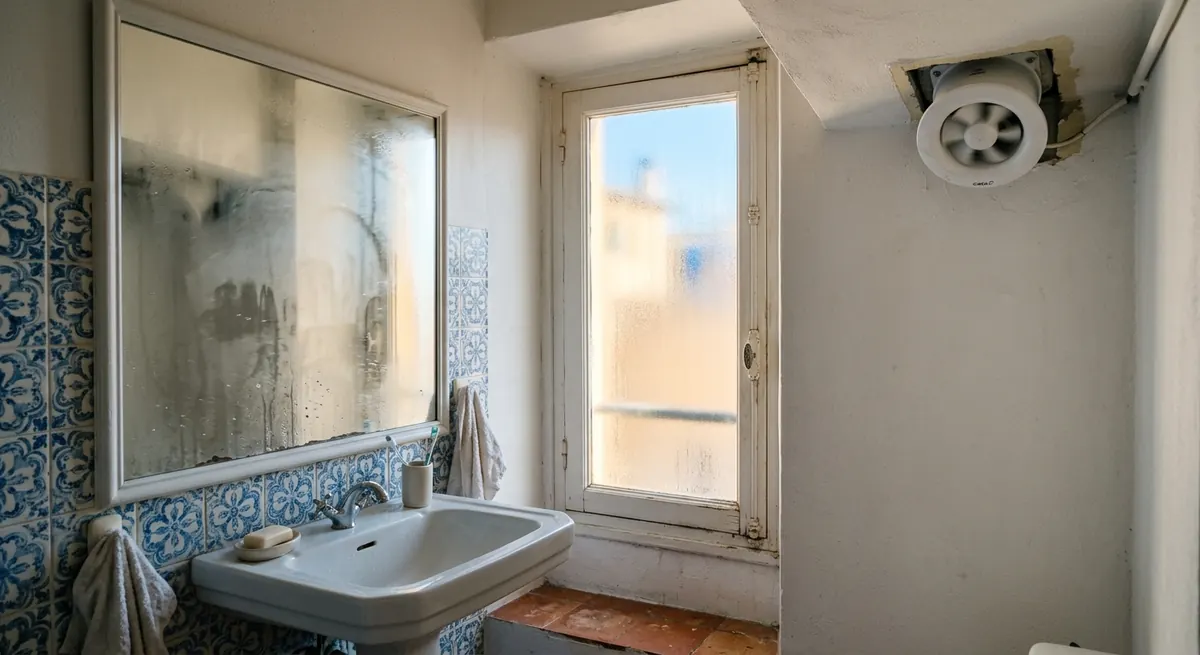
Why Riviera Bathrooms Turn Moldy Faster Than Inland Homes
I have crawled through enough vide sanitaires and gutted enough 1930s bathrooms in Nice's Vieux Nice and Riquier neighborhoods to say this plainly: coastal humidity is not the same beast as inland dampness. Between May and September, ambient humidity along the Promenade des Anglais regularly sits at 70 to 85 percent, and salt-saturated sea air carries microscopic droplets that settle on tile grout, silicone joints, and even paint film. That salt residue is hygroscopic, meaning it actually pulls moisture out of the air and holds it against your walls overnight. Combine that with a bathroom that has a single small window facing an interior courtyard, or no window at all, and you have built a laboratory-grade mold incubator without anyone doing anything wrong.
The building stock itself works against you. Many apartments in Cannes' Le Suquet and Antibes' old town were built between 1880 and 1950, with ventilation shafts (conduits de VMC or simple aeration passive) designed for a much drier, less airtight era. Owners in Monaco face a different but related problem: modern buildings with excellent double glazing and air conditioning create huge temperature swings between the cooled living areas and a humid, unventilated bathroom, which triggers heavy condensation on cold tile and mirror surfaces. I have opened false ceilings in Le Cannet apartments and found black mold colonies thriving quietly for two or three years, invisible from below, simply because nobody ever addressed the airflow problem at its source.
Reading the Signs: Is It Condensation, Infiltration, or a Dead VMC?
Before spending a single euro, diagnose correctly, because the fix for condensation mold is completely different from the fix for water infiltration mold. Condensation-driven mold shows up as fine black speckling on ceiling corners, around the shower curtain rail, and along window frames, typically worse in the coldest corner of the room. It smells musty but not swampy, and it wipes off fairly easily with diluted bleach, only to return within two or three weeks. Infiltration mold, by contrast, often traces a plumbing line, appears as a spreading stain with a yellowish or brownish halo, and frequently comes with a spongy or bubbling texture in the paint or plaster underneath. If you see that halo pattern, call a plumber before you touch a paintbrush, because painting over an active leak just hides a much bigger bill later.
A quick and genuinely useful test costs nothing: buy a 15 euro hygrometer from any Nice hardware store like Monsieur Bricolage on Route de Grenoble and leave it in the bathroom for a week, checking readings after showers. If humidity spikes above 70 percent and takes more than 30 to 40 minutes to drop back below 60 after a shower, your extraction is inadequate, full stop. I also tell clients to hold a lit incense stick or a tissue near the extractor grille while the fan runs; if the smoke or tissue is not pulled firmly toward the vent, the ductwork is either blocked, disconnected, or the motor has failed, which is astonishingly common in buildings over 25 years old where nobody has ever cleaned the shaft.
Fixing the Airflow Problem: Realistic Options and What They Cost
If your bathroom has no mechanical extraction at all, which is still true for a surprising number of older Nice apartments, installing a simple extractor fan wired to the light switch or a humidity sensor is the single highest-impact fix available. Expect to pay 150 to 250 euros for the unit itself (Aldes and Vortice are the brands most Riviera electricians reach for first) plus 150 to 300 euros in labor for a straightforward installation through an existing exterior wall or shaft, so budget 300 to 550 euros total for a basic job done properly by a registered electrician. If the fan needs to be humidity-triggered rather than switch-triggered, which I strongly recommend for rental apartments in Cannes where tenants forget to run it, add roughly 60 to 100 euros for the hygrostat model.
For buildings that need a full mechanical ventilation upgrade, a VMC simple flux installation covering a full apartment typically runs 900 to 1800 euros installed, while a VMC hygroreglable, which automatically adjusts extraction rates based on measured humidity in each room, costs 1800 to 3500 euros depending on how many wet rooms need coverage and how accessible the existing ductwork is. I have specified hygroreglable systems on three renovations in Antibes over the past couple of years specifically because they cut bathroom mold recurrence dramatically compared to constant-flow systems, and the energy savings on heating partly offset the higher upfront cost. If a full VMC is not in the budget this year, a portable dehumidifier rated for small rooms, running two or three hours after each shower, costs 150 to 300 euros to buy and roughly 3 to 6 euros a month in electricity, and it is a genuinely effective stopgap while you save for the proper fix.
Removing Existing Mold Safely, Without Making It Worse
For surface mold on tile grout, silicone joints, and painted plaster, skip the bleach-and-water folklore that gets repeated endlessly online; bleach kills the visible spores on the surface but does not penetrate porous grout or plaster, so the colony regrows from underneath within weeks. Instead, use a dedicated anti-mold product such as HG Mold Remover or Starwax's specialist spray, available at Nice-area Weldom or Leroy Merlin stores for 8 to 15 euros a bottle, applied generously and left to work for the full contact time stated on the label, usually 15 to 30 minutes, before scrubbing with a stiff nylon brush and rinsing thoroughly. Always ventilate hard during and after this process, opening the window and running the extractor, because the fumes from these products are genuinely unpleasant in a small enclosed room.
When mold has gotten into plaster, behind tiles, or into a false ceiling cavity, which I see regularly in ground-floor apartments near Nice's port where damp rises from below, surface cleaning is not enough and you need remediation. A professional mold treatment for a single bathroom, including anti-fungal treatment, resealing joints, and repainting with an anti-mold coating, typically costs 300 to 800 euros depending on surface area and severity, while more extensive work involving replastering or partial tile removal can run 1200 to 2500 euros. Get at least two quotes from local artisans specializing in traitement anti-humidite, since I have seen quotes for the identical job vary by 40 percent between companies in the Nice-Cannes corridor, and always ask specifically whether the price includes addressing the ventilation cause, not just cosmetic removal, because otherwise you are paying to repeat this exercise again next summer.
Long-Term Habits and Materials That Actually Keep Mold Away
Once the airflow is sorted, the materials you choose make a real difference over a five to ten year horizon. Repainting a bathroom with a dedicated anti-mold or salle de bain formulated paint, rather than standard wall paint, costs a bit more upfront at 30 to 45 euros for a 2.5 liter tin versus 20 to 25 euros for standard paint, but the additive fungicides genuinely extend the interval before regrowth, especially on ceilings above showers. Similarly, when resealing a shower enclosure or bathtub, insist on a mold-resistant silicone sealant with fungicide additive, sold for 8 to 12 euros a tube at any Riviera hardware store, and plan to redo that seal every two to three years regardless of appearance, since even the best silicone loses its fungicidal properties well before it looks visibly dirty.
Daily habits matter just as much as products, and this is the part clients resist most because it requires actual behavior change. Wiping down wet tile and glass with a squeegee after every shower takes 30 seconds and removes the standing moisture that mold needs to establish itself; I keep a 5 euro squeegee hanging in every bathroom I renovate specifically for this reason. Leave the bathroom door open for at least an hour after showering to let humidity disperse into the rest of the apartment rather than trapping it in one small room, and if you are away from your Riviera apartment for weeks at a time, as many Cannes and Monaco owners are, leave a small dehumidifier or even a moisture-absorbing box like a 5 euro Absorbeur d'humidite running continuously, because an unattended humid bathroom over a two-week absence is exactly when I have seen the worst colonization occur.
Frequently asked questions
Cleaning removes visible mold from the surface but does not fix the underlying cause, which along the Riviera is almost always inadequate ventilation combined with high ambient humidity and salt-laden sea air. Unless the room's airflow problem is addressed with a working extractor fan or VMC, mold will keep returning within weeks of any cleaning, no matter how thorough.
A basic switch-triggered extractor fan installed by a registered electrician typically costs 300 to 550 euros total including the unit and labor. A humidity-sensing model adds roughly 60 to 100 euros, and a full VMC hygroreglable system for an entire apartment runs 1800 to 3500 euros depending on the number of wet rooms.
Bleach kills surface spores but rarely penetrates porous grout or aging silicone, so mold typically regrows within a few weeks. A dedicated anti-mold product left on for its full contact time, followed by scrubbing and thorough rinsing, works far better, and severely affected silicone joints should simply be cut out and replaced with a mold-resistant sealant.