
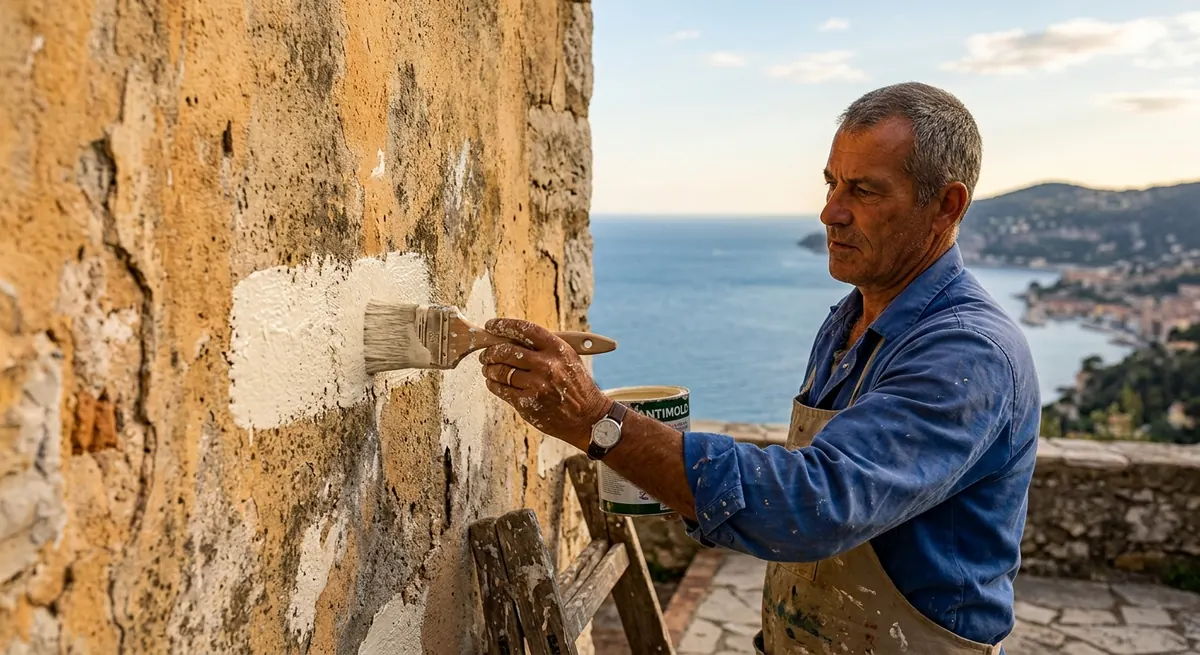
Why Mold Keeps Coming Back on Sea-Facing Shutters
Walk along the Promenade des Anglais or up toward Mont Boron and you will see the same pattern on nearly every third-floor balcony: shutters that were repainted eighteen months ago already showing those telltale grey-green speckles at the bottom slats. It is not bad luck and it is rarely bad paint on its own. The real culprit is a combination most homeowners underestimate — fine salt particles carried by onshore wind settle into the wood grain or aluminum joints, they are hygroscopic, meaning they actually pull moisture out of the air and hold it against the surface long after a rain shower has dried everywhere else. That trapped film of brine-laced water is exactly what mold spores need to colonize, and standard acrylic paints simply cannot bridge that cycle.
The second factor is orientation, which matters more here than almost anywhere else in France. A shutter facing due south in Antibes gets hammered by UV that chalks ordinary paint within three summers, while the same house's east-facing shutters, shaded and damp most mornings, become a mold incubator instead. I have inspected villas in Cap d'Antibes where the owner repainted every wall the identical off-white, not realizing the north and south elevations needed completely different prep and even different sheen levels. On the Monaco and Beausoleil side, add the particular humidity trap created by steep terrain and tall buildings blocking airflow, and you get facades that stay damp for hours after everyone else's have dried. Fix the diagnosis first, or any paint job — however expensive — buys you at most two seasons before the same stains reappear.
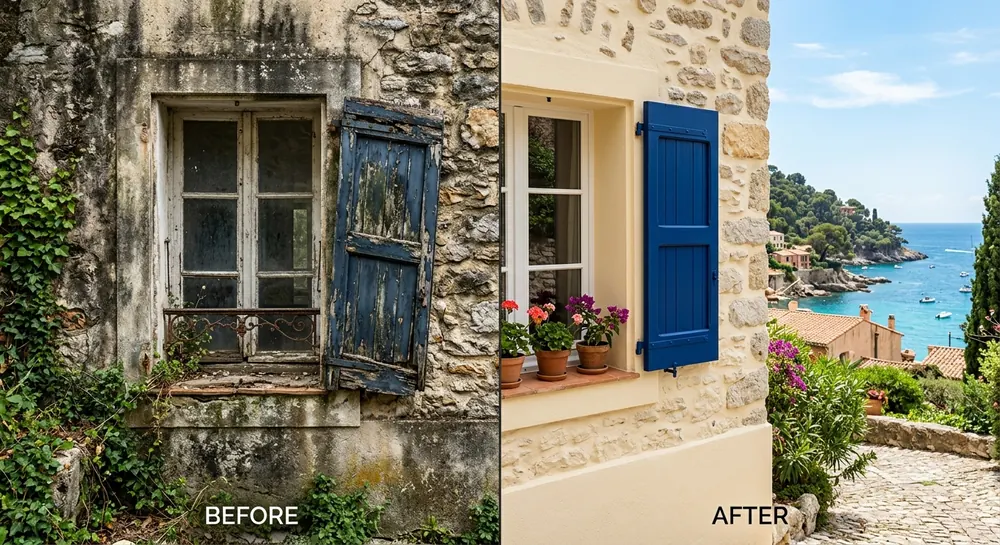
Reading the Substrate Before You Open a Single Tin
Before any quote gets written, I always run a moisture meter against the shutter slats and the lower third of the facade, typically finding readings of 18-22% on wood that looks perfectly dry to the eye, versus a healthy 10-14% on the same wood elsewhere. Anything above 16% on timber means paint has no business going on yet, full stop, because it will blister or let mold grow underneath the film within one rainy autumn. On rendered facades, tap-testing reveals hollow sounding patches where salt crystallization has pushed the render away from the wall, a classic issue on older Belle Époque buildings in central Nice where the original lime render was never designed for today's pollution and traffic salt runoff.
Materials matter too, and this is where I see the most costly mistakes. PVC shutters, common on 1980s-90s builds around Cagnes-sur-Mer, need a completely different approach than solid chestnut or meranti wood shutters typical of older Cannes properties — PVC needs a specific adhesion primer because standard paint simply peels off the slick surface within a year near the coast. Aluminum shutters, increasingly popular from Villefranche to Menton for their low maintenance reputation, actually trap condensation inside hollow profiles if drainage holes get clogged with salt crust and pollen, something I check with a simple flashlight inspection during every quote visit. Skipping this diagnostic stage to save an afternoon routinely costs clients 400-600€ extra later when the wrong system has to be stripped and redone.
Choosing a Paint System That Actually Survives Salt Air
For facades within two kilometers of the sea, I now almost exclusively specify siloxane or silicone-resin masonry paints rather than standard acrylics. Brands like Tollens Cristallin Façade or Seigneurie Ravaltop Siloxane run 48-68€ per 10-liter bucket more than a basic acrylic equivalent, covering roughly 6-8m² per liter depending on render texture, but their micro-porous structure lets trapped wall moisture breathe out while physically repelling liquid water and salt penetration. On pure acrylic jobs I have redone in Golfe-Juan, mold returned within fourteen months; the same walls treated with siloxane systems I inspected after four years in similar exposure were still clean. Expect full facade costs of 35-55€/m² including two coats and standard prep, rising toward 65€/m² on textured or previously failed coatings needing extra passes.
Shutters need their own logic entirely. Marine-grade microporous alkyds or the newer water-based polyurethane hybrids, such as V33 Volets and Boiseries Marine or Corlor's Haute Protection Façade Mer line, cost more per liter — typically 32-45€ for 2.5 liters — but include fungicidal and algaecide additives engineered specifically for coastal humidity rather than the generic mildewcide dosed into standard exterior paint. I specify satin rather than full gloss for sea-facing shutters almost every time now; gloss shows every salt crystal and water spot within weeks, while satin hides minor surface imperfections while still shedding water well. A full repaint of a standard 1.2m x 1.4m shutter pair, prep included, runs 180-280€ through a local artisan in the Nice-Cannes corridor, climbing to 320-380€ for larger Belle Époque shutters or anything requiring wood consolidation first.
The Prep Sequence That Actually Stops Recurrence
Paint quality matters less than people assume; prep is where mold recurrence gets solved or guaranteed. My standard sequence on Riviera jobs starts with a biocide wash — I use Xylophène Anti-Mousse or an equivalent quaternary ammonium based treatment, left to dwell 24-48 hours depending on humidity that day, which actually kills spore colonies rather than just bleaching the visible stain the way diluted bleach does. Skipping this step and going straight to sanding is the single most common DIY mistake I see; sanding without killing the colony first just aerosolizes spores across the whole surface and into surrounding cracks, guaranteeing regrowth within months. Expect this treatment alone to add 8-15€/m² to a quote, money that pays for itself within the first year.
After the biocide cures, full sanding down to sound substrate follows, then a dedicated anti-mold primer — not a universal undercoat — formulated with fungicidal barrier properties, something like Zinsser Perma-White exterior primer or the Seigneurie equivalent, applied at the manufacturer's stated film thickness rather than thinned to stretch coverage, a shortcut I still catch some painters doing to save fifteen minutes of rolling. On wood shutters with any rot pockets, epoxy wood consolidant gets injected before filling, adding perhaps 25-40€ per shutter but avoiding a full slat replacement later at 90-120€ each. Timing matters enormously here too: on the coast, humidity after 11am regularly climbs past the 80% threshold where paint adhesion suffers, so experienced crews schedule biocide and primer work for early morning only, between roughly 7am and 10am, something worth asking any quote you receive whether they actually plan around.
Maintenance Rhythm and When to Call a Professional
Even a correctly specified siloxane-and-marine-paint system is not a lifetime fix-and-forget solution on this coast; it is a maintenance rhythm. I advise clients from Nice to Menton to do a visual inspection every spring after the winter storms, checking shutter hinges and lower slat edges first since that is where water pools and salt concentrates. A light rinse with fresh water twice a year, ideally after any mistral-driven sea spray event, costs nothing but a garden hose and twenty minutes, yet it removes the salt crust before it has time to pull moisture and start a new mold colony. Properly prepped and painted shutters on a south or west sea-facing elevation should realistically need a light maintenance recoat around year five to six, versus year two on poorly prepped jobs — that gap alone represents real savings, often 600-900€ over a decade on an average villa with eight to ten shutters.
Knowing when to stop DIYing matters as much as the technical steps. If mold keeps returning on the same spot within one year despite fresh paint, that is almost always a moisture intrusion issue behind the surface — a failed joint, a blocked weep hole, condensation from an AC unit dripping onto the wall below — not a paint problem, and no amount of better paint fixes it until that source gets diagnosed and resolved, sometimes by a different trade entirely. For full facade work above two stories, scaffolding and safety requirements alone push most Riviera jobs toward professional crews regardless of skill level; local artisan day rates run 280-380€ including insurance, and a typical villa facade plus shutters package takes a two-person crew four to six working days depending on exposure and surface condition. Get at least two quotes and ask specifically which biocide and primer products they plan to use — the answer tells you more about job quality than the final price alone.
Frequently asked questions
A marine-grade microporous alkyd or water-based polyurethane hybrid with fungicidal additives, applied in satin finish, performs best. Brands like V33 Marine or Corlor Haute Protection Façade Mer are specifically formulated for coastal salt and humidity exposure.
Usually the paint was applied over a live mold colony without a proper biocide treatment first, or moisture is intruding from behind the surface through a joint, hinge, or drainage issue that the paint alone cannot fix.
Expect 180-280€ per shutter pair for standard sizes including full prep, biocide treatment, and marine-grade paint through a local artisan, rising to 320-380€ for larger period shutters needing wood consolidation.