
Why So Many Nice Apartments Still Have Dangerous Old Panels
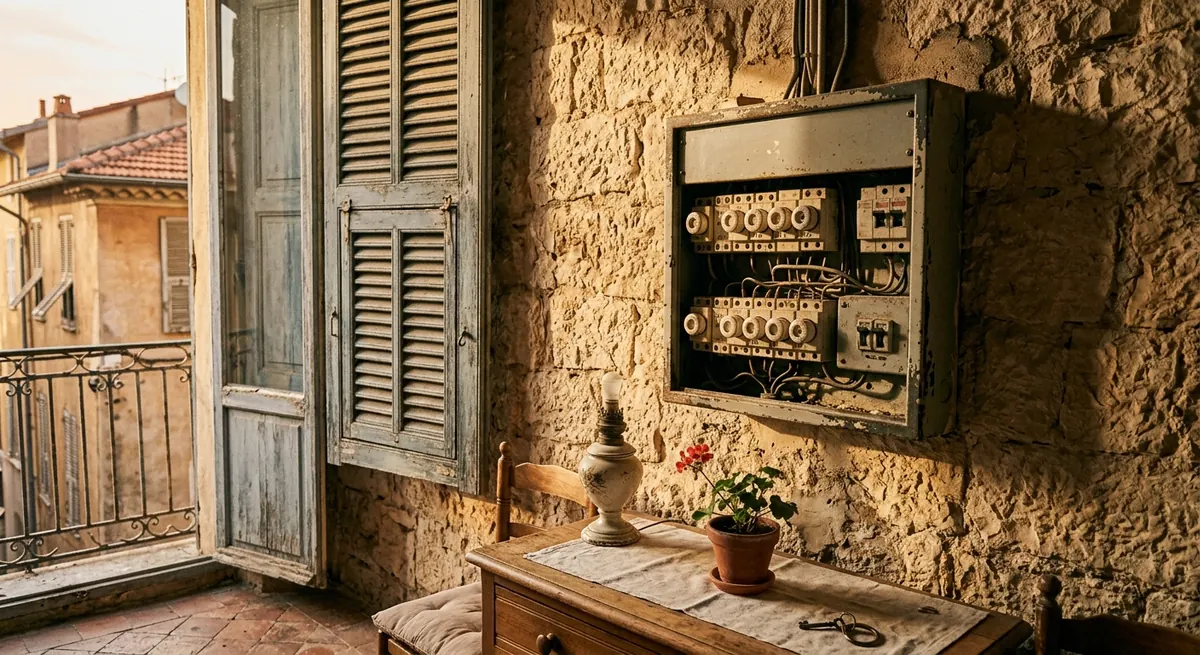
Walk into almost any building in the Carré d'Or, Cimiez, or the back streets behind Avenue Jean Médecin and you will find apartments where the electrical installation has barely changed since Pompidou was president. Many blocks date from 1900 to 1965, and their internal wiring was often upgraded only once, sometime in the 1960s or 1970s, with porcelain fuse carriers (the classic white ceramic plugs, locally called fusibles or plombs) feeding circuits that were never designed for a dishwasher, an air conditioning split unit, and three phone chargers running at once. I have opened panels in Vieux Nice where the original slate board is still screwed to the wall, patched over decades by different electricians, each adding a breaker without ever touching the earth bonding underneath.
For a foreign buyer used to GFCI outlets and modern breaker panels back home, this can be startling. The issue is not aesthetic nostalgia, it is genuine risk. Old fuse boxes typically lack any differential (earth leakage) protection, meaning a faulty appliance or a frayed cable in a damp bathroom wall won't trip anything before someone gets a serious shock. Add to that the fact that many of these buildings never had a proper earthing (terre) circuit installed until forced to by later renovations, and you get installations that technically function, keep the lights on, and would fail a safety inspection in about four minutes flat.
Spotting the Warning Signs Before You Sign the Compromis de Vente
Before you fall for that 1930s mosaic floor and sea-glimpse balcony in Riquier or Musiciens, ask the agent or notaire for the diagnostic électrique, a mandatory report for any home where the installation is more than 15 years old, valid for three years at the time of sale. This document, which costs around 100 to 180 euros when commissioned separately, flags major anomalies: absence of a 30mA differential breaker, lack of earthing, undersized conductors, or an old-style panel with no dedicated circuit breakers at all. In my experience inspecting Riviera apartments, roughly seven out of ten pre-1970 units in central Nice show at least one of these red flags, and it is rarely disclosed proactively by sellers who have lived there for thirty years without incident.
Beyond the official report, there are visual tells you can check yourself during a viewing. Look for a panel with ceramic fuse holders instead of modern circuit breakers, visible cloth-insulated wiring (often black or cream fabric sheathing) behind sockets, two-pin outlets with no earth pin in kitchens or bathrooms, and a general absence of any RCD (differential) device near the meter. If the seller mentions the building was rewired in 1968 as a selling point, treat that as a warning rather than reassurance; fifty-plus-year-old copper and insulation are well past realistic service life, even if everything still technically works. None of this should kill a sale, but it absolutely should factor into your offer price and your renovation budget.
What NF C 15-100 Actually Requires in Practice
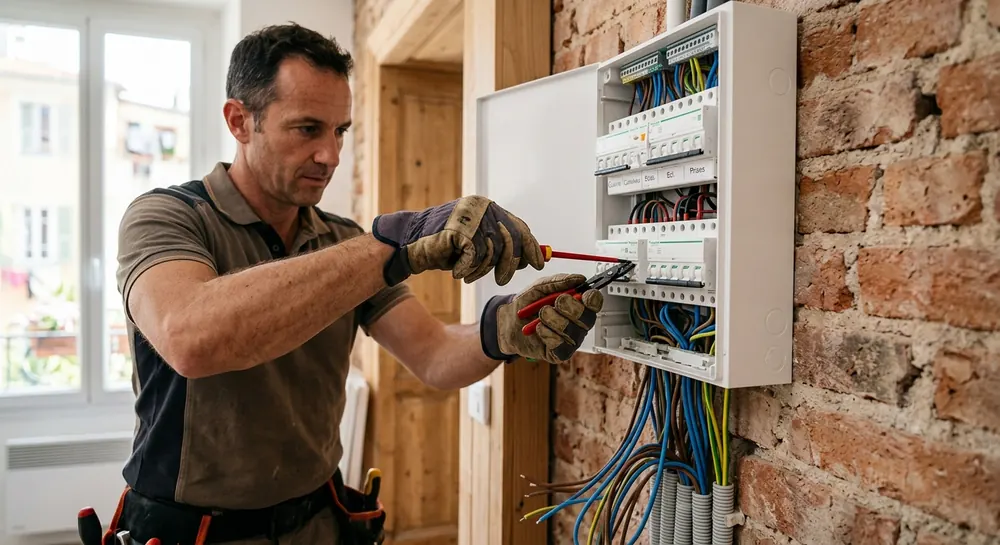
NF C 15-100 is the French electrical safety standard, and while full retroactive compliance isn't legally mandatory for existing owner-occupied housing, it becomes unavoidable the moment you touch the installation during a renovation, add a new circuit, or want a Consuel certificate for insurance and resale peace of mind. The standard requires a modern panel with individual circuit breakers sized correctly for each circuit, at least two 30mA differential breakers (one typically dedicated to kitchen and bathroom-adjacent circuits), a verified earthing system connected to all metal fixtures and socket outlets, and minimum numbers of sockets per room based on floor area. In a typical 55 square meter Nice apartment, that usually translates to a panel with 10 to 14 modules, properly labeled, replacing a board that might currently have four or five ceramic fuses total.
What surprises many buyers is how much of the standard concerns things they would never think to ask about: bathroom zoning rules that dictate exactly how far a socket must sit from a shower or bathtub, mandatory VMC (ventilation) electrical feeds, and a requirement for a general cut-off switch accessible near the entrance. In older Nice buildings with shared risers (gaines techniques) running through a communal stairwell, upgrading your own panel sometimes also means coordinating with the syndic to confirm the building's main incoming supply and grounding point are adequate, since several apartments in the same column may still be feeding off a shared, outdated earth rod from the 1960s. This is a conversation worth having with the syndic or a local electrician before you commit to a renovation calendar.
Realistic 2026 Costs and the Upgrade Process
For a straightforward panel swap alone, keeping existing wiring but installing a new compliant tableau with differential breakers, expect to pay between 1,400 and 2,800 euros for a one or two-bedroom apartment in Nice, depending on the number of circuits and whether asbestos-containing materials need careful handling around the old board (common in buildings from the 1950s and 60s). If the wiring itself is the problem, which it usually is in anything built before 1975, a full rewire including new panel, conduits, sockets, and switches runs roughly 150 to 230 euros per square meter, so a 60 square meter apartment in Cimiez or Libération typically lands between 9,000 and 13,500 euros including materials and labor, done by a registered electrician (artisan qualifié, ideally Qualibat or RGE certified for insurance purposes).
The process itself takes longer than people expect, partly because of Nice's older building stock and partly because of paperwork. A full rewire on an occupied apartment usually takes two to three weeks of actual work, assuming walls need to be opened and replastered, plus another one to two weeks waiting for a Consuel inspector to validate the installation before EDF will reconnect the new panel to the grid. I generally advise clients to add a 15 percent contingency to any electrical renovation quote in historic Nice buildings, because once walls open up, it is common to discover additional surprises: knob-and-tube remnants behind plaster, undersized meter cable from the communal riser, or a junction box hidden inside a chimney breast that nobody knew existed. Budgeting 2,000 euros of slack on a 12,000 euro project has saved more than one of my clients from an awkward mid-project conversation.
Deciding When to Upgrade: Before Renovation, Before Resale, or Right Now
If you are buying to renovate anyway, electrical work should happen first, before new flooring, kitchen cabinetry, or fresh plaster goes in, simply because running cable later means tearing into finished surfaces. This is also the cheapest moment to add circuits for things you will want later: a dedicated line for air conditioning units (increasingly common given Riviera summers), USB-equipped outlets, or an EV charger point if you have a parking space in the building's basement garage. Doing it all in one coordinated phase with a single electrician, rather than piecemeal over several years, typically saves 20 to 30 percent compared to repeat call-outs and partial fixes.
If you are instead planning to sell within the next year or two, a full rewire may not be worth the investment, but a panel upgrade to add differential protection almost always is, since it is relatively inexpensive, reassures buyers' own diagnostic reports, and removes one of the most common negotiating levers used to chip 5,000 to 10,000 euros off an asking price in Nice's competitive but increasingly cautious resale market. Insurers have also grown stricter: several Riviera-based assureurs now ask directly whether the installation has differential protection before confirming home insurance terms, and a clean bill of electrical health can smooth that conversation considerably. My rule of thumb for owners sitting on the fence: if the panel still has visible ceramic fuses, address it now regardless of your timeline, because that specific configuration is the one most likely to cause both an insurance claim dispute and a genuine house fire.
Frequently asked questions
Not strictly mandatory for private resale, but a diagnostic électrique is required for any installation over 15 years old, and serious anomalies must be disclosed. Many buyers now negotiate price reductions or request upgrades as a condition of sale, so addressing it beforehand often protects your asking price more than it costs.
A straightforward panel replacement with modern differential breakers typically runs 1,400 to 2,800 euros for a one or two-bedroom apartment. Full rewiring, needed when the cabling itself is original, costs roughly 150 to 230 euros per square meter including Consuel certification.
Sometimes, if the existing cable gauges and insulation are sound and an electrician confirms it during inspection, but in pre-1970 Nice buildings this is the exception rather than the rule. Most properties from that era need at least partial rewiring, particularly in kitchens and bathrooms, to meet current earthing and zoning requirements.