
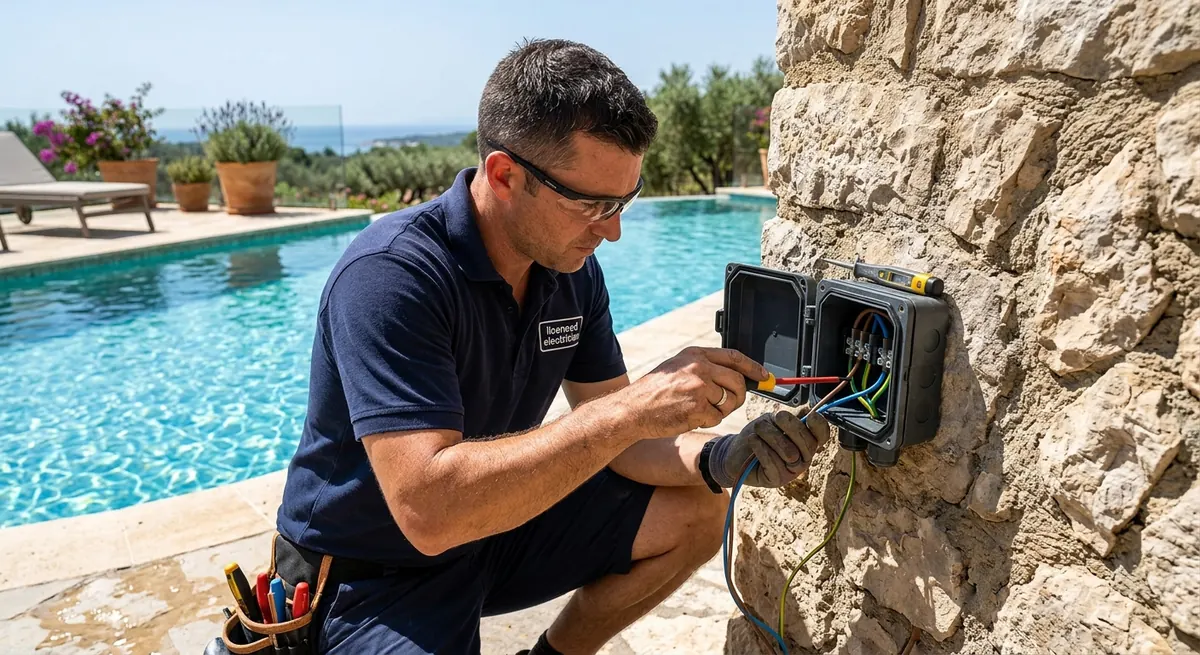
Why Ordinary Outdoor Sockets Fail Within Two Seasons on the Coast
I have pulled more corroded outdoor outlets out of villas between Cap d'Antibes and Beaulieu-sur-Mer than I can count, and the pattern is always the same: a perfectly decent IP44 socket bought from a mainland supplier, installed by a well-meaning handyman, gone green and crusty within eighteen months. The culprit is not just rain. It is the combination of airborne salt from the sea breeze, chlorine vapor rising off the pool, and UV exposure that together attack the zinc plating and brass contacts far faster than inland installations ever experience. A terrace in Cannes facing the Croisette takes a harsher daily beating than most outdoor equipment is rated for, even when the datasheet says weatherproof.
The visible symptom is usually a white or greenish bloom around the screws and a stiff, crumbly rubber flap that no longer seals properly. The invisible symptom, and the dangerous one, is corrosion creeping into the contact points inside the box, raising resistance, generating heat, and in the worst cases causing arcing behind a cover that still looks fine from outside. I have seen this trigger nuisance tripping of the differential circuit breaker at a villa in Mougins, and in one case near Villefranche-sur-Mer, a melted socket back-box that very nearly started a fire inside a wooden pergola. None of this is exotic or unpredictable; it is simply what happens when standard hardware meets fifteen kilometers of open Mediterranean.
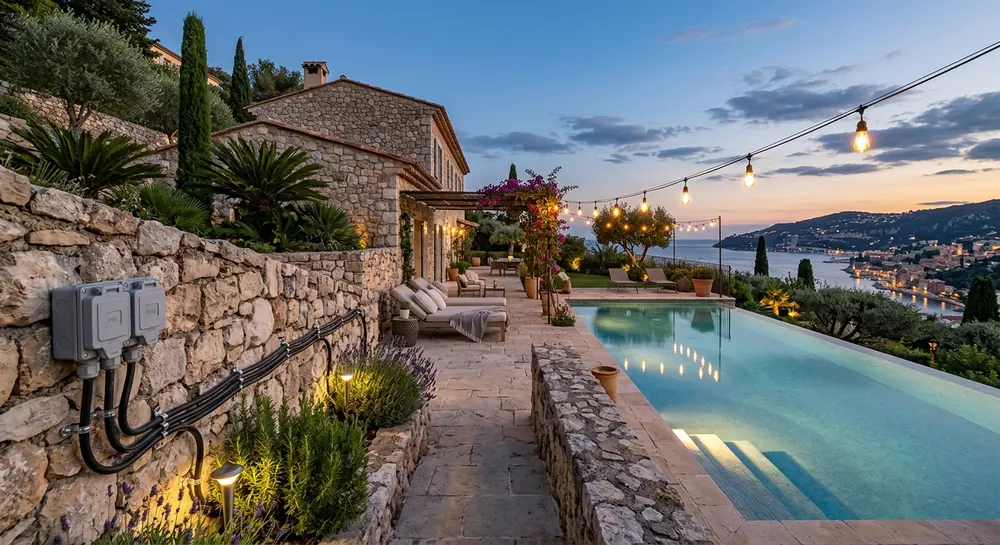
What NF C 15-100 Actually Requires Near Pools and Terraces
French electrical code divides the area around a swimming pool into volumes, and this matters enormously for where you are even allowed to put a socket. Volume 0 is inside the pool itself, volume 1 extends 2 meters from the edge and up to 2.5 meters high, and volume 2 extends a further 1.5 meters beyond that. No standard socket outlet is permitted in volumes 0 or 1 at all; in volume 2, you need a minimum IP44 rating, though in practice any installer worth hiring on the Riviera will push for IP65 or better given the salt exposure. Outside volume 2, general outdoor sockets must still be protected by a 30mA residual current device (RCD), and NF C 15-100 requires this regardless of distance from water once the socket is outdoors or in a damp location like an open terrace.
Beyond the IP rating, the standard is specific about mounting height (minimum 25cm from finished ground level, though I push clients toward 40cm given winter storm surges we have seen in Antibes and Golfe-Juan), about using a dedicated circuit breaker per group of outdoor outlets, and about bonding any exposed metal pool equipment to the main earth terminal. A Monaco-based inspector I worked with on a villa renovation last winter flagged three otherwise compliant installations purely because the earth bonding cable to the pool's metal ladder had never been connected, an oversight invisible unless you specifically test for it. Getting a Consuel certificate for new pool-area wiring is not optional if you want insurance to pay out after an incident, and increasingly, Riviera insurers are asking for proof of compliance before renewing contracts on properties with pools.
Choosing Hardware That Actually Survives the Mediterranean Climate
Skip anything described simply as 'outdoor rated' and look specifically for IP65 or IP66 enclosures with marine-grade stainless steel or glass-reinforced polyester housings rather than standard painted zinc alloy. Legrand's Plexo range and Hager's Design range both offer genuinely robust IP66 outdoor sockets running roughly 35 to 65 euros per unit depending on whether you choose single or double gang, with the sealed spring-loaded covers that matter far more than people realize, since a flap that does not snap shut firmly is where moisture gets its first foothold. For anything within splash distance of a pool, I specify units with a captive silicone gasket rather than a foam gasket, because foam compresses and loses its seal within two to three Riviera summers under constant UV and heat cycling.
On a recent terrace rewiring job in Antibes, we replaced six standard outdoor points with marine-grade IP66 units in stainless housings, added a dedicated 30mA RCD sub-board, and ran all new cabling in UV-stabilized conduit rather than reusing the original PVC that had gone brittle after a decade in the sun. Total cost for materials and labor came to roughly 2,800 euros for six points plus the sub-board, which sounds steep until you compare it to the 450 euros we charged eight months later for a neighboring villa that tried to save money with standard hardware and needed an emergency callout after a socket arced during a thunderstorm. As a rule of thumb, budget 180 to 350 euros per properly installed outdoor point including a qualified electrician's labor, and treat anything quoted under 120 euros per point with real suspicion, because it almost always means standard indoor-grade hardware repurposed outdoors.
Installation Realities: RCDs, Circuits, and Hiring the Right Électricien
Every outdoor circuit on a Riviera property should sit behind its own 30mA RCD, separate from the general household circuits, so a fault at the pool pump or garden lighting does not plunge the entire villa into darkness during a dinner party on a July evening in Saint-Jean-Cap-Ferrat. I also strongly recommend a dedicated circuit breaker rated to the specific load, typically 16A for general outdoor sockets and a separate 20A or 32A circuit if you are running a pool heat pump or a jacuzzi, since undersized breakers nuisance-trip constantly in humid conditions and oversized ones fail to protect against the slow-building fault currents corrosion actually causes. Conduit should run buried at a minimum depth of 50cm if crossing open ground, encased in red warning tape per French convention, and any above-ground runs along a pergola or wall need UV-rated sheathing, not the grey standard conduit that turns chalky and cracks within three or four Mediterranean summers.
Finding a qualified électricien who actually understands coastal corrosion, rather than just copying a mainland spec sheet, makes a real difference. Look for someone registered with Qualifelec, ideally with the SPEC or similar outdoor-specific mention, and ask directly whether they have worked on pool installations that passed Consuel inspection, since that certification process catches the earthing and volume-zone errors that cause problems later. Expect day rates in the 350 to 550 euro range for a qualified electrician around Nice and Cannes, slightly higher near Monaco, and get a written devis that specifies the exact IP rating and brand of hardware, not just 'outdoor socket,' because vague quotes are where corner-cutting hides. A full rewiring of pool-area electrics on a mid-sized villa, including new sub-board, RCDs, six to eight outlets, and compliant conduit, typically runs between 2,200 and 4,500 euros depending on cable run length and how much of the existing infrastructure can be reused safely.
Maintenance: Catching Corrosion Before It Becomes a Hazard
Outdoor sockets near the sea need a twice-yearly inspection, ideally once in spring before the pool season starts and once in autumn after the worst of the summer salt spray and chlorine exposure has accumulated. The check itself takes a competent electrician under an hour per property: visually inspecting covers and gaskets for cracking, testing the RCD trip function with the built-in test button, checking that mounting screws have not seized or corroded in place, and using a simple continuity tester on the earth bonding where pool equipment is involved. Budget 90 to 150 euros for this seasonal service call, which is trivial compared to the cost of emergency repairs or, worse, the liability exposure if a guest gets shocked at a rental property during the busy summer letting season around Cannes or Antibes.
Between professional checks, owners can do their own basic visual inspection: look for any white or green powdery residue around screw heads, press the RCD test button monthly (it should trip immediately with an audible click), and never ignore a socket cover that no longer closes with a firm, confident snap, since that gap is exactly where salt-laden moisture gets in. If you are renting out your villa through platforms serving the Cannes Film Festival or Monaco Grand Prix crowds, factor this maintenance into your seasonal prep alongside pool servicing and garden upkeep, because an electrical fault during a high-occupancy week is both a safety risk and a reputational one. In my experience, villas that treat outdoor electrical maintenance as seriously as pool chemistry rarely have problems beyond routine gasket replacement every four or five years, while those that treat it as an afterthought are the ones calling for an emergency electrician at 11pm on a Saturday in August.
Frequently asked questions
Within volume 2 of the pool zone (1.5 meters beyond the 2-meter safety perimeter), a minimum of IP44 is required by code, but given salt air and chlorine exposure on the coast, IP65 or IP66 rated sockets with sealed gaskets are strongly recommended and what most qualified local électriciens will install anyway.
Expect roughly 180 to 350 euros per properly installed outdoor point including labor and marine-grade IP66 hardware, with a full pool-area rewiring including a dedicated RCD sub-board typically running between 2,200 and 4,500 euros depending on the number of points and cable run length.
Twice a year is the practical minimum: once in spring before pool season and again in autumn after summer salt and chlorine exposure, with a professional check costing around 90 to 150 euros, plus monthly RCD test-button checks owners can do themselves.