
Why Salt Air Rewrites the Rulebook for Garden Lighting
I have pulled out more corroded fixture housings in Villefranche-sur-Mer and Cap d'Antibes than I care to count, usually installed by a mainland supplier who never factored in what three kilometres of open sea does to aluminium within eighteen months. Standard garden spotlights rated IP44, fine in Lyon or Grenoble, turn chalky white and seize up here because the salt-laden air carries microscopic chloride particles that settle on every exposed surface, then react with humidity overnight dew that coats gardens from Beaulieu to Menton almost every morning between October and April. The fix is not exotic, it is specification: marine-grade 316 stainless steel or powder-coated solid brass housings, sealed gaskets rated IP65 or higher for anything within 500 metres of the shoreline, and connectors potted in resin rather than simple twist caps.
Budget for this reality from day one rather than retrofitting it later, because the price gap between a bargain aluminium path light at 18 to 25 euros and a proper marine brass equivalent at 45 to 70 euros looks painful until you compare it against a full relamping job three summers later. On a villa in Cannes-la-Bocca I rewired last year, the original installer had used zinc-alloy uplights throughout a property 200 metres from the Croisette; within two seasons the lenses had pitted and half the units had internal corrosion shorting the LEDs. We replaced everything with marine-rated fixtures and the client's total spend, counting the wasted first installation, ended up roughly 40 percent higher than if we had specified correctly from the start.
Designing a Lighting Plan That Suits a Mediterranean Garden
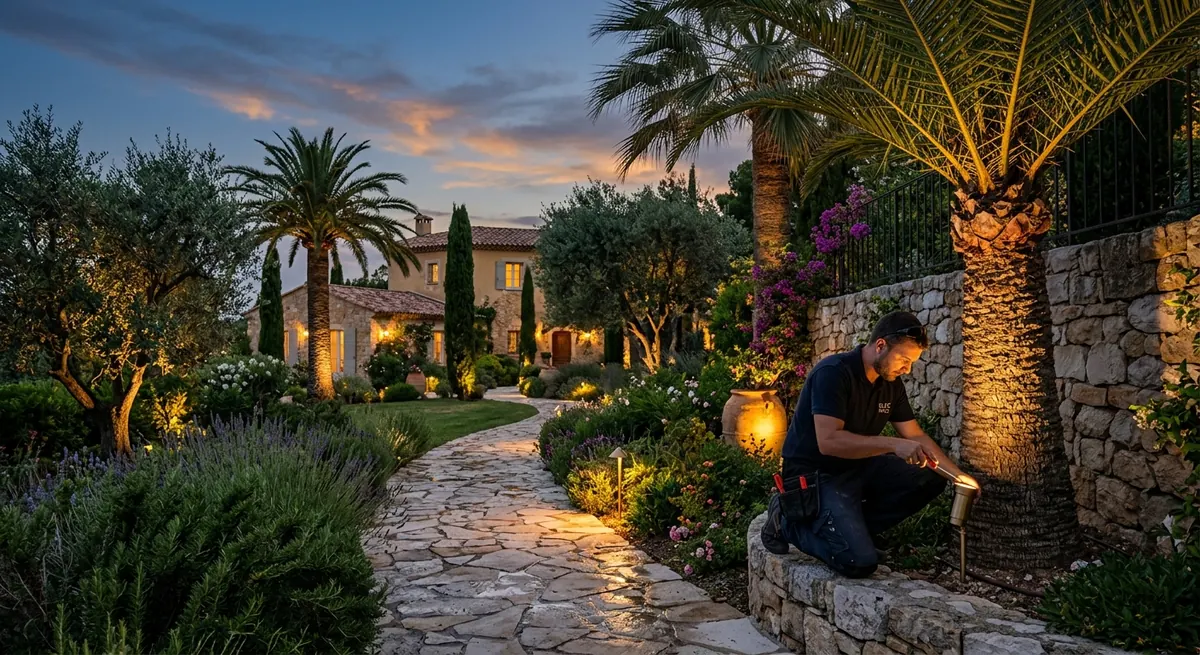
A good Riviera lighting design starts on paper, not with a box of fixtures from a hardware store in Mandelieu. Walk the property at dusk, note where the olive trees, agave clusters, bougainvillea-covered walls and dry-stone terraces catch the eye, and think in layers: path lighting at ankle height for safety along steps and gravel walkways, uplighting into tree canopies and palm crowns for drama, and discreet wall grazing along stone facades typical of Mougins or old Antibes town houses to bring out texture without glare. Avoid flooding the whole garden with light, which flattens everything and, frankly, annoys neighbours in dense hillside developments around Le Cannet or Saint-Jean-Cap-Ferrat where properties sit close together.
Warm colour temperature matters more here than almost anywhere else I have worked, because the local stone, ochre renders and pale gravel all read as cold and institutional under anything above 3000K. Stick to 2700K for a soft, candlelit quality that suits Provençal architecture, and reserve slightly cooler tones only for accent lighting on modern glass-and-concrete villas around Roquebrune or Èze where the architecture calls for a crisper look. On a typical 1,500 square metre garden with pool, terrace and driveway, a sensible plan runs to between 35 and 60 fixtures, and I always build in a lighting control plan too, whether that is a simple photocell and timer at 80 to 150 euros or a smart app-controlled system from 400 euros upward that lets owners dim zones separately for a dinner party versus a quiet evening.
Low-Voltage Versus Mains: What Actually Belongs in a Coastal Garden
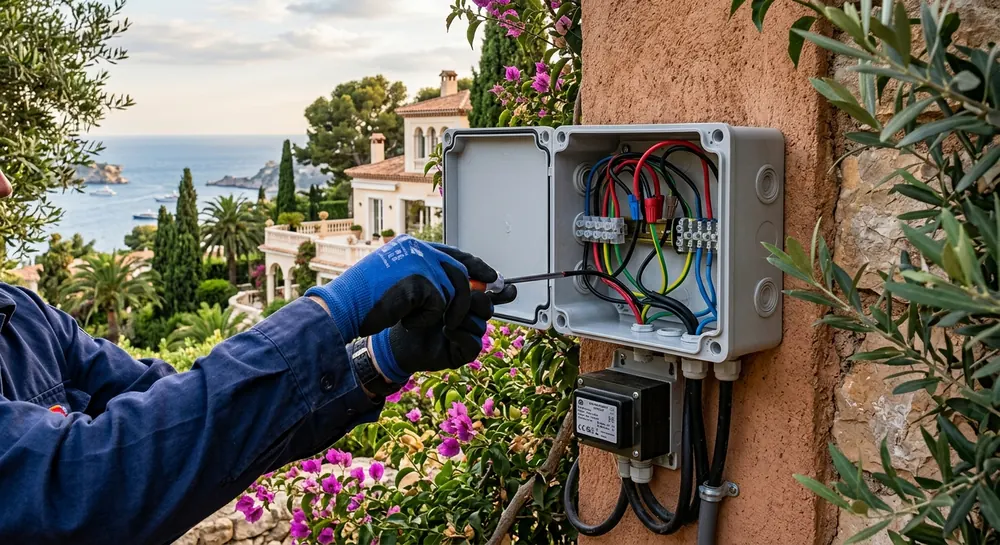
Almost everything in a residential garden here should run on low-voltage 12V or 24V systems, fed from a transformer in a ventilated, weatherproof enclosure mounted in the garage or a technical room, never buried in a flowerbed where humidity will eventually find its way in regardless of the rating printed on the box. A quality multi-tap transformer sized for 300 to 600 watts of LED load costs between 250 and 600 euros depending on brand, and running at low voltage means that even if a cable gets nicked by a gardener's strimmer in Valbonne or a spade during replanting in Grasse, there is no risk of electrocution, unlike a mains-fed 230V circuit buried at standard depth. The trade-off is voltage drop over distance: on a long run past 25 to 30 metres from the transformer, undersized cable will dim the far fixtures noticeably, so I spec 2.5mm² or even 4mm² direct-burial cable for anything beyond that, which costs more upfront but saves a frustrating callback six months later.
Mains-voltage fixtures still have a place for permanent architectural features such as facade floodlighting on a large Cap Ferrat property or integrated step lighting poured into concrete during a terrace rebuild in Saint-Raphaël, but these require a qualified électricien and a dedicated circuit with 30mA RCD protection, full compliance with NF C 15-100, and a Consuel certification before the local Enedis connection is signed off. For most garden and pathway applications though, low voltage is simpler, safer around children and pets, cheaper to extend later, and far more forgiving of the inevitable DIY tinkering that happens once an owner discovers how satisfying it is to reposition an uplight under a young olive tree.
Installation Realities: Cable Runs, Rocky Soil and Local Permits
Trenching on the Riviera is rarely the tidy job it looks like in a brochure. Much of the coastal strip from Villefranche to Théoule-sur-Mer sits on shallow topsoil over limestone bedrock, and I have lost count of the days a two-person crew spent breaking through rock with a mini excavator and hand tools to get a cable run just 40 centimetres deep across a 60 metre garden. Budget realistically: a straightforward trenching and cable-laying day in workable soil runs about 350 to 500 euros in labour, but rocky terrain around Grasse's hillsides or the dry-stone terraces common in Peillon and the Niçois backcountry can double or triple that figure once rock-breaking equipment and extra days enter the quote. Always run conduit, even for low-voltage cable, because garden maintenance crews with tillers and edge trimmers do not know where your cables sit, and a 1 to 2 euro per metre conduit cost is nothing compared to a weekend spent tracing a cut cable through gravel.
On the regulatory side, most garden lighting installs do not require a permit, but anything attached to a listed facade in old Antibes or within the protected perimeters that exist around parts of Vieux Nice and Monaco's border zones can trigger a déclaration préalable at the mairie, particularly if fixtures are visible from the street or affect a shared boundary wall. Pool-adjacent lighting has its own rules too: any fixture within the immediate pool surround must meet IPX8 submersible standards if submerged, or IP65 minimum if simply nearby and exposed to splash and chlorine vapour, which is itself quietly corrosive to the same housings that survive sea air reasonably well. I always recommend owners keep photos and invoices of the exact fixture models installed, because when a storm surge or an unusually salty mistral season causes premature failure, having the specification on hand speeds up any warranty claim with the supplier.
Budgeting, Maintenance and Choosing the Right Installer
For a mid-sized villa garden of around 1,000 to 2,000 square metres with pool, terrace, driveway and planted borders, a complete professional low-voltage lighting installation, including transformer, 40 to 55 marine-grade fixtures, cabling, trenching and commissioning, typically lands between 9,000 and 16,000 euros depending on terrain difficulty and fixture quality. Smaller terrace-only projects in an apartment garden in central Nice or a townhouse courtyard in Antibes can come in at 2,500 to 4,500 euros, while larger estates around Cap Ferrat or Mougins with extensive grounds, multiple lighting zones and smart control integration regularly exceed 25,000 euros. Always ask for a lighting plan drawing as part of the quote, not just a fixture count, because a plan forces the installer to think through zones, cable runs and transformer loading rather than scattering lights wherever looks convenient on install day.
Maintenance is where coastal properties diverge sharply from inland ones: plan for an annual service visit costing 150 to 300 euros to clean salt deposits off lenses, check gasket seals, and test the transformer and timer settings before the summer season when the garden gets used most. Expect to replace a handful of fixtures every three to five years even with marine-grade specification, simply because no housing is entirely immune to decades of Mediterranean exposure, and keep 10 to 15 percent of your original fixture count in spares on hand since discontinued models can be hard to match years later. When choosing an installer, ask specifically about their experience with coastal corrosion rather than just their general electrical credentials, request to see a property they wired at least two years ago, and insist on a written list of fixture IP ratings and materials in the quote itself rather than a vague description like outdoor-rated, which in this climate genuinely is not good enough.
Frequently asked questions
For gardens within roughly 500 metres of the coastline, aim for IP65 as a baseline for all fixtures, and IP67 or IPX8 for anything submerged in or very close to a pool or water feature. Combine the rating with marine-grade 316 stainless steel or solid brass housings, since the IP figure alone does not protect against salt corrosion over the long term.
Yes, 12V and 24V systems are safe around children, pets and garden tools since there is no risk of serious shock even if a cable is damaged, and modern LED fixtures at low voltage produce excellent warm, even light comparable to mains options. The main limitation is voltage drop over long cable runs, which a properly sized transformer and cable gauge easily solves.
A full professional installation for a 1,000 to 2,000 square metre garden with pool and terrace typically costs between 9,000 and 16,000 euros including marine-grade fixtures, transformer, trenching and cabling. Smaller courtyard or terrace projects can start around 2,500 to 4,500 euros, while large estates with extensive grounds often exceed 25,000 euros.