
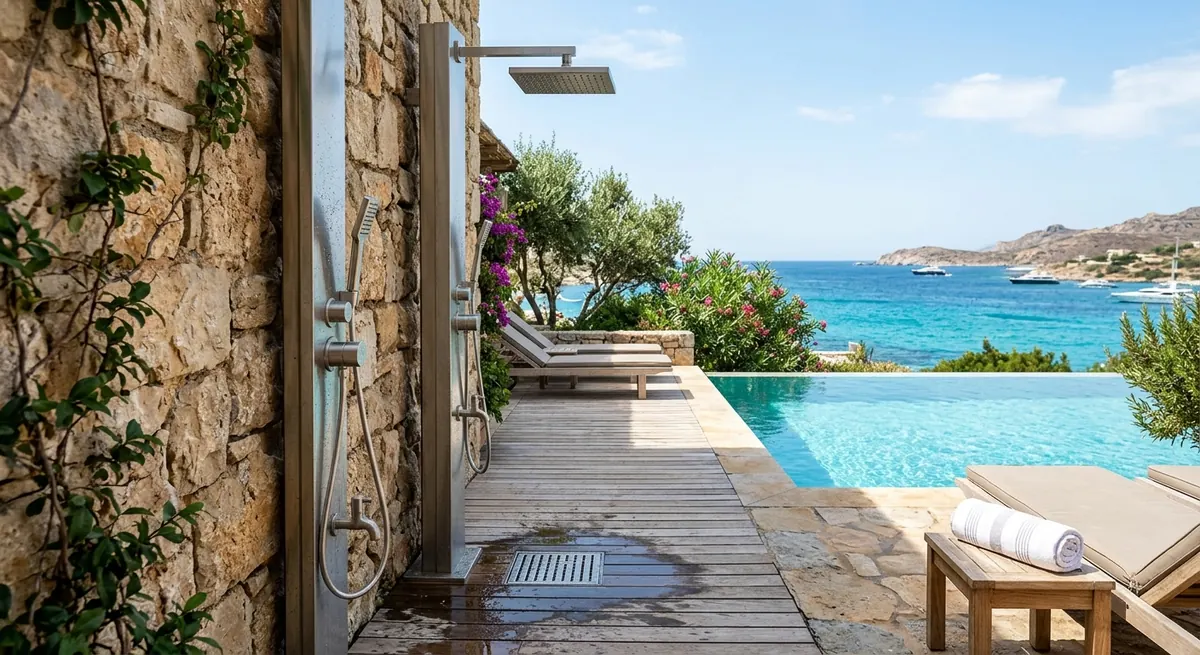
The Salt-Air Reality: Why Ordinary Outdoor Showers Fail Fast Here
I have pulled out more corroded shower columns on the Cap d'Antibes and around Villefranche-sur-Mer than I can count, usually after only two or three seasons. The culprit is almost never bad installation technique in the obvious sense — it is material choice. Standard chrome-plated brass fittings bought at a generic hardware chain in Nice look fine in the showroom, but chrome plating is microscopically thin, and once salt-laden sea spray and humid night air start working on a pinhole in that plating, the zinc underneath sacrifices itself within eighteen months. Add mistral gusts that drive airborne salt several hundred metres inland — yes, even properties in the hills above Cannes or Mougins get a measurable salt load — and you understand why so many villa owners end up replacing a supposedly 600€ shower kit twice in five years.
The second failure mode is less visible but costs more: hidden pipework in standard galvanized steel behind the cladding. Galvanizing buys you maybe four or five years near the coast before rust starts bleeding through grout lines on a pool-house wall, and by then the fix usually means breaking tile to get at the pipe. On properties right on the water in Cap Ferrat or Beaulieu-sur-Mer, I now specify nothing less than 316L stainless steel or properly rated marine bronze for any run within three metres of a shower head, full stop. It costs more upfront — typically 20 to 35 percent more than standard fittings — but it is the single biggest lever for avoiding a full re-do before the decade is out.
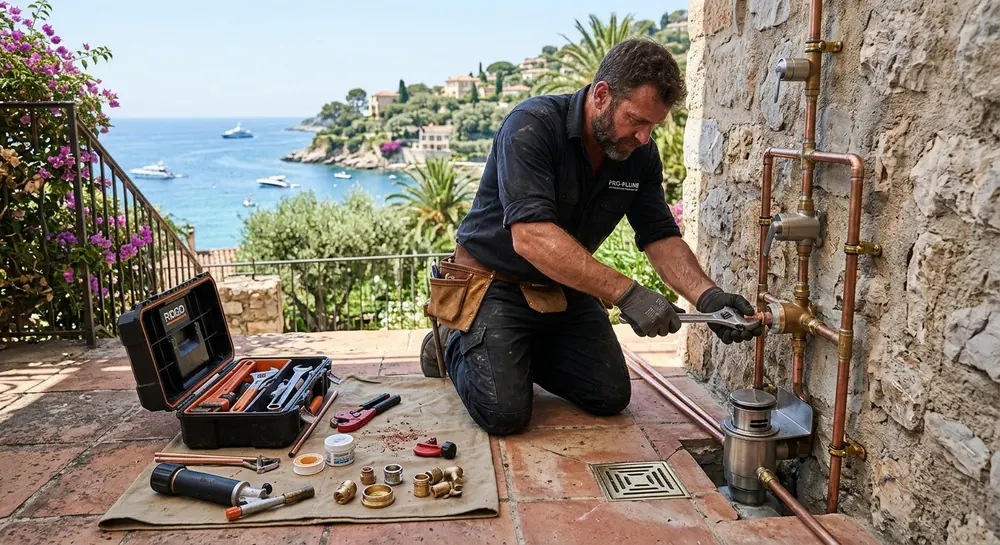
Drainage First: Get the Slope and the Discharge Point Right
Most outdoor shower disasters I get called to fix are drainage problems wearing a corrosion costume. Water that pools around the base migrates into expansion joints, undermines the dalle, and accelerates corrosion on anything metallic nearby — so drainage design has to come before you even think about which shower head to buy. On a pool deck, I want a minimum 1.5 percent slope directed toward a stainless or PVC floor drain, never toward a simple gravel soak-away unless your sol is genuinely permeable limestone scree, which is rare on the clay-heavy ground you find around Mougins and inland Grasse. Budget 400 to 900€ for a proper point d'évacuation tied into the existing eaux usées network if you are near the house, and more — often 1200 to 2000€ — if you need a dedicated run out to a soakaway pit on a villa with no nearby connection.
Greywater rules matter more than most owners realise, and they are enforced unevenly but very real along this coast. In Antibes and Cannes, outdoor shower discharge generally must join the eaux usées (wastewater) system rather than run into eaux pluviales or straight onto a terrace that slopes toward the street or a neighbouring parcel — check with the service de l'urbanisme before pouring any concrete, because a badly routed drain is one of the more common reasons a permis de construire amendment or a simple déclaration préalable gets rejected on villa renovations near Golfe-Juan. If your property sits on an assainissement non collectif (individual septic system), as many do above Théoule-sur-Mer and in parts of the arrière-pays, your fosse toutes eaux needs to be sized to take the extra shower volume — a point too many installers gloss over until the septic company flags it during the next vidange.
Materials That Actually Survive Sea Spray and Mistral Wind
For the exposed shower column itself, three materials have earned their keep on Riviera job sites: 316L stainless steel (sometimes sold as marine grade or A4), solid brass with a genuine marine bronze or powder-coated finish, and in budget-conscious installs, UV-stable reinforced PVC columns dressed with teak or iroko cladding. Stainless at 316L spec resists pitting corrosion dramatically better than the more common 304 grade — ask your supplier specifically for 316L and get it in writing on the devis, because some Côte d'Azur showrooms quietly substitute 304 to shave 15 percent off the price. A full 316L outdoor shower set, valve, head and foot wash included, runs roughly 650 to 1400€ depending on finish, versus 300 to 600€ for a decent 304 unit that will likely need replacing within five to seven years near the water.
Underneath the visible fixture, I always push clients toward PE-Xa or multicouche piping rather than copper for the feed lines in coastal soil, because copper reacts badly with the alkaline, often salt-contaminated earth you get within a few hundred metres of the Mediterranean, particularly around reclaimed land near the Nice airport corridor and parts of the Antibes marina district. Where pipework must be exposed — say, running up an exterior pool-house wall in Monaco or Cap d'Ail — I wrap it in a UV-resistant gaine and secure it with 316 stainless clips, never the galvanized ones that come bundled cheaply with most plumbing kits. It is a small material swap, maybe 40 to 80€ extra on a typical job, but it is the difference between clips that are still tight in year eight and clips that have rusted through and let the line sag by year three.
Water-Saving Fixtures That Still Feel Good After a Swim
Water metering along the coast has gotten noticeably stricter in recent municipal contracts, and a few villa clients near Mandelieu-la-Napoule have seen their consommation bills jump once a pool-house outdoor shower got heavy summer use from guests. The fix is not to under-spec the shower experience but to choose flow-regulated heads and push-button or self-closing valves. A good self-closing foot valve combined with a 6 to 8 litre-per-minute shower head — versus the 12 to 15 lpm you get on unregulated standard heads — can cut consumption by close to half without anyone noticing a weaker rinse, because the water pressure feeding most villa installations (3 to 4 bar) is more than enough to carry a lower flow rate comfortably. Expect to pay 90 to 220€ for a quality flow-restricted head and valve set from brands with genuine marine warranties, versus 40 to 60€ for the bargain version that will clog with limescale within two seasons given how hard the water runs in much of the Alpes-Maritimes.
Thermostatic mixing is worth the extra cost on any shower serving a pool deck used by children or elderly guests, which describes most of the villa pool-houses I work on between Cannes and Menton. A decent thermostatic mixer with anti-scald protection adds roughly 150 to 300€ to the fixture cost but also, in practice, reduces wasted water because people are not running the tap for thirty seconds trying to dial in a temperature by feel. Pair that with a small instant water heater or a tap into the pool-house's existing chauffe-eau — sizing the run so hot water reaches the head in under ten seconds — and you avoid the classic Riviera complaint of a shower that runs lukewarm for a full minute before anything useful happens, which on a metered summer rental property adds up to real wasted litres across a season.
Installation Costs, Timeline, and Choosing the Right Plumber
A straightforward single outdoor shower on an existing pool deck with nearby plumbing access — new 316L column, flow-regulated head, proper drain tie-in — typically lands between 1800 and 3200€ all-in on the Riviera, including the artisan's déplacement fee, which itself can run 60 to 120€ depending on how far up the hills the villa sits. Add a second shower head, a foot wash station, or stone cladding to match an existing pool surround, and realistic budgets climb to 4000 to 7000€. The premium end — think a Cap Ferrat property wanting a fully bespoke bronze fixture set into a travertine wall with hidden plumbing and a heated feed — can reach 9000 to 14000€ once masonry and finishing trades are factored in alongside the plumber. Always get the devis itemised by material grade; a vague line reading ensemble douche extérieure fourniture et pose without specifying 316L or marine brass is a red flag worth questioning before you sign.
On timeline, a single-fixture install with existing drainage access typically takes a competent équipe one to two days, but add three to five days if you need new trenching for the evacuation line or if the dalle needs breaking and re-pouring. Book early: the window between April and June is when most Riviera plumbers specialising in pool-house work are least overbooked, whereas trying to schedule anything in July or August — when every villa on the coast wants a shower fixed before guests arrive — means waiting weeks and often paying a rush premium of 10 to 20 percent. When vetting an artisan, ask directly whether they have installed 316L or marine bronze fixtures before, request to see two or three finished jobs that are at least three years old (not freshly done, which tells you nothing about how they age), and confirm the devis specifies both the alloy grade and the drainage discharge point in writing — the two details that separate a shower lasting fifteen years from one you are redoing before the next Grand Prix weekend in Monaco.
Frequently asked questions
316L stainless steel (sometimes labelled marine grade or A4) or solid marine bronze are the two materials that reliably resist salt-air pitting corrosion long-term. Standard 304 stainless and chrome-plated brass look similar at purchase but typically show rust or pitting within two to five years in coastal exposure, especially within a few hundred metres of the water in spots like Antibes, Villefranche-sur-Mer or Beaulieu.
In most cases a simple outdoor shower on an existing terrace does not require a full permis de construire, but the drainage connection does need to comply with local rules, and any structural addition (new slab, cladding wall) may trigger a déclaration préalable. Check with the service de l'urbanisme of your commune — Antibes, Cannes and Nice each handle greywater discharge questions slightly differently — before pouring concrete or connecting into the eaux usées network.
A quality self-closing valve paired with a flow-regulated head (6 to 8 litres per minute) against an unregulated standard head (12 to 15 lpm) typically cuts consumption by 40 to 50 percent over a season of regular use, without a noticeable drop in rinsing comfort given the 3 to 4 bar pressure common in most Riviera villa installations.