
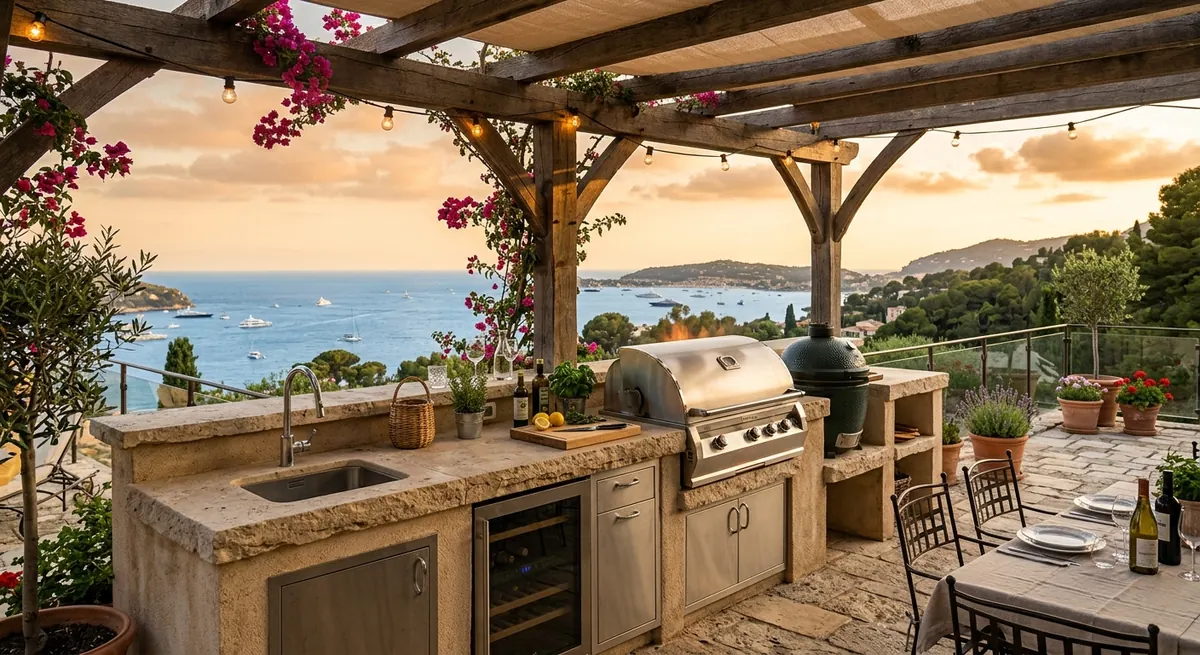
Why the Salt Air Wrecks Ordinary Kitchens Within Two Seasons
I have walked onto more than one terrace in Cap d'Antibes or Villefranche-sur-Mer where a beautiful outdoor kitchen, installed just eighteen months earlier by a well-meaning but inexperienced contractor, was already rusting through the hinges and pitting on the countertop edges. The culprit is always the same: standard 304-grade stainless steel and interior-grade cabinetry that were never designed to sit fifty metres from open water, catching salt-laden wind off the Baie des Anges or the Golfe-Juan every afternoon. Once chloride ions get into a weld seam or a screw hole, corrosion spreads fast, and by the second summer you are looking at a full replacement rather than a repair.
The fix is to spec for marine exposure from day one, even if your villa is a kilometre back from the coast, because the mistral and the onshore breeze carry salt further inland than most owners expect. That means 316L stainless steel for any exposed metal - grills, sink basins, cabinet frames - which costs roughly 25 to 35 percent more than 304 grade but simply does not pit the same way. For countertops, sintered stone like Dekton or Neolith at 700 to 1,100 euros per square metre installed outperforms granite in UV stability and is completely inert to salt, unlike some limestones popular in older Provençal builds. Cabinetry should be either powder-coated aluminium or a genuinely marine-grade HPL, not painted MDF dressed up as outdoor furniture - I have seen the latter delaminate within one Riviera winter of rain and humidity swings between Nice and Grasse.
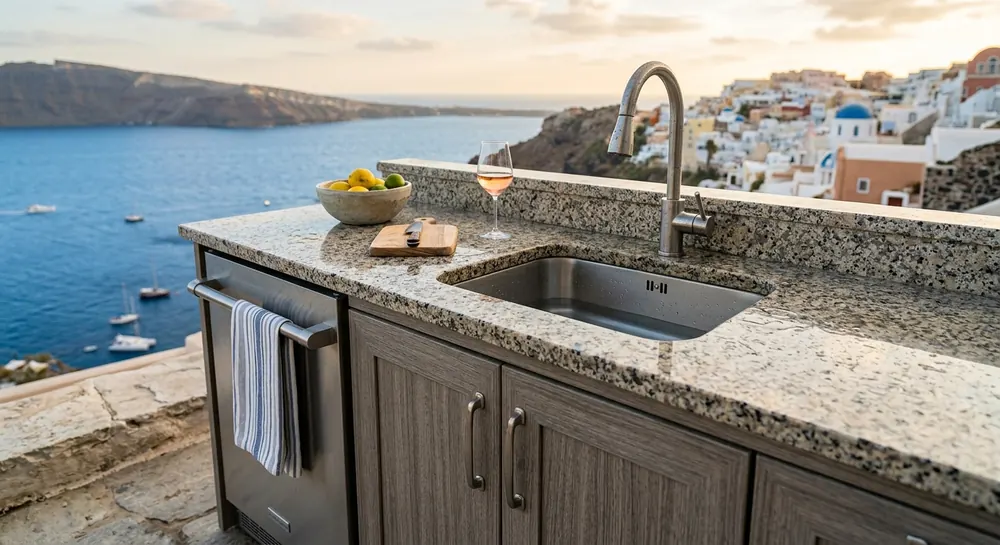
Laying Out the Kitchen for Real Al Fresco Entertaining
Riviera entertaining has its own rhythm: aperitif on the terrace around 7pm while the light turns gold over the bay, dinner that drifts past 10pm, and a host who wants to keep chatting rather than disappear into a galley kitchen. That changes the brief from a purely functional cooking module to something closer to a working bar-and-grill zone. I generally design around three linked stations - a grilling and searing zone (often with a built-in gas or charcoal grill plus a side burner), a prep and wash station with a bar sink, and a serving counter with stools facing outward toward the view rather than the wall. Keeping the cook facing guests, not turning their back on them, sounds like a small detail but it is the single change that gets the most compliments from clients in Mougins and Valbonne.
Circulation matters more outdoors than people assume, especially on properties in Cannes or Beaulieu-sur-Mer where terraces are generous but often narrow and linear. I aim for a minimum of 1.1 metres of clear walking space behind any seated guest and at least 90 centimetres between the grill and an opposing counter so two people can work without colliding, which happens constantly once a party is in full swing. Shade is not optional here - a fixed pergola in aluminium and glass or a retractable bioclimatic louvre roof, typically 8,000 to 18,000 euros depending on span, protects both the cooking equipment and your guests from a midday sun that regularly hits 35°C on exposed terraces between June and August. Lighting should be layered too: warm task lighting over the grill, softer perimeter lighting for ambiance, and everything on a separate circuit so you are not blasting halogen brightness across a dinner table at 9pm.
Connecting the Kitchen to Pool and Garden Without Creating a Maintenance Headache
The best outdoor kitchens I have worked on around Antibes and Roquebrune-Cap-Martin do not sit as an isolated box at the end of the terrace; they read as one continuous outdoor room with the pool deck and the planted borders. That usually means matching the kitchen's flooring material to the pool surround - large-format porcelain pavers in a sand or grey tone work well because they stay cool underfoot even in August and tie visually into most Riviera pool finishes, whereas natural stone like travertine, though beautiful, needs regular sealing to resist chlorine splash and olive oil stains near the grill. Positioning matters too: keep the kitchen close enough to the pool that swimmers can grab a drink without a long detour, but far enough back, generally three to four metres, that splash and sunscreen do not end up on your countertop or in your gas burners.
Garden integration is where a lot of otherwise good designs fall down, usually because someone plants a fast-growing hedge or a row of olive trees too close to the cooking zone without thinking about maintenance access or root damage to plumbing lines. I always route water and gas lines in accessible conduit rather than burying them directly under planting beds, because Riviera soil is often rocky and any future repair near mature Mediterranean planting becomes expensive and destructive otherwise. For scent and shade without the mess, lavender and rosemary borders near the seating area work beautifully and are drought-tolerant, while a pergola dressed with wisteria or a mature fig tree gives dappled shade over a dining table by year two or three - just keep any deciduous planting far enough from the grill that falling leaves and fruit are not landing in your food come September.
Choosing Equipment That Earns Its Keep
Villa owners often want to replicate a full indoor kitchen outside, and I usually talk them down to something leaner and more durable instead. A quality built-in gas grill in 316L stainless, from brands like Lynx or Fire Magic, runs 3,500 to 9,000 euros depending on size and burner count, and will outlast two cheaper units bought on a tighter budget. A wood-fired or gas pizza oven is genuinely worth the 4,000 to 12,000 euro investment for anyone who entertains regularly, since it becomes the centrepiece of the evening in a way a grill rarely does - I have seen dinner parties in Mougins organise themselves entirely around who gets to slide the next pizza in. Beyond that, resist the urge to add a full range or oven outdoors; a two-burner side station and a compact outdoor-rated fridge (800 to 2,200 euros) cover ninety percent of real use cases.
Plumbing and electrical work outdoors on the coast needs its own care: any exterior outlet must be IP65-rated at minimum, GFCI-protected, and ideally on a dedicated circuit with surge protection, because summer storms rolling in from the Estérel can be sudden and severe. Gas lines should run in protected conduit with an accessible shutoff, and if you are adding a sink, check with your plumber whether you need a backflow preventer, which is often required by local regulation when connecting to potable water near a pool system. Budget an extra 15 to 20 percent on top of equipment costs for this infrastructure work if it is not already present on the terrace, since retrofitting gas and 220V lines into an existing stone terrace in somewhere like Cap Ferrat is far more disruptive, and costly, than running them during a broader renovation.
Budget, Permits and Realistic Timelines
A modest but well-built summer kitchen - grill, counter, sink, basic storage, on an existing terrace - typically lands between 18,000 and 35,000 euros in the Alpes-Maritimes, while a full entertaining setup with a pizza oven, bar seating, pergola and integrated lighting comfortably reaches 60,000 to 100,000 euros on larger properties around Cannes or Saint-Jean-Cap-Ferrat. Material choice drives a good chunk of that spread: Dekton over laminate, 316L over 304 stainless, and a bioclimatic pergola over a simple canvas shade can each add five figures, but they are also the elements that determine whether the kitchen still looks sharp in eight years rather than three. I always tell clients to weight their budget toward structure and materials first, equipment second, and decorative extras last, because a beautifully tiled kitchen with a cheap grill ages better than the reverse.
On permits, most straightforward outdoor kitchen projects under 20 square metres of new roofed structure only require a déclaration préalable de travaux, processed by the mairie in about one month, but anything larger, any change to the building's silhouette visible from the road, or work near a property covered by the Loi Littoral in coastal communes like Villefranche or Beaulieu can trigger a full permis de construire with a two to three month review. Always check the local PLU before finalising pergola height or footprint, since several Riviera communes cap outbuilding height at 3 to 3.5 metres and restrict total imperméabilisation of the plot, which matters if you are also adding paved decking around the pool. Realistically, factor twelve to sixteen weeks from signed design to first barbecue once permitting, groundwork, and equipment lead times are accounted for, and try to start the permit process in autumn if you want to be cooking outside by the following June.
Frequently asked questions
Sintered stone such as Dekton or Neolith is the most reliable choice, running roughly 700 to 1,100 euros per square metre installed. It resists salt corrosion, UV fading and oil staining far better than granite or untreated limestone, which are common but higher-maintenance options in coastal villas.
Small structures under about 20 square metres of new roof usually only need a declaration prealable de travaux, approved in around a month. Larger builds, or anything within Loi Littoral protected zones near the coastline, typically require a full permis de construire and a longer review, so check your commune's PLU before finalising the design.
A complete setup with a built-in grill, pizza oven, bar seating, sink, storage and a bioclimatic pergola typically ranges from 60,000 to 100,000 euros depending on materials and terrace size, while a simpler grill-and-counter kitchen can be built for 18,000 to 35,000 euros.