
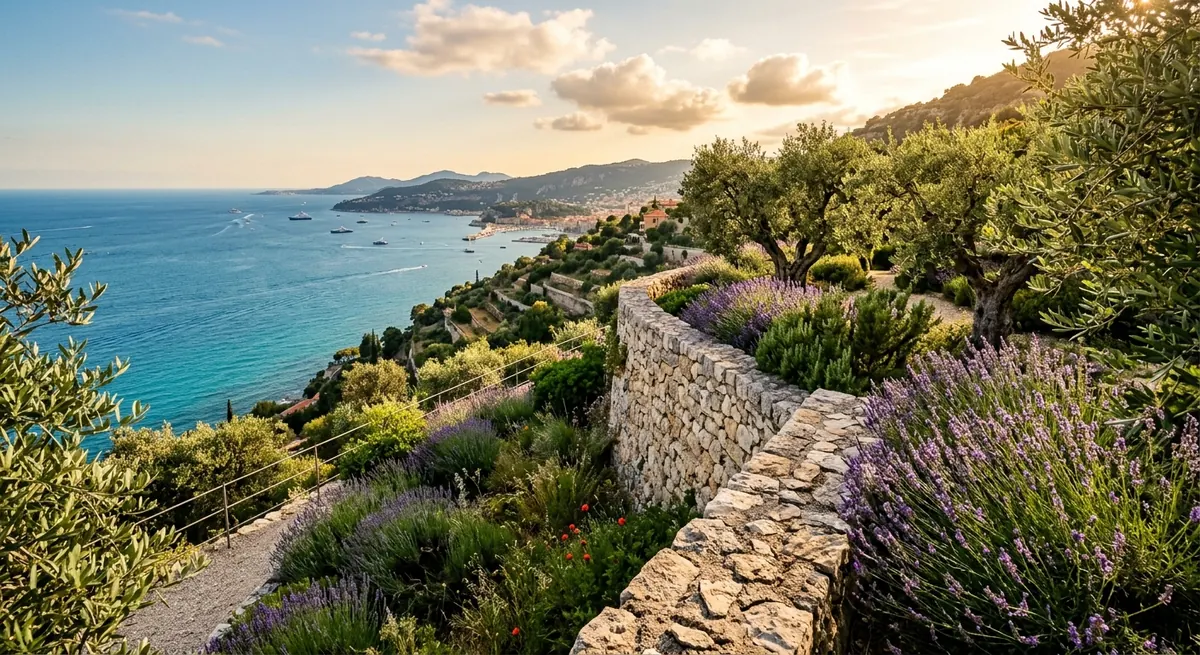
Why Riviera Hillside Gardens Are Particularly Prone to Slippage
I have walked enough collapsed terraces above Villefranche-sur-Mer and Beaulieu to know that the Côte d'Azur's geology is unforgiving once you start reshaping a slope. The region sits on a patchwork of schist, marl and decomposed limestone that holds together reasonably well when undisturbed, but turns to slurry the moment it is cut, backfilled or saturated. Add in the Mediterranean's signature weather pattern — six months of near-drought followed by torrential autumn episodes that can dump 150mm of rain in a single afternoon over Mandelieu or Cannes-la-Bocca — and you get a slope that alternates between bone-dry and completely waterlogged, which is exactly the cycle that destroys poorly built walls.
Most of the villas I work on between Nice, Vence and Grasse were terraced decades ago, often with dry stone restanques built by farmers who understood the land far better than some of the quick concrete block walls thrown up in the 1980s property boom. Those original restanques, when intact, are remarkably stable because they let water pass straight through the joints. The trouble starts when someone later pours a swimming pool, adds a parking pad, or builds a pool house uphill without recalculating the loads the wall below now has to carry. I have seen a perfectly good hundred-year-old wall in Saint-Jean-Cap-Ferrat start bulging within two winters of a neighbour adding 40cm of compacted fill behind it for a new driveway.
Choosing the Right Type of Wall for Your Slope
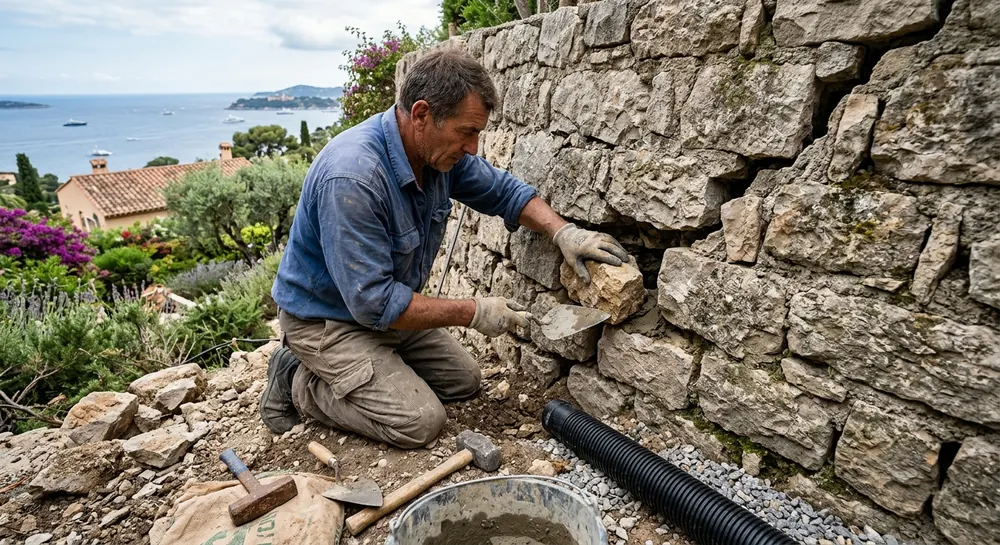
For walls under about 1.2 metres retaining light garden terraces, a well-built dry stone restanque remains hard to beat on the Riviera, both visually and structurally — expect 280 to 450€ per square metre depending on stone type and whether you are reusing existing material from the property. Local limestone and the honey-coloured stone common around Antibes and Mougins drain naturally through the gaps, which solves most of your hydrostatic pressure problem before it starts. Gabion walls, galvanized or stainless steel cages filled with stone, run cheaper at 150 to 280€ per square metre and work well on utilitarian slopes near a garage or access ramp, though they are rarely what buyers want to see from a terrace with a sea view in Cap d'Antibes.
Beyond about 1.5 metres, or wherever a wall supports a driveway, a pool deck or a structure above it, I move clients toward reinforced concrete walls with a proper footing and rebar cage, typically 400 to 650€ per square metre installed, sometimes faced afterward with stone cladding to keep the Provençal look. For genuinely difficult sites — steep clay slopes above Grasse or unstable fill in parts of La Turbie — crib walls or soil-nailed and shotcreted faces come into play, and here costs jump to 800 to 1500€ per linear metre because you are essentially stabilizing the hillside itself, not just building a wall on top of it. The right choice depends less on budget alone and more on an honest read of what is actually happening underground, which is why I always push for at least a basic geotechnical opinion before pouring anything structural on a slope steeper than 30 percent.
Drainage and Construction Details That Actually Prevent Failure
Nine times out of ten when I am called to diagnose a bulging or cracked retaining wall somewhere between Antibes and Monaco, the structural design was fine but the drainage was an afterthought. Water trapped behind a wall adds enormous hydrostatic pressure, and on this coast that pressure spikes dramatically during the autumn deluges that hit the Var and Alpes-Maritimes almost every October. A proper French drain — a perforated pipe wrapped in geotextile and bedded in gravel running the full length of the wall's base — should be standard on anything taller than 80cm, and it typically adds only 80 to 120€ per linear metre to the job, which is cheap insurance against a 15,000€ rebuild later.
Weep holes spaced every 1.5 to 2 metres along the wall face, a compacted gravel backfill rather than reused clay soil, and a footing set below the local frost-and-erosion line are the other non-negotiables I insist on. For anything over roughly 1.5 metres in height, or any wall near a boundary or access road, you will also need to check the PLU with your mairie — Nice, Cannes and most Alpes-Maritimes communes require at minimum a déclaration préalable de travaux, and walls supporting a structure or exceeding 2 metres often require a full building permit plus a geotechnical study (étude G2) if the commune is in a mapped landslide risk zone, which several hillside sectors above Villefranche and Eze genuinely are. Skipping this step does not just risk a fine; it can void your insurance entirely if the wall later fails and causes damage downhill.
Keeping an Existing Wall Healthy Through the Seasons
A retaining wall is not a build-it-and-forget-it element, especially here where winter rain and summer drought stress the structure in opposite ways every single year. I recommend owners do a proper visual check twice annually, ideally in October before the rains and again in April once the ground has settled. Look for horizontal cracks wider than 3mm, any outward bulge you can confirm with a straightedge or string line, water pooling at the base after rain rather than draining away, and weep holes that have become blocked by roots or silt — a surprisingly common issue on older Riviera properties where fig and olive roots find their way into every gap over a few decades.
Vegetation on and around a wall is a mixed blessing: shallow-rooted ground cover like thyme or rosemary helps bind surface soil and looks the part on a Provençal terrace, but anything with an aggressive root system — bamboo, eucalyptus, even mature olive trees planted too close — can prise stones apart or crack concrete from the inside over five to ten years. Minor repointing of a dry stone wall runs 60 to 100€ per square metre and is worth doing the moment you spot loose stones rather than waiting for a section to fail. If you do see genuine structural movement, do not patch it cosmetically; call in someone who can assess whether it is a drainage fix, localized underpinning, or a full rebuild, because a wall that has already started rotating on its base rarely stabilizes on its own and the repair bill roughly triples for every season you wait.
Budgeting the Project and Choosing the Right Contractor
For a typical hillside villa project involving 20 to 40 linear metres of retaining wall across a few terraces, realistic all-in budgets on the Côte d'Azur run from about 25,000€ for a straightforward dry stone or gabion solution up to 70,000€ or more where reinforced concrete, soil stabilization and significant drainage works are required, plus 10 to 15 percent if a geotechnical study and permit process are involved. Always get at least three quotes, and be wary of any devis that does not explicitly detail drainage provision, footing depth, and the type of backfill material — vague quotes are the single biggest red flag I see from clients who later call me to fix a failed wall that cost half what mine would have.
Insist on a contractor who carries assurance décennale for structural masonry work, not just general liability, since retaining walls fall squarely under the ten-year structural guarantee in French construction law, and ask to see the attestation before signing anything. Local experience matters enormously here: a mason who has only worked on flat inland sites in the Var may not understand the specific drainage and movement challenges of a steep slope above Beaulieu or Roquebrune, whereas firms that have spent years on Riviera hillsides will instinctively over-specify drainage and footing depth because they have seen what happens when it is skipped. It is also worth timing the works for late spring or early autumn, avoiding both the peak summer heat that makes concrete curing tricky and the depths of the rainy season when excavation on an open slope becomes genuinely hazardous.
Frequently asked questions
For most hillside villas expect 150 to 280€ per square metre for a gabion wall, 280 to 450€ per square metre for dry stone, and 400 to 650€ per square metre for reinforced concrete, with full projects often totalling 25,000 to 70,000€ depending on height, length and soil conditions.
Most communes require a déclaration préalable for walls over roughly 80cm to a metre, and a full permit plus geotechnical study for walls over 2 metres, those supporting a structure, or those in a mapped landslide risk zone — always check directly with your mairie before starting.
Watch for horizontal cracks wider than 3mm, any visible outward bulge, water pooling rather than draining at the base, blocked or missing weep holes, and sudden new cracks appearing in a pool deck or driveway above the wall — all warrant an immediate professional assessment.