
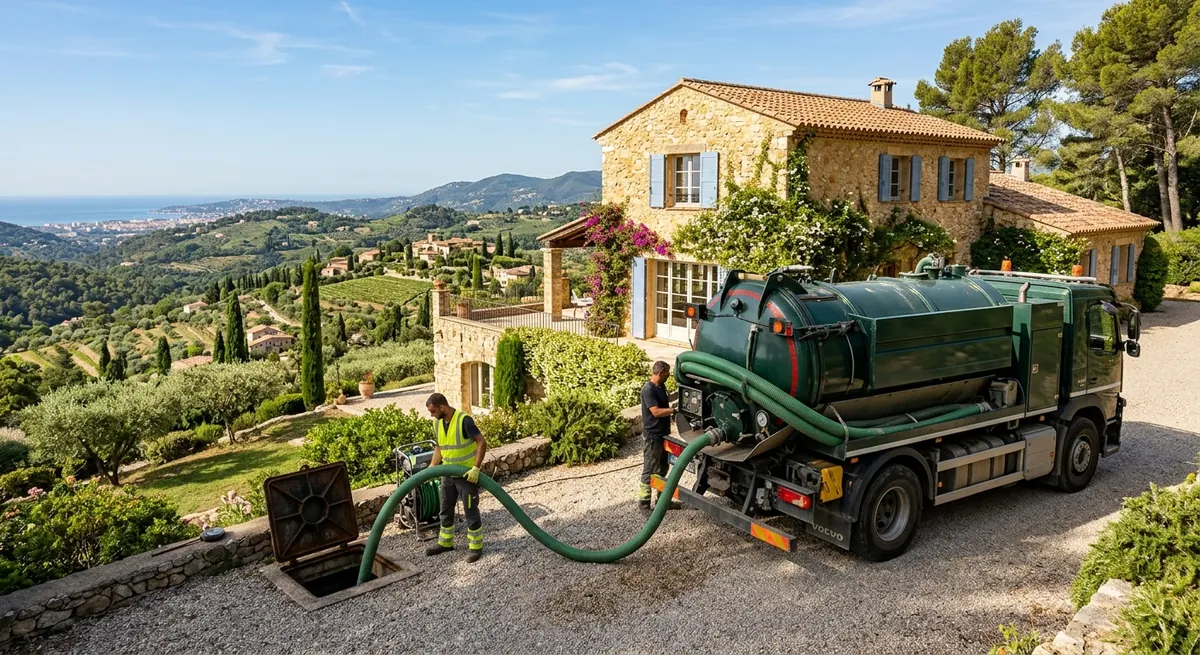
Why So Many Hinterland Villas Still Run on Septic Systems
Drive up from Nice through Saint-Jeannet, Gattières, Coursegoules or the hills above Bar-sur-Loup and you quickly leave the mains sewer network behind. The Métropole Nice Côte d Azur and neighbouring communautés d agglomération have extended collective sewage lines along the coast and major valley roads, but scattered hamlets, olive-grove properties and villas perched at 400 to 700 metres altitude were simply never connected. Laying a gravity or pumped sewer line up a hairpin road to serve six houses rarely makes financial sense for a commune, so roughly a third of the properties I inspect in the Var and Alpes-Maritimes backcountry still rely on assainissement non collectif, or ANC as the French administration calls it.
This is not a second-rate solution when it is properly sized and maintained, and plenty of restored bergeries and 1970s villas in Tourrettes-sur-Loup or Le Rouret run perfectly clean systems for decades. The trouble starts when a previous owner installed an undersized fosse septique thirty years ago for a two-bedroom house, then the place got extended to five bedrooms with a pool house and a guest gîte, and nobody ever recalculated the load. I have opened tanks behind villas worth 1.8 million euros that were built for a household a fraction of that size, and the smell alone tells you the story before the lid even comes off fully.
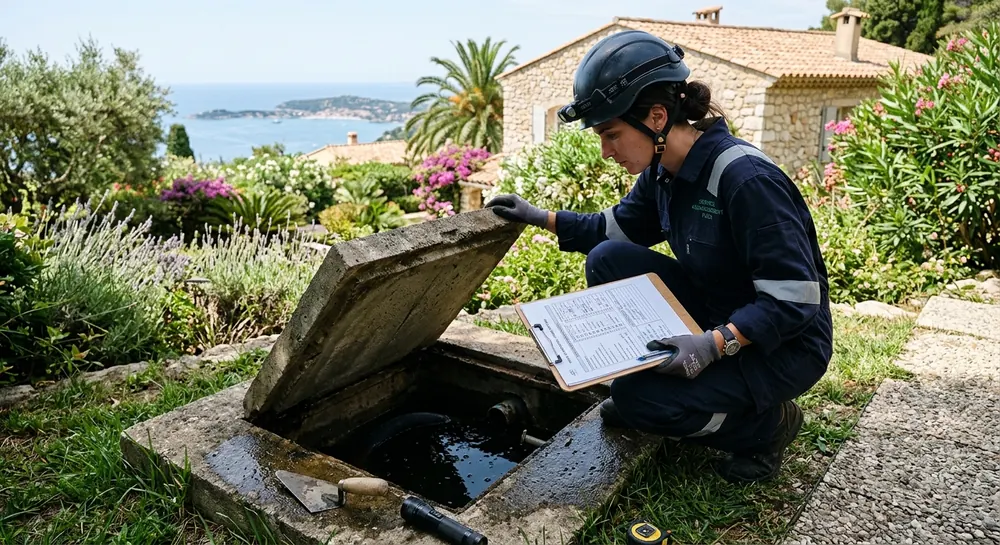
How the SPANC Inspection Actually Works
Every commune or intercommunality in France is required to run a Service Public d Assainissement Non Collectif, and in the Alpes-Maritimes this usually sits under bodies like the Métropole Nice Côte d Azur, the CASA around Antibes-Sophia, or smaller rural intercommunalités further inland. The SPANC agent's job is not to fine you for fun, whatever the local rumour mill says in villages like Aspremont or Levens, but to verify that your installation does not pollute groundwater, streams or the karstic limestone that much of the hinterland sits on. A routine control visit happens roughly every four to six years for a well-functioning system, and it typically lasts thirty to forty-five minutes: the agent lifts the manhole covers, checks sludge and scum levels with a graduated rod, tests that the pretreatment and dispersion or treatment stages are both present and connected correctly, and asks to see your last pumping receipt.
Fees vary by commune but expect somewhere between 90 and 180 euros for a standard periodic control, sometimes billed directly by the SPANC, sometimes folded into your water bill. If you are buying or selling a villa in Cabris, Le Bar-sur-Loup or the hills behind Grasse, a specific pre-sale ANC diagnostic is mandatory and must be less than three years old at the signing of the sale, which catches out a surprising number of vendors who assumed their system was fine because nothing had backed up yet. A non-compliant report does not block the sale, but it does obligate the buyer to bring the installation up to standard within one year of the purchase, and that clause has a way of reappearing at the negotiating table to shave five to fifteen thousand euros off an asking price.
Realistic Pumping Frequency and What Drives the Cost
The textbook rule of thumb, and the one most SPANC officers will quote you, is to pump out the fosse toutes eaux when sludge occupies about fifty percent of the tank volume, which in practice for a standard family of four in a 3,000-litre tank works out to roughly every three to four years. But altitude, water usage and soil conditions on the Nice hinterland change that calculation more than people expect. Villas with large gardens, drip irrigation drawn from the same water meter, or a pool backwash line mistakenly plumbed into the septic system tend to fill faster and need pumping every two to three years instead. I have also seen the opposite problem in holiday homes around Coursegoules or Gréolières that sit empty eight months a year: infrequent use lets the biological digestion process stall, and sludge can build up unevenly even with light overall volume.
On pricing, a straightforward pump-out of a 3,000 to 5,000 litre fosse septique or fosse toutes eaux by a licensed vidangeur runs between 220 and 380 euros in the Nice hinterland as of this year, climbing toward 450 to 600 euros for larger 8,000 to 10,000 litre tanks common in bigger villas with five-plus bedrooms. Access matters enormously here: a tank buried under a gravel driveway with a manhole flush to the surface is a quick job, but tanks tucked under a terrace, behind a retaining wall in Peille or Èze-village, or reached only via a narrow path will add a call-out premium of 80 to 150 euros for extra hose length or a smaller specialised truck. Always ask for the bordereau de suivi des déchets, the official waste tracking slip, since it doubles as your proof of maintenance for the next SPANC visit and for any future property sale diagnostic.
Micro-Stations and Upgrades: When Replacement Beats Repair
Since the tightening of ANC regulations under the arrêtés of the past decade, many hinterland villas with failing or grossly undersized systems are being pushed toward compact micro-station d épuration units rather than traditional fosse plus epandage fields, especially on plots where soil percolation is poor or space for a full drain field simply does not exist. These electromechanical units use aerobic bacteria and a blower to treat wastewater far more thoroughly, discharging water clean enough in some configurations to go to a simple soakaway rather than a full leach field, which is a real advantage on the tight, terraced plots typical around Vence, Saint-Paul-de-Vence or La Colle-sur-Loup. Installed cost for a micro-station sized for a 5 to 6 person household typically lands between 8,500 and 13,000 euros including groundworks, though rocky terrain common in this region can push excavation costs up by another 2,000 to 4,000 euros when the pelle mécanique hits solid limestone at forty centimetres.
The trade-off nobody mentions upfront is the electricity draw and the servicing contract: micro-stations need power for the blower running continuously, adding perhaps 25 to 40 euros a month to your bill, and manufacturers require an annual maintenance visit costing 150 to 250 euros to keep the warranty valid. For villas that are only occupied part of the year, this ongoing cost and the risk of the biological culture dying off during long vacancies makes a well-sized traditional fosse toutes eaux with a generous epandage field the more forgiving choice, provided there is enough flat, permeable land available. My rule with clients renovating in the hinterland is simple: if you have the garden space and decent percolating soil, stick with gravity-based treatment and just budget properly for pumping; if you are on a tight terraced plot in Tourrettes-sur-Loup or a rocky slope above Peillon, the micro-station's smaller footprint usually justifies the extra running cost.
Frequently asked questions
Most communes and intercommunalités in the Alpes-Maritimes schedule a periodic control every four to six years for a compliant, well-maintained system. Non-compliant installations, or those flagged during a previous visit, get reinspected sooner, sometimes within twelve to eighteen months, and property sales always trigger a fresh mandatory ANC diagnostic regardless of when the last routine visit occurred.
A failed or non-compliant report does not carry an immediate fine in most cases, but it starts a clock: you typically get four years to bring the installation up to standard for an existing owner, or one year if the non-compliance was flagged during a property sale. Ignoring the notice can eventually lead to a mise en demeure and financial penalties, so it is worth budgeting for the fix as soon as the report lands rather than waiting.
Tank size relative to household size and water usage is the biggest factor, but pool backwash accidentally plumbed into the septic line, heavy garden irrigation on the same system, or a property that sits empty for months and then hosts a full house of summer guests can all throw off the standard three to four year rule. Getting the tank checked with a sludge rod at each pumping, rather than just guessing on a calendar, is the most reliable way to catch the real pattern for your specific villa.