
Why the Riviera Sun Is Both a Gift and a Puzzle
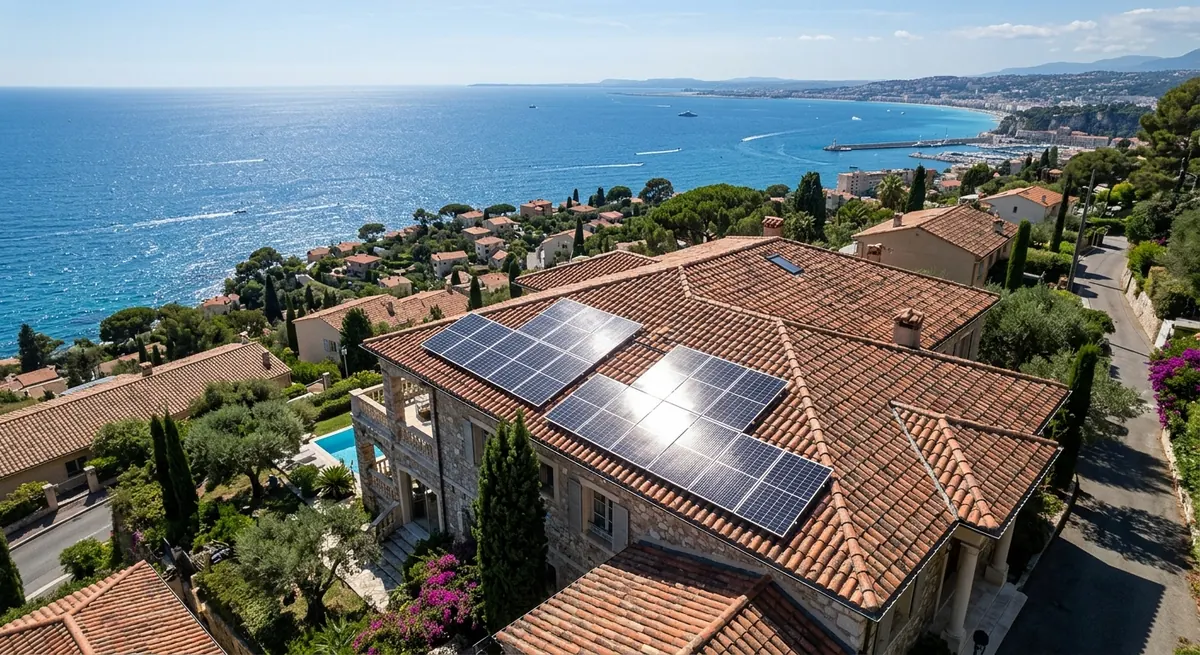
Nice logs roughly 2,750 to 2,900 hours of sunshine a year, which puts it ahead of Lyon or Paris by a wide margin and makes solar arithmetic genuinely favorable here. But the terrain that makes the Riviera beautiful also complicates every rooftop survey I run: hillside villas in Falicon or Saint-Jean-Cap-Ferrat often sit in the shadow of a neighbor's umbrella pine by 3pm, and dense old-town buildings in Cannes or Antibes throw shade across each other's terraces for hours. A proper site visit with a solargraph or Solmetric tool, not a satellite estimate from an online calculator, is the only way to know whether your south-facing roof pitch is actually worth 6kWc or only 3.5kWc of usable panels.
Roof type matters more here than in most of France. Genoise-tiled roofs common in Vieux Nice and the Antibes old town need specialized flashing and often a lighter panel format to avoid overloading century-old rafters rated for maybe 40kg/m2 less than modern trusses. Flat roof terraces, very common in 1970s Cannes-la-Bocca or Cap 3000 area apartment blocks, are actually easier: you mount panels on tilted aluminum frames with ballast trays, avoiding roof penetrations entirely, though you sacrifice a bit of density since rows need spacing to prevent self-shading. Either way, budget for a structural check by the installer before signing anything; I have seen two projects in Cagnes-sur-Mer stall for six weeks because nobody checked the charpente first.
Permits: What the Mairie and the ABF Will Actually Ask For
Most standalone houses need only a déclaration préalable de travaux (DP) filed with the mairie, and the town has one month to respond in ordinary zones. The complication on the Riviera is the Architecte des Bâtiments de France, whose approval is mandatory within 500 meters of a classified monument or inside a secteur sauvegardé. That radius covers a startling chunk of Nice's Vieux Nice, Cimiez, Cannes' Le Suquet, and most of the Antibes ramparts. The ABF will frequently reject visible black panels on a street-facing slope and instead push you toward the rear roof pitch, or toward solar tiles that mimic terracotta, which run 30 to 50 percent more expensive per kWc than standard modules. Get the ABF's informal opinion before commissioning a full technical study; a five-minute conversation at the Nice Métropole planning desk has saved several of my clients thousands of euros in redesign costs.
Monaco operates under its own building code entirely, administered by the Direction de l'Aménagement Urbain, and requires a full technical dossier even for small residential installs, plus proof that the installer carries Monaco-recognized insurance. Once panels are physically installed anywhere in France, the second permit-like hurdle is the Consuel visit, a mandatory electrical conformity inspection before Enedis will connect your installation to the grid or activate net metering. Expect the whole administrative chain, DP approval, Enedis raccordement request, and Consuel scheduling, to take ten to fourteen weeks in the Alpes-Maritimes during the busy spring and summer install season, so plan accordingly if you are hoping to catch a full summer of production.
Wiring It Into an Existing NF C 15-100 Installation
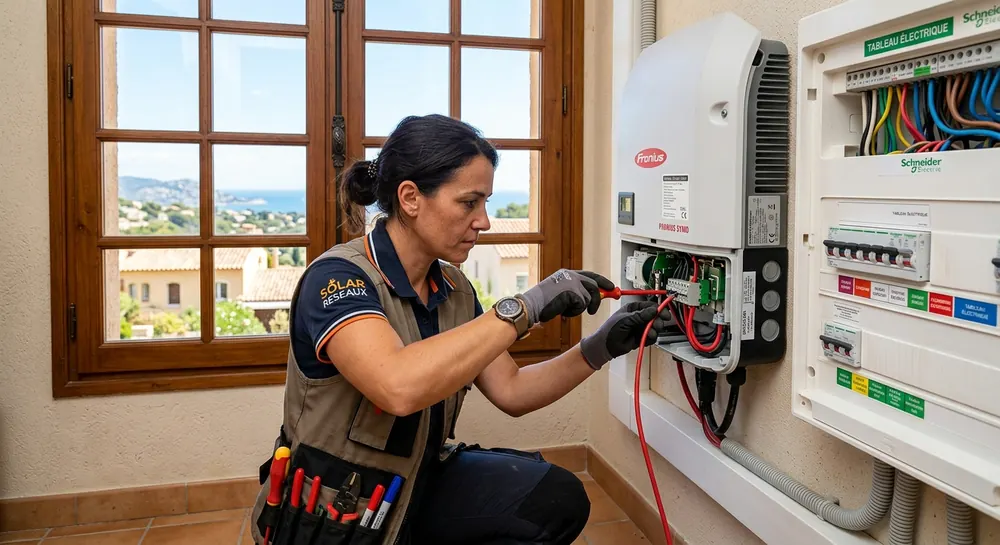
Almost every Riviera home built or renovated after 2010 already complies with NF C 15-100, and a solar retrofit has to slot cleanly into that framework rather than bypass it. In practice this means a dedicated DC isolator switch mounted at the roof penetration point, a DC combiner box if you are running multiple strings, and a dedicated AC circuit breaker of the correct rating (typically 20A or 25A for a 3kWc string inverter setup) inside your existing tableau électrique. If your consumer unit is more than fifteen years old or already fully populated with modules, you will likely need to add a sub-panel, which typically adds €400 to €800 to the job. Installers also must add a properly rated parafoudre, a surge protection device, which matters more here than inland given how frequently the Var and Alpes-Maritimes get violent autumn thunderstorms rolling off the Mediterranean.
The other decision point is string inverter versus micro-inverters, and on the Riviera this is not purely a cost question. Partial shading from palm trees, chimneys, or neighboring rooflines is common enough that micro-inverters, which optimize each panel independently, often produce 8 to 15 percent more usable energy on a shaded roof despite costing roughly €150 to €200 more per panel. On an open, unshaded terrace roof in somewhere like La Californie in Cannes, a single string inverter at a lower cost is usually the smarter call. Whichever route you choose, insist your installer is RGE QualiPV certified; this is not paperwork theater, it is what makes you eligible for the reduced 10 percent VAT rate on installations under 3kWc and is required by most home insurers before they will cover fire risk from a rooftop PV system.
Real Costs and Honest Payback Numbers for 2026
Installed prices along the coast currently run €2,200 to €2,600 per kWc for a straightforward 3 to 6kWc residential system, rising to €2,800 to €3,200 per kWc once you add tile-mimicking panels for an ABF-constrained facade or scaffolding for a steep hillside villa in Èze or Villefranche-sur-Mer. A typical 6kWc install on a well-oriented Antibes roof lands around €14,000 to €16,000 before the government's prime à l'autoconsommation, which currently knocks off roughly €80 to €90 per kWc for systems under 9kWc, so subtract about €500 from that total. Electricity prices matter enormously to the payback math: with EDF's regulated tariff sitting well above €0.20 per kWh and self-consumption typically covering 40 to 60 percent of a household's daytime usage in a Riviera home with decent afternoon occupancy, most 6kWc systems I have tracked pay back in 8 to 11 years, comfortably inside the 25 to 30 year panel lifespan.
Selling surplus power back to the grid under the EDF Obligation d'Achat contract currently brings in around €0.04 to €0.10 per kWh depending on system size, which is far less attractive than avoiding a purchase at €0.20-plus, so the real financial lever is maximizing self-consumption rather than maximizing total production. This is where a modest battery, typically €4,000 to €7,000 installed for 5 to 10kWh of storage, needs scrutiny: on the Riviera's sunny, mild climate a battery often shaves only one to two years off payback compared to a battery-free system, because so much production already lines up with daytime AC and pool-pump loads that are common in this region. I generally advise clients to run a full year without a battery, log their actual self-consumption ratio through the inverter's monitoring app, and only add storage later if the data genuinely justifies it.
Running the Project Without Regrets
Choose an installer with verifiable RGE QualiPV certification and ask to see at least two completed jobs within twenty kilometers, ideally on a similar roof type to yours; salt air corrosion from the Mediterranean is real, and I have seen budget installers use standard steel fixings that started rusting within eighteen months on a Cap d'Antibes roof less than 200 meters from the water. Insist on stainless steel or marine-grade aluminum mounting hardware for anything within a few kilometers of the coast, even if it adds €300 to €500 to the quote; it is far cheaper than a re-mount five years later. Scaffolding for tile roofs typically adds €1,500 to €2,500 depending on roof height and access, and steep hillside properties around Beausoleil or upper Nice can push that figure higher because of restricted street access for the crane truck.
If you live in a copropriété, budget extra time and diplomacy: the syndic and a majority of co-owners must approve any rooftop modification at a general assembly, which on the Riviera often means waiting for the annual meeting rather than pushing through an emergency vote. Bring a clear technical dossier, expected noise and access disruption during install (usually one to two days for a straightforward 6kWc system), and a realistic shared-cost or individual-ownership structure, since French law allows individual owners to install and own their own panels even within a shared building under the 2019 loi énergie-climat provisions. Once installed, plan on an annual visual inspection and a panel wash every twelve to eighteen months; Riviera dust, pollen from the mimosa season, and salt residue can reduce output by 5 to 8 percent if left unaddressed, a cheap fix at €80 to €150 per cleaning that most homeowners simply forget to schedule.
Frequently asked questions
Yes, in almost all cases you need to file a déclaration préalable de travaux with the mairie, and if your property sits within 500 meters of a classified monument or in a protected sector, which covers large parts of Vieux Nice and Cimiez, the Architecte des Bâtiments de France must also approve the design, panel color and roof placement before work can start.
For 2026, expect €2,200 to €2,600 per kWc for a standard installation, meaning a typical 6kWc system runs roughly €14,000 to €16,000 before the prime à l'autoconsommation subsidy, with costs rising toward €3,000 per kWc if you need ABF-compliant tile-style panels or scaffolding for a steep or hard-to-access roof.
Yes, French law under the loi énergie-climat allows an individual co-owner to install and own panels on the shared roof, but you still need approval from the syndic and a vote at the general assembly, so it is worth preparing a full technical dossier and timing your request around the annual meeting to avoid long delays.