
Why Nice's Old Town and Port District Are So Loud After Dark
I have measured noise in a client's fourth-floor flat on Rue Droite at 2am and watched the meter hover between 68 and 74 decibels every time a group spilled out of a bar below - roughly the level of a running vacuum cleaner, except it lasts until closing time. Vieux Nice, the Port district around Rue Bonaparte, and the streets feeding into Place Garibaldi were built for pedestrians and carts, not for terraces packed with tourists until 1am and delivery scooters at dawn. The buildings themselves compound the problem: most date from the 17th to 19th century, with single-pane windows in wooden frames that have shrunk and warped over 150 years, leaving air gaps you can feel with your hand on a windy night.
The party walls in these buildings are often just 15 to 20cm of soft stone or rubble masonry, sometimes with a layer of old lath-and-plaster that does almost nothing acoustically. Add narrow streets that act like echo chambers, bouncing conversation and scooter engines between facades, and you get a district where even a well-insulated modern flat two streets back from Cours Saleya still picks up bass frequencies from music venues. Renters in these zones frequently tell me they assumed double glazing alone would fix things, only to discover that low-frequency noise - the thump of a sound system or a truck idling - travels through walls and floors just as easily as through glass, sometimes more so. Understanding which noise path dominates in your specific flat is the first real step, and it usually takes an evening with the windows open and closed, phone decibel app running, to find out.
Windows: The Single Biggest Investment That Pays Off
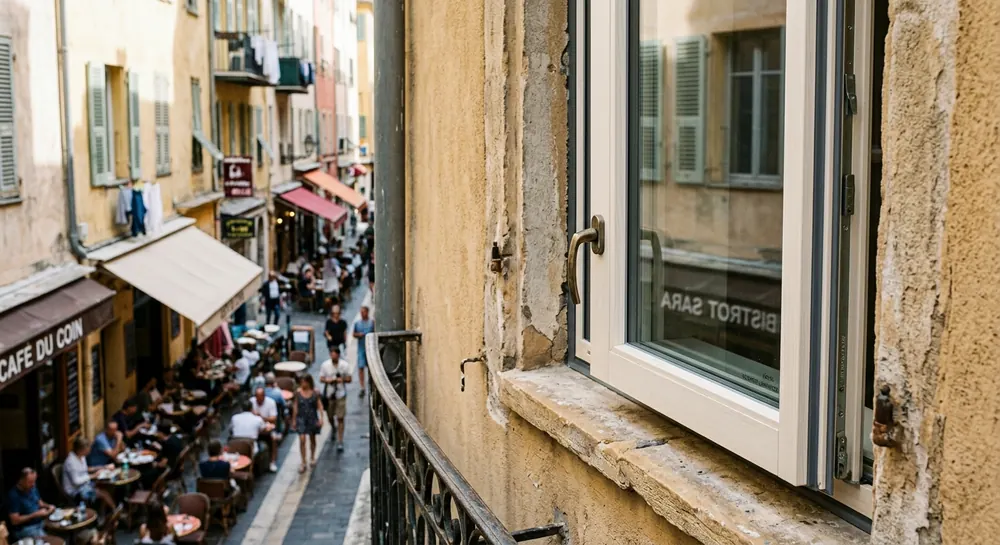
If your flat overlooks a terrace on Rue de la Préfecture or faces the Promenade du Paillon where scooters cut through at all hours, your windows are almost certainly your weakest point, responsible for 60 to 70 percent of the noise you hear indoors. The most cost-effective serious fix is secondary glazing: an additional interior pane, typically 6 to 10mm laminated acoustic glass, mounted on a slim aluminium or PVC frame a few centimetres inside your existing window. In Nice, local glaziers around Avenue Malausséna quote roughly 450 to 750 euros per window for this, and it can cut perceived noise by 8 to 12 decibels - genuinely the difference between hearing every word of a street conversation and hearing a muffled hum.
Full replacement with acoustic double or triple glazing costs more, generally 800 to 1,600 euros per window installed depending on size and whether you need custom haussmannian-style frames to satisfy a copropriété's aesthetic rules, which many buildings in Vieux Nice and along Rue de France enforce strictly. The acoustic performance gain over standard double glazing is real but often smaller than people expect unless you specify asymmetric glass thicknesses, for example 10mm and 6mm panes rather than two matching 4mm sheets, since matching thicknesses resonate at the same frequency and let more sound through. For renters who cannot alter windows, heavy interlined curtains with a mass-loaded vinyl layer, plus draft-sealing foam strips around the frame (a 20-euro DIY job), will not transform the room but can shave off a noticeable few decibels for under 150 euros total, which matters when a full renovation is not on the table.
Walls: Dealing With Thin Party Walls and Shared Corridors
Once windows are addressed, party walls become the next obvious culprit, especially in converted buildings near Place Garibaldi where a single large apartment was split into two or three units decades ago, leaving nothing but a stud wall or a single layer of brick between neighbours. The standard professional solution is a resilient, decoupled wall build-up: metal furring channels fixed with acoustic isolation clips, 45mm of mineral wool packed into the cavity, and two layers of 13mm acoustic plasterboard, ideally with a damping compound between the sheets. This assembly typically costs 90 to 140 euros per square metre installed in the Nice area, and for a standard bedroom wall of 12 to 15 square metres you are looking at 1,200 to 2,000 euros including finishing and repainting.
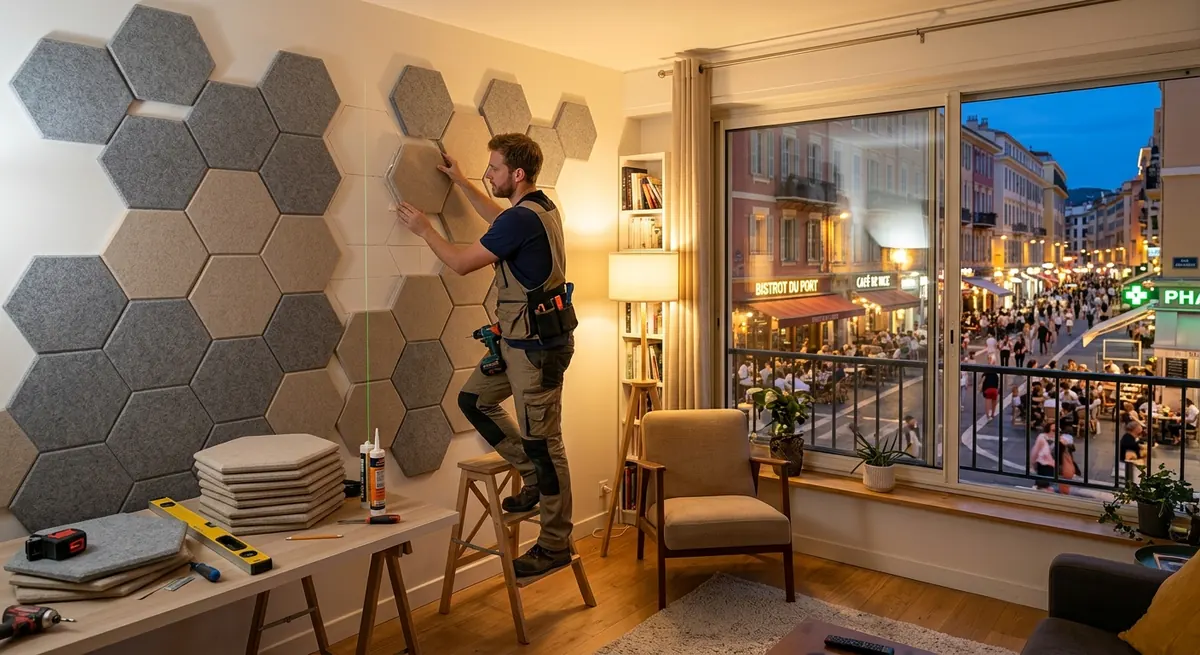
A cheaper interim measure, popular with tenants who cannot touch the structure, is mounting acoustic panels or quilted sound-blankets directly on battens, which reduces the reverberant slap-back noise inside the room even if it does little to stop transmission through the wall itself - useful against your own echo but not against a neighbour's television. I have also seen good results in older Nice buildings from simply filling gaps around pipe penetrations and electrical boxes with acoustic sealant, since a two-centimetre unsealed hole around a radiator pipe can let through more noise than the entire rest of the wall combined, and this fix costs under 30 euros in materials. Before committing to a full wall rebuild, always check whether your noise problem is actually airborne (voices, music) or structure-borne (footsteps, plumbing), because the treatments differ substantially and copropriété rules in most Nice buildings require formal approval before touching a shared party wall.
Floors and Ceilings: Taming Impact Noise From Upstairs and Below
Impact noise, the thud of footsteps, dragged chairs, or a washing machine on spin cycle from the flat above, is a distinct problem from airborne street noise and needs a different fix. In older buildings around Rue de la Préfecture and the Antibes-adjacent quarters with original tomette tile floors, the classic solution is a floating floor: a resilient underlay of 8 to 15mm rubber or cork laid over the existing floor, then a rigid layer of plywood or new tiling on top, fully decoupled from the walls with a perimeter isolation strip. Expect to pay 60 to 100 euros per square metre for this done properly, so a 20 square metre living room runs 1,200 to 2,000 euros, and it is genuinely one of the more disruptive renovations since furniture and sometimes doors need adjusting for the new floor height.
When you cannot touch the floor above (you are not the owner of that unit) or below (your own ceiling), a suspended acoustic ceiling is the fallback: a metal grid hung on resilient hangers below your existing ceiling, filled with mineral wool and closed with acoustic tiles or plasterboard, costing 70 to 110 euros per square metre and typically losing 8 to 10cm of ceiling height, which matters in older Nice apartments where ceilings can already be modest at 2.5 metres. For renters facing noisy upstairs neighbours in a shared building near Boulevard Jean Jaurès, the pragmatic first move before any construction is a direct, polite conversation, sometimes reinforced by a letter from the syndic, since French co-ownership rules (règlement de copropriété) generally require reasonable quiet hours, and mediation is far cheaper than any acoustic ceiling. Only when that fails does it make sense to invest in the physical fix, and even then, thick rugs with a dense felt underlay over 60 percent of the floor area can meaningfully soften impact transmission for under 300 euros as a stopgap.
Building a Realistic, Phased Soundproofing Budget
Most owners I work with in Nice do not tackle everything at once, and that is the right instinct: soundproofing rewards a phased approach where you fix the biggest leak first, live with it for a few weeks, then reassess. A sensible sequence for a typical two-bedroom flat facing a lively street is secondary glazing on the street-facing windows first (roughly 1,500 to 2,500 euros for three windows), then draft-sealing and door sweeps on the entry door (150 to 300 euros), then, only if the problem persists, a party wall treatment on the bedroom shared with a noisy neighbour. Spread across a year, a full package for a 65 square metre flat in a district like the Port or Vieux Nice generally lands between 4,000 and 9,000 euros depending on how many rooms need treatment and whether you use resilient wall systems or simpler panel-based fixes.
Renters have fewer structural options but more flexibility on furnishings and short-term fixes: heavy curtains, door draft stoppers, acoustic wall panels on removable strips, and rugs can realistically be assembled for 400 to 900 euros and installed over a weekend without any landlord approval, while still delivering a perceptible improvement in sleep quality. Owners planning a full acoustic renovation should also factor in that many Nice copropriétés require prior board approval for anything touching windows or party walls, which can add six to ten weeks to a project timeline, so starting the paperwork early in the season, before the summer nightlife peak, saves considerable frustration. Whatever budget you settle on, get at least two quotes from local acoustic specialists rather than general renovation firms, since proper acoustic work depends on details - clip spacing, sealant type, glass asymmetry - that a generalist contractor will often skip to save time, and those shortcuts are exactly where the promised decibel reduction disappears.
Frequently asked questions
Secondary glazing on street-facing windows gives the best return for the money, typically 450 to 750 euros per window with an 8 to 12 decibel reduction. Combine it with door draft seals and heavy lined curtains for a full package under 1,000 euros that requires no structural work or landlord approval in most cases.
Yes, generally. Changing window frames or exterior appearance almost always requires prior approval from the syndic and sometimes a vote at the general assembly, especially in protected facades common in Vieux Nice. Interior-only fixes like secondary glazing mounted inside the room, suspended ceilings, or floating floors usually do not need approval since they do not alter the building's exterior or shared structure, but always check your règlement de copropriété first.
For a 65 square metre flat, a complete package covering windows, one party wall, and a bedroom ceiling typically runs 4,000 to 9,000 euros, depending on whether you choose secondary glazing versus full replacement and simpler acoustic panels versus a full decoupled wall system. Phasing the work over several months, starting with windows, spreads the cost and lets you measure improvement before committing to structural changes.