
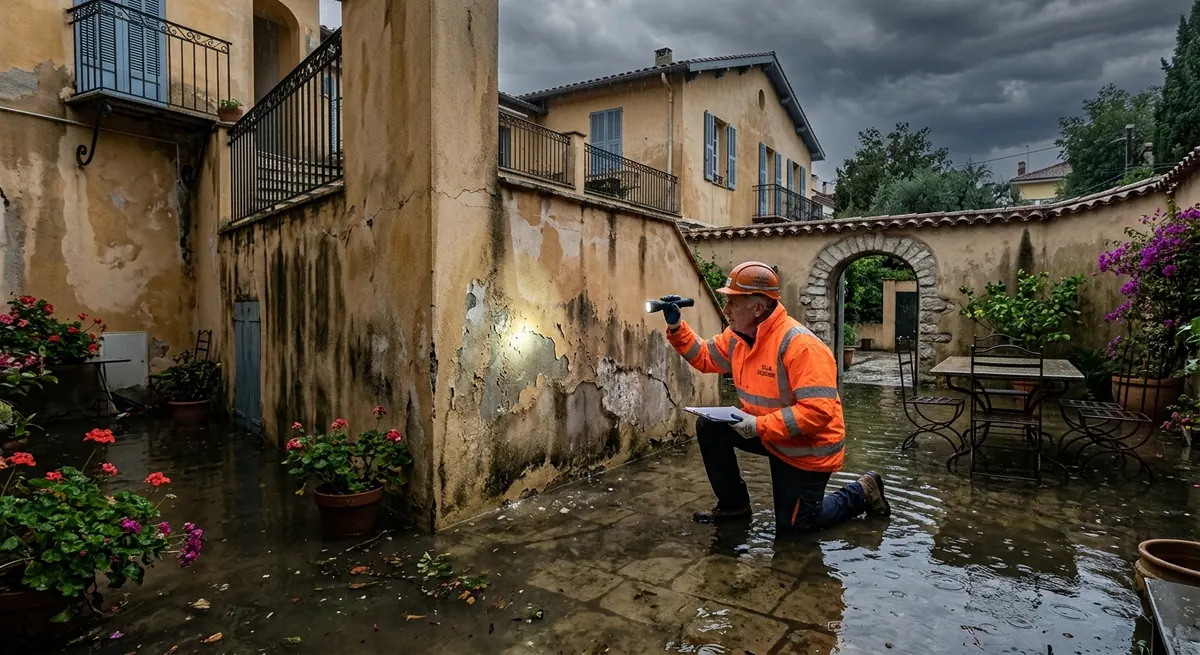
The First 48 Hours: Stabilizing Your Villa Before the Adjuster Arrives
I have walked into more flooded basements in Cap d'Antibes and cracked garden walls in Vence than I can count, and the pattern is always the same: the owners who act fast and methodically in the first two days save real money later. Cut the electricity at the main breaker if water has reached sockets or the fuse board, even if the power is still on — a soaked distribution board in a 1960s villa near Fabron is a fire risk, not just an inconvenience. If a tree limb or roof tile has opened a hole in the roof, get a tarpaulin over it immediately rather than waiting for a full repair quote; rainwater sitting in a ceiling void for a week does far more damage than the original storm.
On the Riviera, emergency roofers (couvreurs) get booked solid within hours after a big blow, so calling three at once is not disloyal, it is survival. Expect to pay 400 to 900 euros for urgent tarping on a standard villa roof, more if access requires a crane on a steep Cap Ferrat or Éze property. If water has pooled in a lower level, a submersible pump plus a few days of industrial dehumidifier rental runs 60 to 90 euros per day per unit, and you will typically need two or three units running for a fortnight in a flooded rez-de-jardin. Photograph everything before you move a single piece of furniture — insurers pay attention to water lines on walls, mud deposits, and the state of skirting boards, and once you have mopped up, that evidence is gone.
Building Your Insurance File: Cat Nat, Garantie Tempête and What Adjusters Actually Look For
French home insurance splits storm damage into two separate mechanisms and mixing them up costs owners money. The garantie tempête, grêle, neige is a standard clause in almost every multirisque habitation policy and triggers automatically once wind speeds or hail intensity meet a recognised threshold, no special decree needed. Flash flood damage, by contrast, usually falls under the régime Cat Nat (catastrophe naturelle), which only applies once an arrêté interministériel officially classifies your commune for that specific event. This matters enormously along the Paillon, the Var, or smaller Riviera streams that turn violent in minutes: if your commune is not listed in the decree, a flood claim can be refused even though the water clearly came from the storm, whereas wind and roof damage from the same event is usually still payable under the standard tempête clause.
Once the paperwork question is settled, focus on the file. Send your insurer a written déclaration within five days for storm damage or ten days after the Cat Nat decree is published for flood claims — miss that window and you can lose the claim outright. For villas above roughly 800,000 euros in areas like the Carré d'Or in Cannes or the Californie district in Nice, it is worth paying for your own expert d'assuré, an independent loss adjuster who represents you rather than the insurance company; fees run 800 to 2,500 euros depending on property size, but on a serious claim they routinely negotiate settlements 20 to 40 percent higher than the insurer's first offer. Keep every receipt, even for a 15-euro tarp strap from the local Brico, and get at least two written devis before starting non-urgent repairs, since insurers can and do query invoices that arrive without competing quotes.
When to Call a Structural Engineer: Reading the Warning Signs
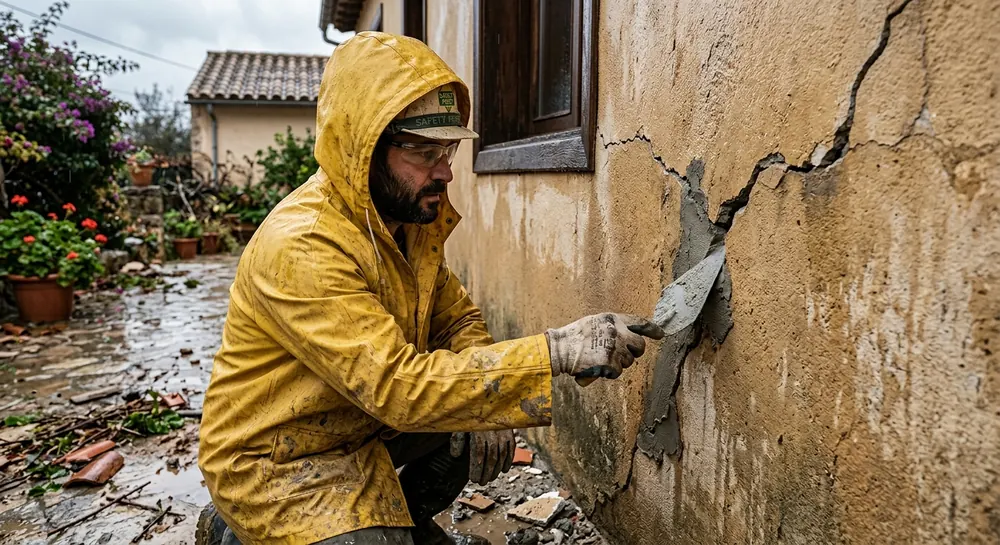
Not every crack after a storm is cosmetic, and on Riviera hillsides the geology makes this a real concern. Villas built on the clay and schist slopes around Vence, Tourrettes, or the back of Villefranche can shift noticeably when heavy rain saturates the ground and a retaining wall (mur de soutènement) that has held for thirty years suddenly bulges or leans. Warning signs worth taking seriously include cracks wider than 2mm that run diagonally through a corner, doors and windows that suddenly stick when they never did before, and any visible undermining of a foundation edge where flash-flood water has scoured away soil — this last one is common on properties near seasonal ravins in the Antibes and Mougins hills.
When you see any of those signs, call a bureau d'études structure before you call a plasterer. A structural diagnostic on a mid-size villa typically costs 1,200 to 3,500 euros depending on whether it involves simple visual inspection with crack monitoring gauges or a full geotechnical study with soil borings, and the report usually takes seven to fifteen working days. This report is not bureaucratic box-ticking: it becomes the document your insurer, your mason, and eventually a buyer if you sell will all rely on, and rebuilding a wall or slab without one, only to find movement continuing six months later, is a far more expensive mistake than the diagnostic fee itself.
Repair Costs and Sequencing: From Drying Out to Rebuilding
Once safety and paperwork are handled, budget realistically. Roof tile and batten repair on Riviera-style tuile canal roofing runs 150 to 300 euros per square metre depending on pitch and access; render (crépi) repair after wind-driven rain has blown out a facade section costs 60 to 90 euros per square metre; and a genuinely flooded ground floor, including stripped plaster, new electrics up to French NF C 15-100 standard, and flooring, lands between 800 and 1,400 euros per square metre once everything is torn out and rebuilt properly. A collapsed garden wall, extremely common after flash floods in Antibes and Le Cannet, rebuilds at 250 to 450 euros per linear metre depending on height and stone facing, and a flooded pool technical room with ruined pumps and filtration can run 3,000 to 8,000 euros to replace.
The sequencing matters as much as the budget. Walls and slabs need to dry before you close them back up — plan on two to four weeks of active drying with dehumidifiers for a seriously flooded space, and insist your contractor checks moisture readings under roughly 3 percent with a hygrometer before applying render or paint, not just by feel. After a widespread storm across the Alpes-Maritimes, every serious couvreur, maçon, and électricien in the department gets booked for weeks, so if your damage is not urgent-safety-critical, expect to wait four to eight weeks for a proper crew rather than jumping at the first available contractor, who is often available precisely because nobody local will vouch for their work.
Choosing the Right Contractor and Storm-Proofing for Next Time
Storms bring out opportunists, and the Riviera sees its share of door-knocking crews offering instant repairs for cash. Always check that a contractor carries assurance décennale (ten-year structural liability insurance) and, for roofing and insulation work, a Qualibat or RGE certification, and ask for their SIRET number so you can verify the company actually exists before handing over a deposit. A proper devis breaks the job down lot by lot — roofing, waterproofing, render, electrics — rather than giving one vague lump sum, and any contractor who refuses a written contract or demands full payment upfront on a job over a few hundred euros should be shown the door.
Once repairs are done, put some of the insurance settlement toward not repeating this. A clapet anti-retour (backflow valve) on the main drain, essential for villas with a rez-de-jardin below street level, costs 300 to 600 euros installed and prevents sewage backing up during the next flash flood. French drains around foundation walls run 80 to 150 euros per linear metre and have saved several clients I know in Cagnes-sur-Mer from repeat basement flooding. Gutters sized for genuine Mediterranean downpours rather than the standard minimum, plus storm shutters on exposed facades, are cheap insurance compared with another 15,000-euro rebuild, and municipalities like Monaco and Beaulieu-sur-Mer, with their stricter building codes on drainage and runoff, are a reasonable benchmark to aim for even if your own commune does not require it.
Frequently asked questions
For standard wind and storm damage (garantie tempête) you generally have five working days to send a written declaration. For flood damage under the Cat Nat regime, the clock starts once the arrêté interministériel classifying your commune is published, and you then have ten days to file. Send your declaration by registered letter or through your insurer's app with photos attached, and do not wait for the official decree before starting to document damage.
Not automatically. Flood damage typically falls under the Cat Nat mechanism, which only pays out once your specific commune is officially recognised for that event by government decree. Wind, hail, or falling-tree damage from the same storm is usually still covered under the standard tempête clause even if the flood portion is not yet classified, so file both aspects of the claim separately with your insurer.
Expect to pay roughly 400 to 900 euros for urgent tarpaulin work on a standard villa roof in the Nice area, with the higher end applying when a crane or difficult access is needed, such as on steep hillside properties around Cap Ferrat or Èze. Book several roofers simultaneously right after a storm, since reputable crews get fully booked within hours.