
Reading the Damage: What Your Pool Shell Is Actually Telling You
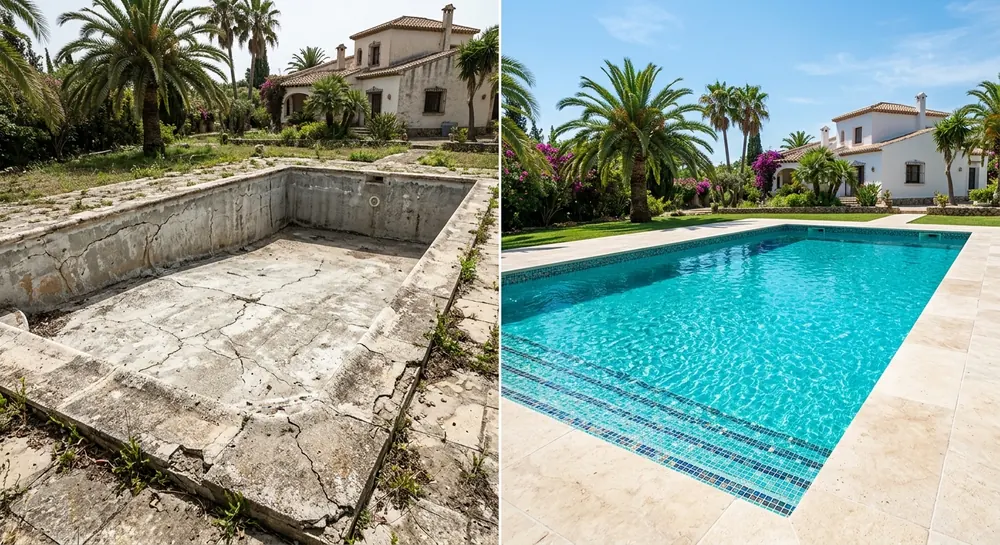
Every March, I get the same calls from villa owners in Mougins and Valbonne: 'the pool looked fine in October, what happened?' The answer is almost always water table movement combined with six months of an empty or half-empty basin. On older gunite shells, hairline cracks that run in a spiderweb pattern around the steps or the deep-end slope usually mean surface shrinkage in the render, not structural failure — annoying but not dangerous. Cracks that run in a straight line across the floor, especially if you can slide a fingernail into them, are a different story: that is often the shell itself moving, frequently linked to the clay-heavy soils you find in the hills above Nice and Villefranche-sur-Mer, where poorly compacted backfill shifts after a wet winter.
Fading tells its own story too. A plaster finish that has gone from deep blue to a chalky, almost grey-white surface has lost its binder to UV and pool chemistry — rub your hand along the wall and if a fine white powder comes off, that is calcium hydroxide leaching out, a classic sign the render is at the end of its 10 to 15-year life. Liners are more binary: either they are holding or they are not. Look for the telltale wrinkles at the waterline, a slightly spongy feel when you press the vinyl near the skimmer, or visible seam separation at the corners. In my experience inspecting pools from Cap d'Antibes down to Théoule-sur-Mer, a liner past its twelfth season rarely survives a full summer of chlorine, sun and pool parties without a tear showing up by August.
PVC Liner Resurfacing: Fast, Affordable, and Honestly Underrated
Liner replacement remains the quickest route back to a swimmable pool, and on the Riviera that matters because the window between 'villa reopens' and 'first guests arrive' is often just three or four weeks. A reinforced armé liner (1.5mm, the standard for anything exposed to this much sun) runs roughly 70 to 120 euros per square metre installed, depending on pattern complexity and whether you want a plain azur blue or a more textured stone-effect finish. For a typical 32m² Riviera pool — say an 8x4 metre rectangle common in Antibes residential developments — budget between 3,500 and 6,500 euros all in, including draining, substrate check and disposal of the old liner.
The trade-off is longevity: a good liner installed by a serious local team will give you 12 to 15 years, sometimes less if your pool sits in a particularly sun-exposed, unshaded garden like many properties on the Cap Ferrat side. Where liners genuinely shine is on pools with irregular shapes or existing minor structural movement, because the material flexes rather than cracks. I would steer clients away from liner only when the underlying gunite shows active structural cracking — putting a liner over a moving shell just delays a more expensive fix by two or three years, and you will see the crack telegraph through the vinyl eventually, usually right where you do not want it, under the pool light niche.
Tile and Mosaic: The Monaco-Cannes Finish for Owners Who Want It to Last 25 Years
If you have ever swum in a pool at a Cap d'Antibes estate or one of the newer builds above Beaulieu-sur-Mer, you have probably touched glass mosaic (pâte de verre) without realising how much it costs — and why owners keep choosing it anyway. Small-format mosaic, whether classic blue, a graduated dégradé effect, or the iridescent gold-flecked tiles popular in higher-end Monaco properties, runs from 150 to 400 euros per square metre installed, with the gap depending almost entirely on tile size and the complexity of pattern work around steps and waterline bands. For a 40m² pool that puts total resurfacing cost somewhere between 9,000 and 20,000 euros, sometimes more if the existing substrate needs significant repair before tiling can begin.
What you are paying for is durability and a finish that genuinely does not fade — pâte de verre is fired glass, and 20 to 25 years of service life without colour loss is realistic if the grout joints are properly maintained. The real cost driver is labour, not material: a skilled tiler lays mosaic by hand, sheet by sheet, and a 40m² pool can take three to four weeks of on-site work, which matters if you are trying to hit a May reopening. My practical advice for Riviera owners considering tile: get the substrate inspection done in January, not April, because any structural repair needed underneath will push your mosaic installation into June, right when you wanted to be swimming.
Plaster and Pebble Finishes: The Middle Ground Most Villa Owners Actually Choose
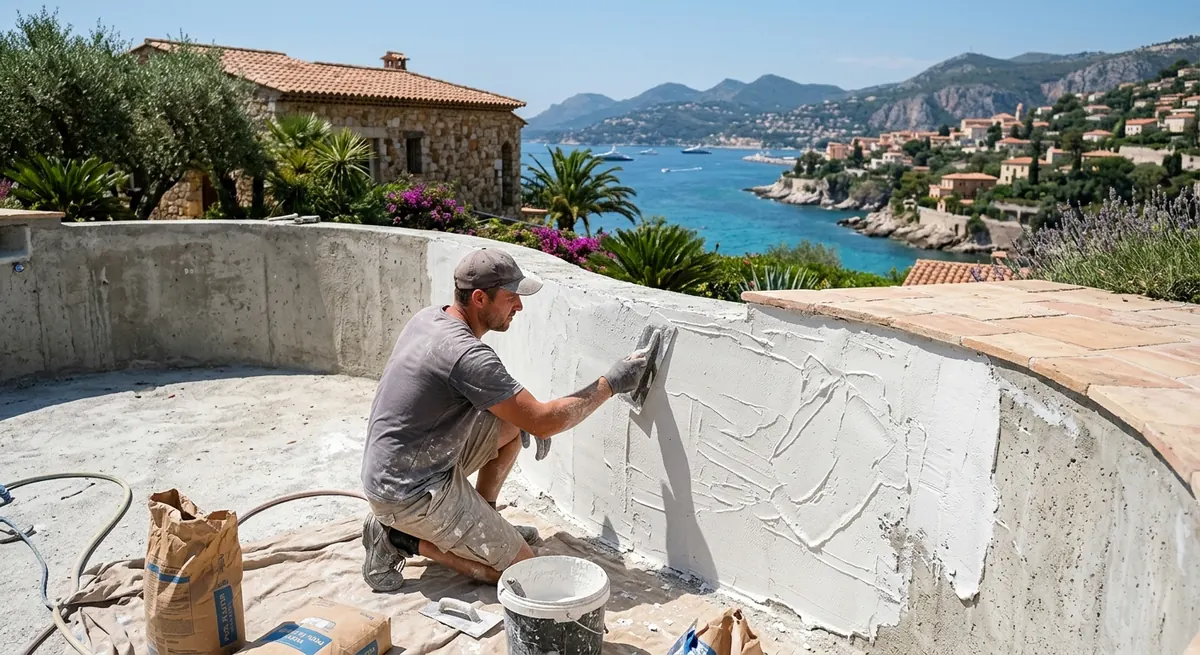
Between the budget liner and the prestige mosaic sits render-based resurfacing — marbrite, quartz aggregate, or pebble finishes — and honestly this is what I recommend for most of my clients between Nice and Grasse. Pricing sits around 60 to 100 euros per square metre for standard marbrite, climbing to 90 to 140 euros per square metre for a textured pebble finish like the ones now common in newer Valbonne builds, which give a more natural, almost lagoon-like look and also happen to be less slippery underfoot around the steps. For a mid-size 35m² pool, that puts plaster resurfacing in the 2,500 to 4,500 euros range for marbrite, or 3,500 to 6,500 euros for pebble, including the mandatory sandblasting or acid-etching of the old surface beforehand.
The catch with any render finish is curing time and water chemistry discipline in the first month. You cannot fill a freshly plastered pool with hose water straight from the Antibes municipal supply and expect it to stay looking good — the calcium content in local tap water combined with an improperly balanced start-up fill is the single biggest cause of blotchy, patchy plaster I see on service calls in June. A good installer will insist on a controlled fill using treated water, continuous circulation from hour one, and a strict no-vacuum, no-brush rule for the first 72 hours. Skip that step to save a few hundred euros on water delivery and you risk a finish that looks mottled within its first season, which is a frustrating way to start a brand-new pool surface.
Timing It Right Before the Riviera Season Starts
Every resurfacing job on the coast runs on the same brutal calendar: everyone wants their pool finished by the last week of April, and every pool company from Cannes to Menton knows it. Booking a serious contractor in January or February, rather than waiting until March, typically saves 10 to 15 percent versus the premium rates that kick in once the rush starts — and more importantly, it means you actually get a slot before the installer's calendar fills with Monaco Grand Prix season villa prep. If your pool needs structural assessment first — and anything with cracks wider than 2mm genuinely should get one — build in an extra two to three weeks for an engineer's report before any resurfacing contract gets signed.
One detail that catches out even experienced owners: hydrostatic pressure. Draining a pool completely in a property with a high water table, which describes a fair number of villas in the valleys behind Nice and around the Var river plain, can cause the empty shell to lift or crack from groundwater pushing up underneath it. Any competent Riviera pool company will install or check a pressure relief valve before full drainage, and if yours does not mention this step unprompted, that is worth asking about directly. Plan the full sequence — drain, repair, resurface, cure, refill — with a realistic six-week buffer before your first planned swim, and you will avoid the scramble I see every single May when a job booked too late runs straight into the first heatwave.
Frequently asked questions
For a standard 50m² pool, expect roughly 4,500 to 7,500 euros for a quality PVC liner, 5,000 to 9,000 euros for marbrite or pebble render, and 12,000 to 20,000 euros or more for glass mosaic, depending on substrate condition and pattern complexity.
No, all three methods — liner, tile and plaster — require a fully drained, dry shell so the surface can be properly inspected, repaired and bonded. Partial drainage or rushing this step is the main cause of premature finish failure within the first year.
Book your contractor by January or February and plan for a six-week window covering drainage, substrate repair, resurfacing and curing, so the pool is genuinely ready — not just filled — before the first heatwave typically arrives in late May.