
Why Riviera Villas Built Before 1970 Are a Perfect Target
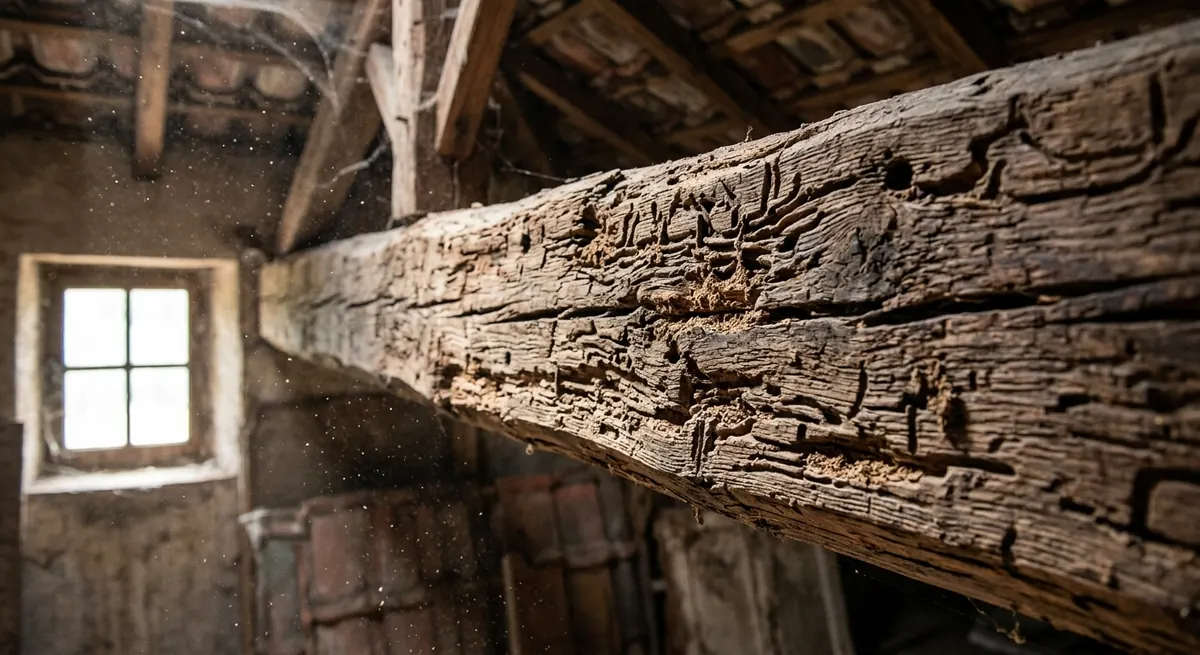
I have opened up more roof spaces in Cimiez, Le Cannet and Cap d'Antibes than I can count, and the pattern repeats itself with depressing regularity. Villas built between roughly 1900 and 1965 were framed almost exclusively in chestnut or maritime pine, both of which termites and the house longhorn beetle (capricorne) find delicious, and both of which were installed with zero chemical protection because nobody worried about that back then. Add in the Mediterranean climate — hot dry summers followed by damp winters, plus gardens irrigated right up against the foundation walls — and you get exactly the humidity swings that let subterranean termite colonies thrive underground and travel up through masonry cracks into your joists.
The whole department of the Alpes-Maritimes has been classified as a termite risk zone for a long time now, which is not bureaucratic overcaution. I have personally found active Reticulitermes colonies in villas from Saint-Jean-Cap-Ferrat down to Menton, almost always starting in a damp cellar, an old bread oven recess, or a garden retaining wall built directly against a wooden sill plate. Add to that the capricorne beetle, which prefers dry attic roof timbers and does not need soil contact at all, and you understand why any serious renovation project on a pre-1970 villa here has to start with a pest inspection, not with a demolition permit.
Reading the Warning Signs Before You Call a Professional
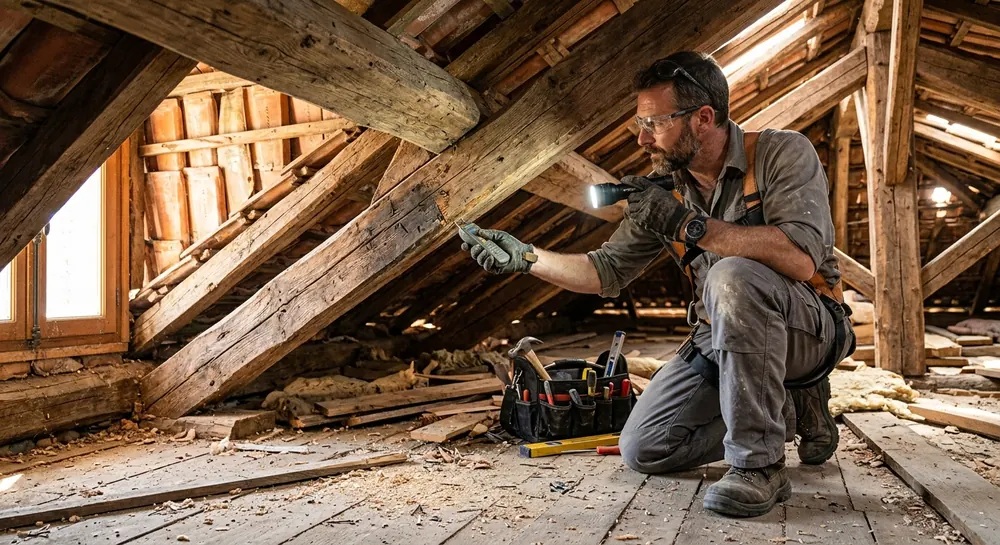
A trained eye catches most of this without instruments. Termite galleries look like thin mud tubes, roughly pencil-width, running up foundation walls, behind skirting boards, or along the underside of a staircase — they build these tunnels to stay moist while traveling between soil and timber. Tap a suspect beam with the back of a hammer: healthy chestnut gives a solid, almost musical thud, while termite-hollowed wood sounds dull and papery, sometimes crumbling at the surface into what looks like sawdust mixed with soil. Capricorne damage shows differently — small oval exit holes about 6 to 10mm across, with fine wood-colored powder (frass) accumulating below, usually discovered when someone finally cleans out an attic that has not been touched in thirty years.
For anything beyond a visual check, hire a certified diagnostician for a proper termite and wood pest survey; expect to pay somewhere between 120€ and 280€ for a villa of average size, more if outbuildings and a garden shed are included. This report is legally mandatory before selling a property in a termite-risk zone, but I push every renovation client to commission one regardless of sale plans, because it gives you a documented baseline and a moisture map of the structure. Combine that with a resistograph test on a handful of suspicious beams — a small drill that measures wood density and pinpoints hidden voids — and you will know exactly which sections need replacement versus which just need curative treatment, which changes your renovation budget considerably.
Curative Treatment: What Actually Works and What It Costs
Once an infestation is confirmed, the treatment strategy depends entirely on which pest you are dealing with and how far the damage has spread. For active subterranean termites, the standard approach on the Riviera combines a chemical soil barrier injected around the foundation perimeter — typically priced between 45€ and 90€ per linear meter depending on wall thickness and access — with localized injection of insecticide directly into infested timber through small drilled holes plugged afterward with wax. On a mid-sized villa of 150 to 180m2, a full curative termite treatment package usually lands somewhere between 3,500€ and 7,000€, and any serious applicator should offer a CTB-A+ certified product along with a written ten-year guarantee, renewable through periodic inspection visits.
Capricorne and other wood-boring beetles get a different protocol since they attack dry timber above ground rather than through soil contact. Here the classic method is surface treatment with a fungicide-insecticide product brushed or sprayed onto exposed roof framing, costing roughly 25€ to 45€ per m2 of treated surface, sometimes combined with deep injection for heavily tunneled beams. When infestation is too advanced — I have seen chestnut tie-beams reduced to a shell you could push a screwdriver through — replacement is the only honest answer, and swapping a structural beam of similar section runs from about 180€ to 320€ per linear meter installed, climbing further if the roof structure needs temporary shoring while the old piece comes out. Never let anyone talk you into simply painting over rotten wood; it buys a season, not a decade.
Prevention Steps Worth Building Into Your Renovation
The best moment to prevent future infestations is precisely during a renovation, while walls are open and beams are exposed, because retrofitting protection later means tearing everything apart again. If you are replacing floor joists or roof timbers, insist on wood pre-treated with an autoclave insecticide process (Classe 4 treatment for anything near ground contact), which adds maybe 8% to 12% to timber cost but removes the soft-wood vulnerability that started the problem in the first place. Around the foundation, a physical termite barrier — either a sand-and-diatomite layer or a mesh system installed at the base of exterior walls — costs around 15€ to 25€ per linear meter and is far cheaper to install now than to inject chemicals later through finished flooring.
Moisture control matters just as much as chemistry. On several jobs near Antibes and Villeneuve-Loubet I have traced repeat infestations directly back to garden sprinklers spraying water against the base of a wall, or a downpipe discharging straight into the foundation soil instead of away from it. Fix the drainage, keep a 20cm gravel strip clear of vegetation around the perimeter, and ventilate any crawl space or cellar with permanent low vents rather than sealing it airtight, which traps humidity and practically invites termites back in. None of this is expensive compared to a full curative treatment, but it only works if it gets planned into the renovation drawings rather than tacked on as an afterthought once the tiler has already left.
Sequencing Pest Treatment Correctly Within the Renovation Timeline
Timing trips up more renovation projects than the treatment itself. Curative injection and soil barriers need to happen before carpentry repairs, insulation, and finishing work begin, not alongside them, because drilling and injecting insecticide into beams that are already boxed in with drywall or insulation is either impossible or requires costly rework. I always schedule the pest company's intervention right after demolition and structural diagnosis, give the products their recommended curing period — often a week or two depending on the formulation — then bring the carpenter back in to replace or reinforce whatever needs it, followed by the rest of the build.
Keep every certificate and guarantee document from the treatment company in your project file, because they matter for two separate reasons. First, decennale insurance carriers and future buyers will ask for them, and a villa without documented termite treatment history is genuinely harder to sell around Nice and Cannes given how aware local buyers have become of the risk. Second, most ten-year guarantees require a follow-up inspection roughly every one to two years to stay valid, so build that appointment into your post-renovation maintenance calendar the same way you would a boiler service — it is a small recurring cost against a potentially five-figure structural repair bill if the colony ever comes back.
Frequently asked questions
Commission a certified termite diagnostic (diagnostic termites), mandatory in the Alpes-Maritimes for any sale since the whole department is classified as a risk zone. It costs roughly 120€ to 280€, examines accessible timber and foundations, and gives you a report valid for six months that you can use to negotiate price or require treatment before completing the purchase.
For a very minor, clearly localized issue you can slow things down with over-the-counter borax or permethrin products, but subterranean termite colonies extend well beyond visible damage through soil and masonry, so DIY treatment almost never reaches the queen or the full network. Professional treatment with a CTB-A+ certified product and a written guarantee is the only approach that reliably stops recurrence.
For a typical 150 to 180m2 villa on the Riviera, budget 3,500€ to 7,000€ for a comprehensive curative termite treatment including soil barrier and injection, plus 25€ to 45€ per m2 for capricorne beetle treatment on roof timbers if needed, and add beam replacement costs of 180€ to 320€ per linear meter for any sections too damaged to save.