
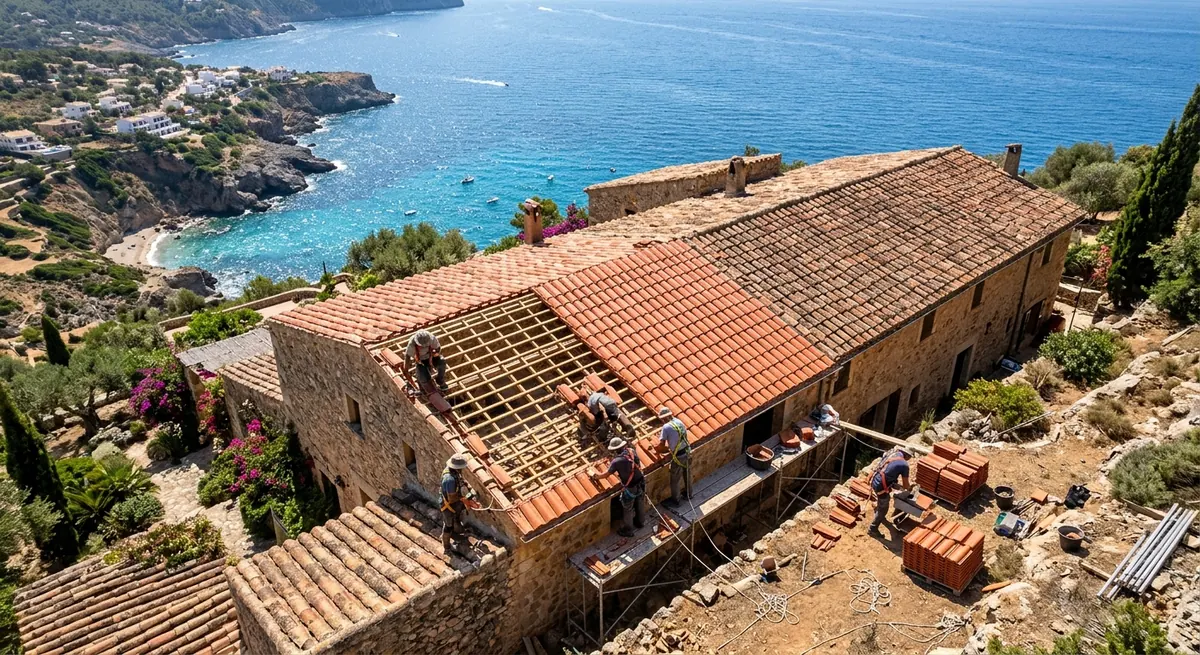
Why Canal-Tile Roofs Struggle on This Coast
I have climbed onto more tuile canal roofs in Nice, Antibes and the hills above Cannes than I can count, and the failure pattern is almost always the same: the tiles themselves outlast everything underneath them. A well-fired canal tile can survive eighty or ninety years of sun without cracking, but the lime mortar bedding (scellement) that holds the covering tiles in place dries out, loses adhesion, and lets wind get a grip. Once the mistral finds a weak point along a ridge or a hip, it doesn't just lift one tile, it peels a whole run like a zipper. I've seen forty tiles scattered across a garden in Saint-Jean-Cap-Ferrat after a single December night of 100 km/h gusts.
The second enemy is thermal cycling, not cold. Roof surfaces on south-facing slopes above Villefranche or in the Baou hills regularly hit 65-70°C in July and August, then drop sharply overnight. That daily expansion and contraction fatigues old mortar joints and the wooden purlins beneath them, especially on villas built before 1960 where the chevrons are undersized by modern standards. Add in salt-laden air within a few kilometres of the sea, which accelerates corrosion of any iron fixings, and you understand why a roof that looks fine from the street can have 15-20% of its tiles loose or cracked underneath.
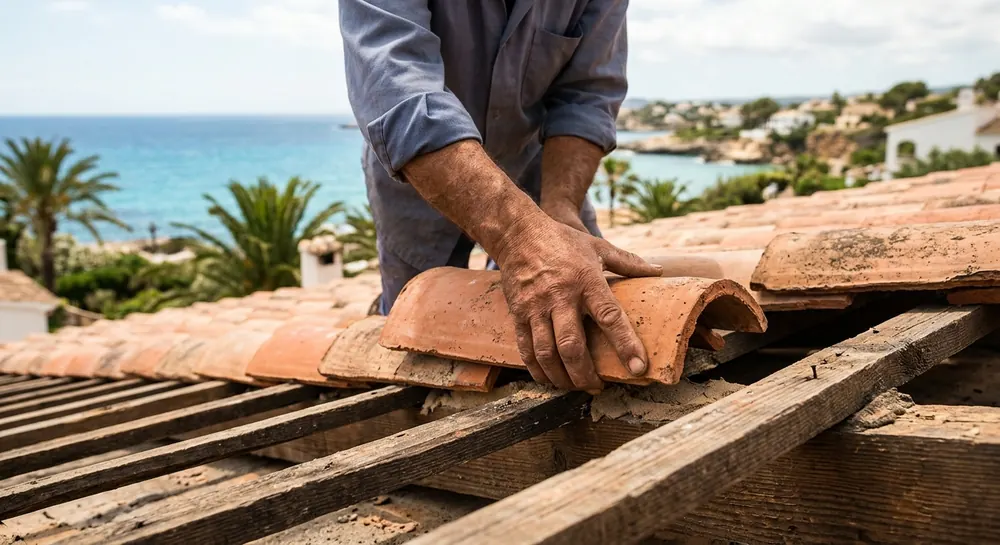
Working Within ABF Heritage Rules
Most of the traditional villas worth restoring in this style sit within a secteur sauvegardé or a périmètre de protection around a classified monument, which means the Architecte des Bâtiments de France has a say before you touch the roof. In Vieux Nice, parts of Antibes' old town, and the hillside villa districts of Cannes and Grasse, the ABF will typically require that you keep the exact tuile canal profile, the warm ochre-to-terracotta colour range, and the traditional double-lit laying pattern rather than switching to a mechanical interlocking tile. Expect to submit a déclaration préalable de travaux with photos, a technical note on materials, and sometimes a sample tile left on site for approval before the architect signs off.
The practical consequence is cost and sourcing time, not impossibility. ABF-compliant reclaimed tuiles canal run €1.20 to €2.20 per piece depending on patina and supplier, versus €0.70-€0.90 for new machine-made equivalents that often get rejected for colour uniformity. I generally budget an extra three to five weeks into any Riviera roof project purely for ABF review and for sourcing matching old tiles from regional dépôts in the Var or Vaucluse. One tip that saves real money: if you're only replacing 20-30% of a roof, negotiate with your roofer to recover and reuse your own best tiles on the visible street-facing slope, and put new or less-matched tiles on the rear slope the ABF never sees from public space — this is accepted in most communes if disclosed honestly in the dossier.
Diagnosis: Restore, Partially Redo, or Full Replacement
Before anyone touches a tile, I walk the attic with a torch and a moisture meter, because what's happening above the tiles usually gets decided below them. If chevrons and voliges show less than 10% rot and the mortar bedding is merely dried and cracked rather than crumbling to dust, a restoration (dépose-repose) is the right call: tiles come off, are sorted and cleaned, the bedding is redone in hydraulic lime mortar, and 80-90% of the original tiles go back on. On a typical 150 m² villa roof near Cagnes-sur-Mer, that runs €160 to €230 per m², scaffolding included, which usually lands between €24,000 and €35,000 for the full project with ridge tiles and valley flashing redone.
Full replacement becomes unavoidable when more than 30-35% of tiles are cracked, when purlins sag visibly, or when a previous owner laid tiles directly on a membrane without proper mortar fixation — common on 1970s-80s additions bolted onto older Belle Époque structures around Menton and Beaulieu-sur-Mer. Full replacement with new breathable underlayment, reinforced timber where needed, and ABF-matched tiles typically costs €260 to €380 per m², so the same 150 m² roof lands between €39,000 and €57,000. Scaffolding alone on a steep Niçois villa roof with limited street access can add €4,000-€7,000, and I always tell clients to get that priced separately because access is often the real cost driver, not the tiles.
Mistral-Proofing and Summer Heat: The Technical Details That Matter
The single biggest upgrade I push for on every coastal reroof is mechanical fixation at vulnerable zones: ridge lines, hips, verges, and the first two rows along any eave facing the dominant northwest wind. Traditional lime mortar alone is no longer enough once you're above 400m elevation or directly exposed to the Var valley wind corridor. Stainless steel storm clips (crochets tempête) at roughly one clip per two tiles along exposed edges cost very little, maybe €1,500-€2,500 extra on a mid-sized roof, but they're the difference between losing three tiles and losing thirty in the next big mistral event. I also now spec a breathable, UV-stable sous-toiture screen under every canal tile roof I touch, even where ABF rules don't require it, because it stops wind-driven rain intrusion during the gusty equinox storms that hit Antibes and Cannes every autumn.
For heat, the fix isn't insulation under the tiles — that traps moisture and the ABF rarely allows visible changes anyway — it's ventilation. A continuous ridge vent or periodic tuile de ventilation inserted every 3-4 m² lets hot air escape from the attic void, dropping peak attic temperatures by 8-12°C in my experience on villas above Grasse and in the Esterel hills. Combined with a reflective, vapour-permeable membrane under the tiles, this keeps upper-floor rooms noticeably more livable through August without touching the exterior appearance the ABF is protecting. It's a modest line item, typically €800-€1,500 on a standard roof, but it's the upgrade owners thank me for two summers later, long after they've forgotten the invoice.
Choosing a Roofer and Planning the Work Around the Seasons
Not every couvreur who works in the region has genuine tuile canal experience; plenty of general roofers will happily quote the job and then struggle with lime mortar ratios or ABF paperwork. Ask to see photos of at least two completed projects within a classified or protected zone, and ask directly how many years they've worked with chaux hydraulique NHL 3.5, the standard lime binder for this region's bedding mortar. A fair, experienced quote should break out tile sourcing, scaffolding, mortar work, storm clips, and underlayment as separate line items — vague all-in quotes under €150/m² on a heritage property are a red flag, because someone is cutting corners on either materials or ABF compliance.
Timing matters more here than most owners expect. The ideal window is April through early June or September through October, avoiding both peak mistral months (December to February) and the risk of afternoon thunderstorms that roll in fast over the Alpes-Maritimes foothills in July and August and can flood an open roof in twenty minutes. I never schedule a tear-off exceeding what can be covered with tarpaulin by end of day, and on any job near Nice or Cannes I build in a 10-15% schedule contingency purely for wind delays on scaffolding work, since safety rules suspend high work above roughly 50 km/h gusts. Plan for six to ten weeks total from signed devis to final ABF sign-off on a mid-sized villa, longer if your commune has a backlog at the Architecte des Bâtiments de France office, which happens routinely in high season around Cannes during festival months.
Frequently asked questions
Often yes, if your villa sits inside a secteur sauvegardé, a site patrimonial remarquable, or within 500m of a classified monument, which covers large parts of Vieux Nice, Antibes, Cannes and Menton. Check with your mairie's urbanisme office before signing any devis, since working without the required déclaration préalable can force you to redo the roof at your own expense.
For a 150 m² roof, a restoration keeping most original tiles typically costs €24,000 to €35,000, while full replacement with new ABF-matched tiles and reinforced timber runs €39,000 to €57,000, scaffolding included. Access difficulty and the extent of rotten purlins are the main variables that push costs toward the higher end.
Traditional lime-mortar bedding alone often fails along ridges, hips and eaves once gusts exceed roughly 90-100 km/h, which happens most winters along this coast. Adding stainless steel storm clips at exposed edges, for an extra €1,500-€2,500 on a mid-sized roof, dramatically reduces tile loss during these events.