
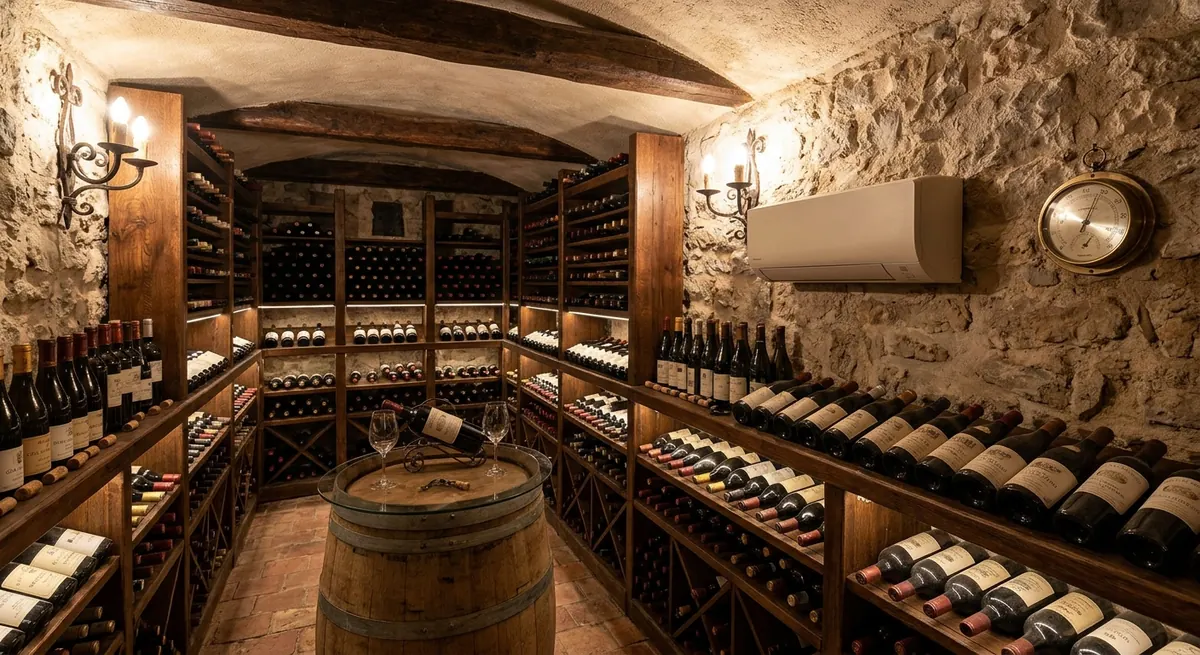
Why the Riviera Climate Is Harder on Wine Than Most Owners Realise
I have walked into more than a dozen villa cellars between Cap Ferrat and Mougins where the owner proudly shows off a 400-bottle collection sitting at 19°C in January and, unbeknownst to them, 27°C by late July. The Mediterranean climate looks mild on paper, but coastal villas see brutal daily swings: a stone cellar dug into a Antibes hillside might hold steady at 14°C through most of the year, then spike 6 to 8 degrees during a mistral-free August heatwave when ambient air hits 34°C and the ground around the foundation simply cannot shed heat fast enough. Add the sea-driven humidity that oscillates between 40% in a dry Tramontane spell and 85% during a humid easterly, and you have the two enemies of fine wine, heat stress and hygrometric shock, working against each other in the same room.
What makes this worse than inland storage is salt air intrusion. Properties within two or three kilometres of the coast, think Villefranche-sur-Mer, Cannes La Croisette, or the Monaco border at Cap d'Ail, develop a fine salt film on any ventilation grille or condensing unit within eighteen months. That salt accelerates corrosion on cheap cellar conditioners and clogs the very humidity exchangers meant to protect the wine. I have replaced evaporator coils on units barely three years old simply because nobody specified a marine-grade treatment at installation. Any climate project on this coast has to budget for that corrosion resistance from day one, not as an afterthought once the first compressor fails.
Designing the System: What Actually Works in a Stone Cellar
The classic domestic air conditioning split system is the wrong tool here, full stop. Standard AC units are built to cool air and dump humidity, which is exactly backwards for a cellar that needs 70-75% relative humidity to keep corks from drying out. What you want is a dedicated cellar conditioner, often called a cave de vieillissement unit, from manufacturers like EuroCave, Climadiff, or CellarPro, sized correctly for the room volume rather than oversized out of caution. A well-insulated 15m² stone cellar in a Valbonne mas typically needs a unit in the 2,000 to 2,800 kcal/h range, costing between €2,800 and €5,500 installed, versus the €1,200 impulse-buy units sold online that simply cannot cope with a Riviera summer load and will short-cycle themselves to an early death.
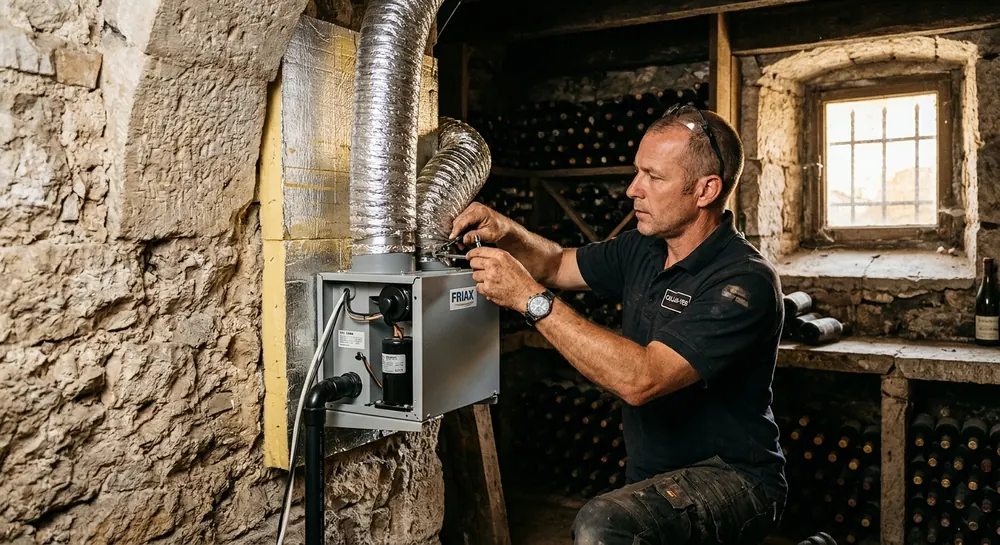
For larger collections, say a 3,000-bottle cellar under a Cap Ferrat villa, ducted systems with remote condensers make far more sense, letting you place the noisy, heat-rejecting part of the unit outside the thermal envelope entirely, often tucked into a technical room or garden wall recess. These setups run €9,000 to €18,000 depending on duct length and condenser placement, but they solve the single biggest complaint I hear from Riviera owners: compressor noise bouncing off stone walls at 45 decibels in what is supposed to be a quiet tasting space. I always spec a secondary humidification line, usually an ultrasonic humidifier tied into the same control panel, because pure refrigeration-based cooling will pull the room below 60% RH during the driest mistral weeks of the year, which is just as damaging to labels and corks as the summer humidity spike.
Protecting Historic Stone Walls From the Equipment You Install
This is where I see the most expensive mistakes. Old Riviera cellars, particularly the 17th and 18th century vaulted rooms you find in Vieux Nice townhouses or Antibes ramparts properties, were built with lime mortar and local limestone that breathe. They manage moisture by letting it migrate slowly through the wall and evaporate, a system that has worked for three hundred years. The instinct to seal everything with a vapour barrier and spray foam insulation, the way you would in a modern build, traps moisture inside the wall structure instead. I have seen lime mortar joints crumble within four years and salt efflorescence bloom across a vaulted ceiling because someone installed rigid polyurethane panels directly against original stone to chase an energy efficiency target that simply does not apply to a 1780s cellar.
The correct approach is to insulate on the inside with a breathable system, typically a lime-based insulating render like those from Diffutherm or similar cork-and-lime composites, applied at 60 to 100mm thickness, which runs €180 to €280 per square metre installed by a mason who understands traditional materials, and they are not easy to find outside the Nice and Grasse area where several heritage-focused artisans still work. Combine that with a floating floor insulation layer rather than sealing the slab, and you preserve the wall's ability to manage moisture naturally while still cutting the thermal load the mechanical system has to fight. Any contractor who proposes standard PIR boards or a continuous plastic vapour barrier against exposed rubble stone in a protected or pre-1900 building should be shown the door, because you will be paying for stone restoration within five years that costs far more than the insulation ever saved.
Installation Realities: Ducting, Condensate, Noise and Redundancy
Condensate management gets overlooked constantly on this coast because installers assume a gravity drain to the nearest sink, which rarely exists in a cellar dug below street level in Cannes or Beaulieu-sur-Mer. You need a condensate pump, roughly €150 to €400 for a reliable model, plumbed to a discharge point that will not back up during the autumn deluges that hit this region every October and November. I spec a float-switch cutoff on every system so that if the pump fails, the compressor shuts down rather than flooding a cellar full of six-figure bottles, a safeguard that costs under €100 in parts but has saved more than one collection I know of personally.
Redundancy matters more here than almost anywhere else in France because Riviera power cuts during summer storms, particularly around Mandelieu and the Var border where the grid gets stressed by peak air conditioning demand, can run four to six hours. A cellar holding steady at 14°C will drift slowly, but a compressor failure during an August heatwave compounds fast. For serious collections above €50,000 in value, I now routinely recommend a small UPS backup for the control electronics, around €600 to €1,200, plus a thermal mass buffer, essentially extra insulation and sometimes a passive cob or limestone thermal wall, that extends the safe drift window from two hours to upwards of twelve. Full projects combining a ducted conditioner, breathable insulation retrofit, humidification, and backup power on a 20m² vaulted cellar typically land between €22,000 and €48,000 depending on how much stone restoration the walls need before any mechanical work even starts.
Monitoring and Long-Term Maintenance on the Coast
A climate control system is only as good as the monitoring behind it, and salt air shortens service intervals compared to inland installations. I tell every Riviera client to budget for a maintenance contract, usually €280 to €450 per year, that includes a coil inspection and rinse every six months rather than the standard annual check, because salt deposits accelerate corrosion on condenser fins specifically in properties within sight of the water, from Golfe-Juan to the Monaco frontier. Skipping this is the single most common reason I get called out for emergency repairs on units that are barely four years old.
For day-to-day monitoring, a wireless hygrometer and temperature logger, something like a SensorPush or Govee unit paired with a smartphone app, costs under €100 and gives you remote alerts if the cellar drifts outside its 12-18°C and 65-75% RH band while you are away in Paris or London for the season, which many Riviera villa owners are for long stretches. I pair that with a quarterly visual check of the stone walls themselves, looking specifically for new efflorescence or hairline cracking near where ducting penetrates the original masonry, because catching a moisture imbalance in month two is a €200 fix and catching it in year three can mean re-pointing an entire vaulted ceiling.
Frequently asked questions
Aim for a stable 12-18°C with 65-75% relative humidity. Stability matters more than hitting an exact number, since repeated swings of more than 3-4 degrees per day stress corks and accelerate ageing far more than a constant 17°C ever would.
Yes, but only with breathable materials. Lime-and-cork insulating renders at 60-100mm thickness, applied by a mason familiar with traditional lime mortar, let the wall continue managing moisture naturally, unlike rigid foam boards or plastic vapour barriers which trap humidity and cause salt efflorescence and mortar decay within a few years.
For a 15-25m² stone cellar, expect €22,000 to €48,000 for a complete project including a ducted cellar conditioner, humidification, breathable insulation retrofit, and condensate management. Smaller single-unit installations in already-insulated spaces can run €3,000 to €6,000.