
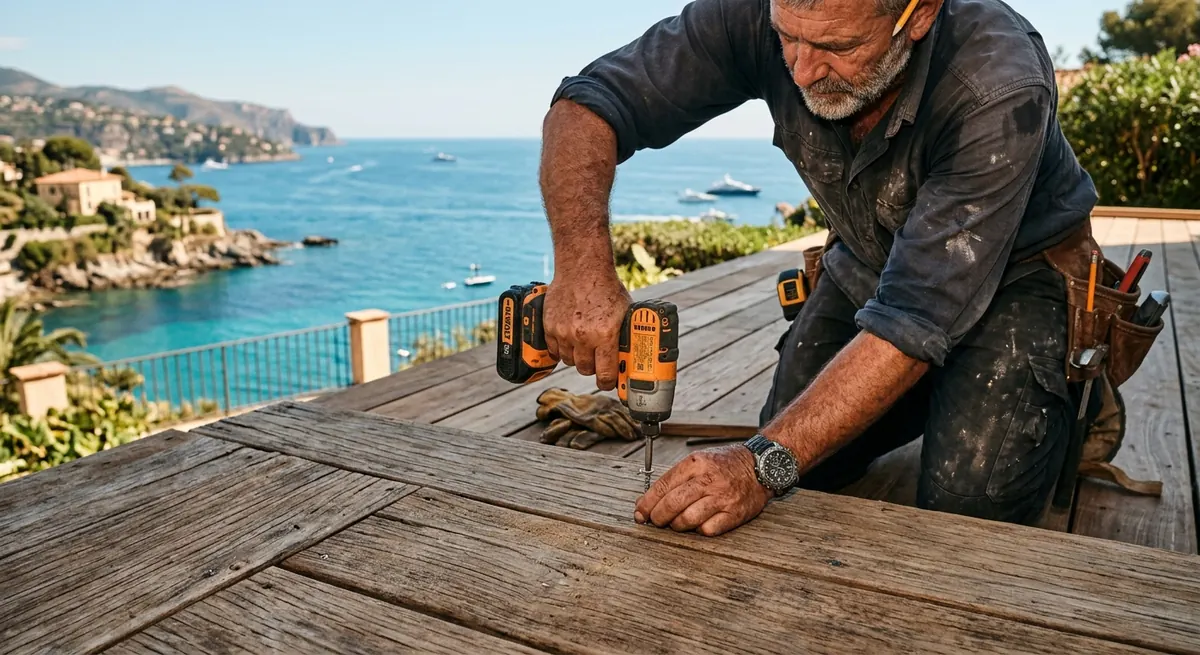
Why Riviera Salt Air Punishes Ordinary Decking
Anyone who has walked a terrace in Villefranche-sur-Mer or Cap d'Antibes after a mistral blowing off the Baie des Anges knows the fine white crust that settles on railings and stone. That same airborne salt works its way into wood fibres and metal fasteners on every south or east-facing deck within a few hundred metres of the water, and even properties set back in the hills around Grasse get a lighter dose carried on the wind. Add roughly 300 days of sunshine a year and UV intensity that is noticeably higher than northern France, and you have a combination that ages ordinary construction timber far faster than most owners expect when they compare it to a project they saw inland.
On several jobs I have inspected in Beaulieu-sur-Mer and along the Roquebrune coast, the failure point was never the decking boards themselves but the fixings: standard zinc-plated screws had rusted through within three winters, staining the wood and loosening entire sections underfoot. That is why any serious specification for a coastal terrace here starts with A4 (316L) stainless steel or coated structural screws, not the A2 grade sold in most generic hardware stores. It is a detail that adds perhaps 4-6€ per square metre to the fastener budget but can double the useful life of the whole structure, and it is the first thing I check when a client asks me to evaluate a quote.
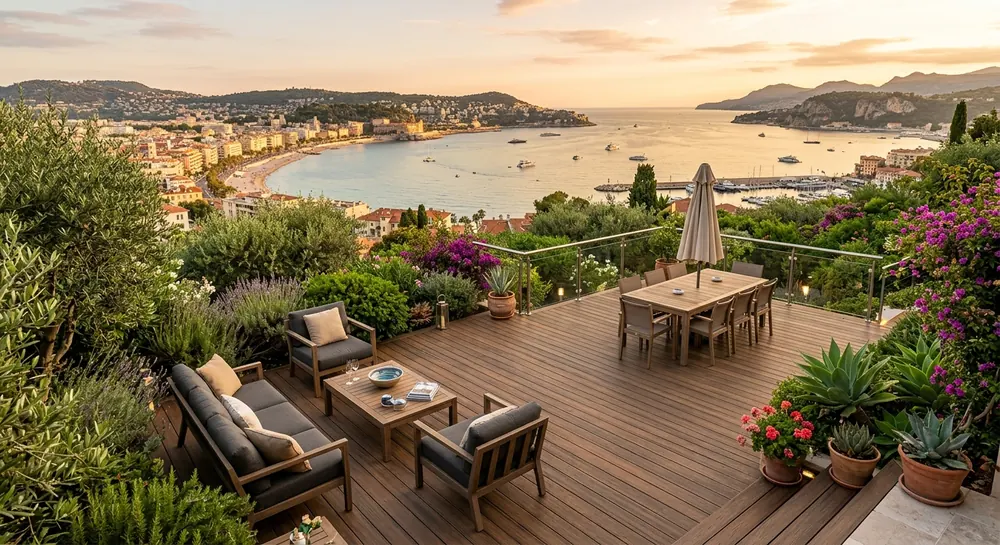
Exotic Hardwoods: Ipe, Cumaru and Teak up Close
Ipe and cumaru remain the benchmark for owners who want a deck that shrugs off salt spray for a generation. Their natural density (Class 4 durability, often above 1000 kg/m3) and high oil content give real resistance to rot and marine corrosion without any chemical treatment, which matters on exposed sites like a Cap Ferrat pool terrace facing open water. Expect to pay 95-150€/m2 for supply of quality FSC-certified boards, plus 45-65€/m2 for skilled installation, so a straightforward 25m2 terrace typically lands between 6500€ and 9000€ turnkey once substructure and fixings are included, more if the design involves complex angles or a curved pool edge.
The trade-off is discipline: left untreated, these woods weather to an attractive silver-grey patina that many Riviera clients actually prefer, but if you want to keep the honey-brown tone you will need to oil the surface twice in the first two summers and once a year afterwards, ideally in spring before the heavy tourist season starts. Weight is also worth flagging for anyone working on a Monaco balcony or upper-floor terrace, since dense tropical hardwood adds significantly more structural load than pine or composite, and I always ask a structural engineer to confirm the existing slab or steel frame before ordering the timber.
Thermo-Treated Pine: Budget-Friendly but Needs Discipline
Thermally modified pine has become popular for rental villas and guesthouses in the Mougins and Grasse hinterland, where salt exposure is lower than on the seafront but budgets still matter. The heat treatment process drives out sugars and much of the residual moisture, which improves dimensional stability and gives reasonable rot resistance at a fraction of the cost of tropical species: material runs 45-75€/m2, and a 25m2 installed terrace, joists included, generally comes in around 2800-4200€. For a second home used mainly in July and August, that price point makes a lot of sense, particularly on terraces sheltered by a building or hedge line.
The catch is that thermo-pine was never designed to fight direct, sustained salt spray the way ipe or teak can, and on an exposed seafront balcony in Nice or Cannes I have seen the surface fibres start to lift and grey unevenly after five or six seasons without diligent care. It needs a UV-stable oil application every year without exception, it dents more easily under heavy planters or dragged furniture, and realistically you are looking at a 12-15 year service life rather than the 25-plus years hardwood can deliver. It remains a smart choice inland or on covered terraces, less so for a villa taking the full brunt of a sea breeze.
Composite Decking: The Low-Maintenance Contender
Capped composite boards from brands like Silvadec, Trex or Fiberon have become the default recommendation I give clients who want to spend their weekends on the terrace rather than maintaining it. The polymer cap resists salt penetration and UV fading far better than any wood species, colours stay stable for a decade or more, and there is no oiling, sanding or sealing required at any point. Material costs sit between 60-130€/m2 depending on the range and colour, with installation adding another 45-60€/m2; a 40m2 composite terrace on a Cannes Californie villa I priced recently came to roughly 7500-10500€ complete, including an aluminium substructure.
Composite is not without compromises, though. On a south-facing terrace in Nice in August, dark-toned boards can reach surface temperatures above 60°C, uncomfortable enough that bare feet genuinely suffer, so lighter grey tones are worth considering even if the brown mimics wood more convincingly. Some budget composite ranges also use variable recycled content that affects long-term colour consistency, and hollow-core boards can sound slightly drummy underfoot compared to solid timber. Weighed against 20-30 years of performance with nothing more than an occasional soapy-water clean, most owners I work with on the coast now choose composite by default and reserve hardwood for areas where the natural material look is non-negotiable.
Substructure, Installation Cost Breakdown, and Choosing Your Artisan
Whatever decking material you choose, the substructure decides whether it survives a Riviera winter. Joists should be spaced 30-40cm apart depending on board thickness, set on a ventilated base with a vapour membrane and drainage gravel to stop standing moisture, and on coastal sites I now specify stainless steel or coated aluminium joists rather than treated pine, since the extra 15-20€/m2 buys real protection against the rot and corrosion that undermines even the best boards from below. Skipping this step to save money is the single most common mistake I see on renovation sites from Antibes to Menton, and it is almost always the reason a five-year-old terrace suddenly needs a full rebuild.
Pulling the numbers together, realistic all-in costs per square metre (material, labour and substructure) run roughly 90-140€ for thermo-treated pine, 140-190€ for composite, and 160-230€ for exotic hardwood, with coastal exposure and design complexity pushing toward the top of each range. When comparing quotes, insist on RGE or Qualibat certification for the artisan, ask specifically which fastener grade they use, and get the warranty terms in writing rather than verbally promised. Booking the work in October or November, once the summer rental rush has passed, generally gets you better availability and sometimes a small discount from installers who are otherwise fully booked from May through September.
Frequently asked questions
Well-maintained tropical hardwood like ipe typically lasts 25-30 years even in exposed coastal spots. Quality capped composite comes close at 20-25 years with virtually no maintenance, while thermo-treated pine generally needs replacement after 12-15 years on a seafront terrace.
Only if the existing substructure and joists are sound, level and properly ventilated underneath. In most coastal renovations we inspect the old frame first and usually end up replacing corroded joists before laying new composite boards on top.
Plan on two coats during each of the first two summers to seal the fresh wood, then one annual application afterwards, ideally applied in spring. South-facing terraces with direct salt spray from the sea often need slightly more frequent attention than sheltered inland decks.